Many renters wonder if they need a credit score of 670 or above to rent an apartment but the typical low approval range is 600–650. Requirements vary by landlord and location. The most common model used is FICO Score 8. We break it down below.
Renters often ask: Is 670 a good credit score to rent an apartment? You’ll typically need a credit score of at least 600 to 650 to rent an apartment, although the requirements vary by location, landlord, building type, and your complete financial picture. Many renters worry about being approved with a low score, but options vary depending on the market. Here's what you need to know about getting approved and how credit affects your rental application.
Guide to Credit Scores for Renters
What Credit Score Do You Need to Rent an Apartment?
The bottom line is that credit score requirements vary by location, but you're likely to get approved in most places if your score is at least 650. If you fall below that, however, that doesn't mean you won't be able to rent.
A 2021 report by The Zebra found that the average credit score for U.S. renters was 650, but it also found that 7.7% of respondents had a fair credit score (580–-669) . A 2026 analysis by Kikoff stated that renters in suburban areas with less renter competition needed a minimum credit score of 620, while renters in highly competitive urban areas (like San Francisco and New York) needed a credit score of 740, depending on the property.
In general, landlords are unlikely to approve someone with a poor credit history but might consider you if you can demonstrate current financial stability or if you have a job offer proving future income.
Credit Scores for Renters by the Numbers [Sources: Zebra and Kikoff]
National Average
Suburban Areas (Less Competitive)
Urban Areas (Competitive)
713
580–620
650–740
Average Credit Scores by City:
City
State
Avg. Credit Score
San Francisco
CA
686
Boston
MA
673
New York
NY
661
Seattle
WA
684
Oakland
CA
636
San Jose
CA
669
Washington
D.C.
659
Minneapolis
MN
638
Los Angeles
CA
663
San Diego
CA
631
1-10 of 20
What Do the Numbers in a Credit Score Mean?
A desirable credit score depends on many factors, including your income, job stability, rental market, and whether you're renting in an urban or suburban area. Here is a general range with approval likelihood:
Focus on renting in less competitive areas or improve your credit score
670–739
Good
High
High
740–799
Very Good
High
High
800-850
Excellent
High
High
Each of the three major credit reporting agencies (Experian, TransUnion, and Equifax) varies in how they determine credit scores. There could be some differences in the scores as a result, but these ranges give you an idea of what to expect.
How is Credit Score Determined?
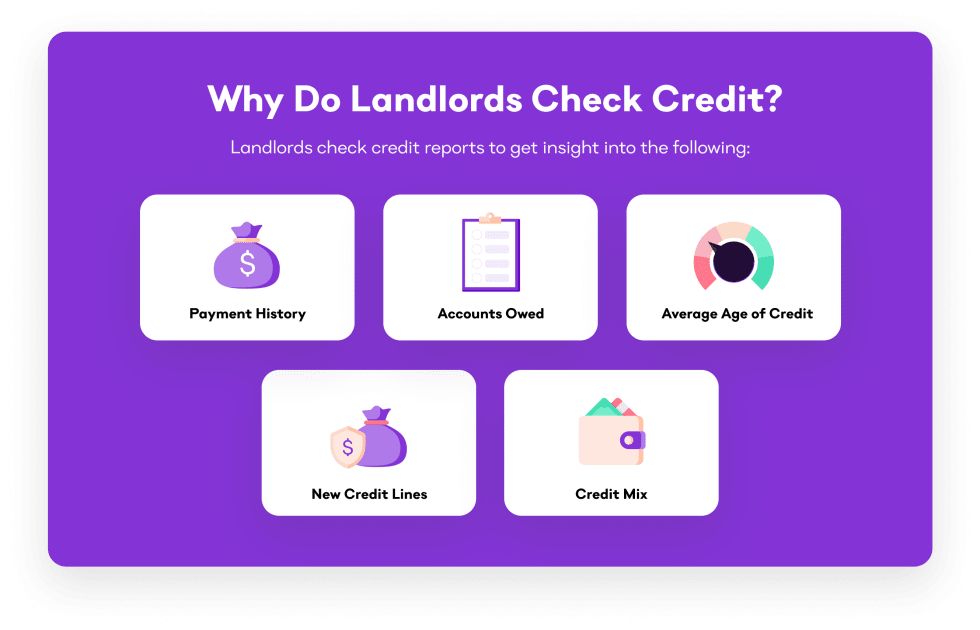
Payment history: This shows how often you've paid your credit cards and loans over the length of your credit history.
Accounts owed: The amount you owe, or outstanding debt, can determine 30% of your credit score and impact your credit profile.
Average age of credit: Credit score algorithms look at how long your accounts have been open and calculate your "credit age."
New credit lines: When you open a new credit card or take out a loan, it can lower the average of your total accounts.
Credit mix: Your credit mix includes mortgages, loans, credit cards, and other factors that impact your credit score.
Each credit reporting agency looks at the weight of these components differently. For instance, Experian uses FICO, which offers a slightly different distribution than the system used by TransUnion.
Why Do Landlords Look for Renters with Good Credit?
Credit scores give landlords a picture of financial history and stability and help landlords assess your ability to pay rent consistently over time. For example, a solid payment history shows that you are willing and ready to meet your financial obligations, as does a long credit history. The amount that you owe helps your landlord understand whether you'll be able to afford rent alongside your other bills.
How to Rent an Apartment with Bad Credit
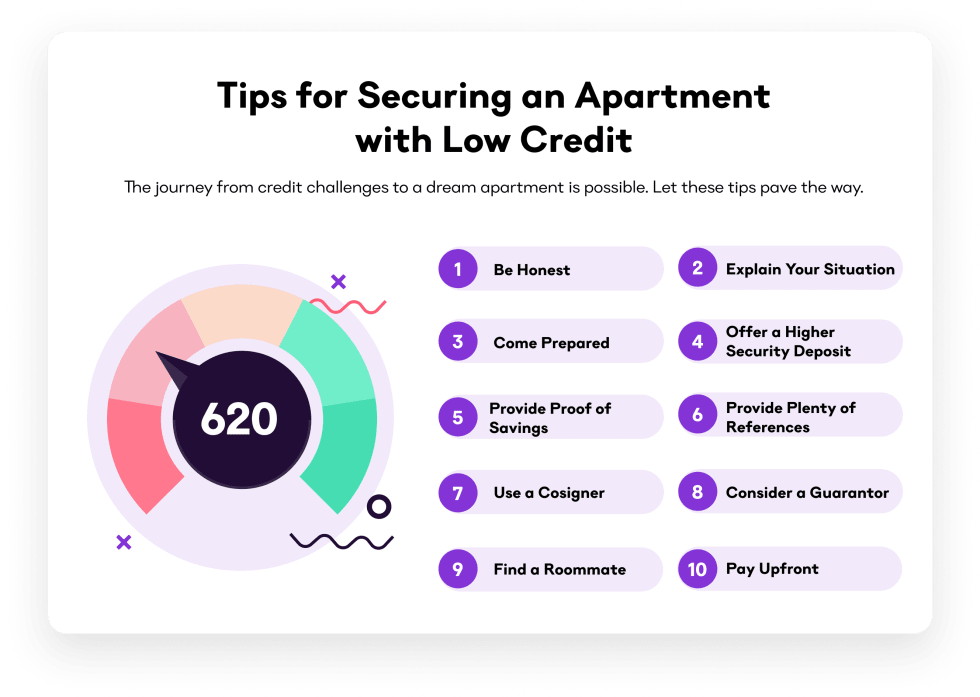
If you can’t meet the minimum credit score to rent an apartment, there are still ways to secure a lease. It takes a little extra effort and thought, but it’s possible. We wrote a guide on renting with no or bad credit, but here is the overview:
Step 1: Gather Supporting Financial Documents
Organize these documents and be prepared to submit them as part of your application:
Your prospective landlord will see your credit score, so prepare a statement that provides the full financial picture, and attach relevant documentation. Here is a sample email template to use as part of your application:
Dear [Prospective Landlord],
My credit score is (x). I would like to give you more financial background to support my rental application.
My score has been impacted by (life event / financial circumstance), but my guaranteed monthly income is (x).
Additionally, I have savings of (x), can pay (x) upfront, have a guarantor / co-signer / roommate, and [list any other supporting factors from the list in Step 2].
Don’t forget to include relevant documentation from Step 1 in your correspondence.
Simple Ways to Improve Your Credit Score
Bad credit isn’t the end of your rental journey. There are still ways you can improve and build your credit score and position yourself as a desirable tenant.
Report your payments: Use a rent reporting service to make sure your on-time payments are reported to the three major credit bureaus. This will ensure that your rent goes toward improving your credit.
Don’t close old credit cards: Closing a credit card could decrease your credit limit and increase your utilization rate, which could negatively impact your score. The ideal utilization rate is below 30% and 10% is considered excellent.
Pay what you can, as often as you can: Making regular payments on credit cards and loans improves your score.
Request a credit increase: Increasing a credit limit lowers your credit utilization ratio and can boost your credit score.
Use autopay: Autopay your credit cards so the money automatically comes out of your account and goes toward debt.
Limit hard inquiries: When a lender or company reviews your credit report during a loan application or credit card process, it's recorded as a hard inquiry. As a result, it can negatively impact your score over time.
Credit scores fluctuate and can rapidly climb with consistent effort. Keep trying to improve your score, even if you don’t feel like it’s making much difference in the near term. You’ll see positive changes as your efforts build over time.
Looking for a New Apartment?
The question isn't always, "What credit score do you need to rent an apartment?" but what can you do to improve your credit? Your credit fluctuates regularly and can improve with some simple actions, like paying down debt and increasing available credit.
Staying proactive and talking to prospective landlords about your situation can also help secure your next lease. They may also agree to a more expensive short-term lease that reduces their risk of renting to someone with bad credit.
Ready to find a new place? Use Apartment List's quiz to find a place matched with your ideal location, price point, and amenities.
FAQs About Credit Scores and Renting
What is the minimum credit score to rent an apartment?
There is no minimum, but 650 is the average credit score for the highest rate of success with a rental application. This varies depending on location and property type.
What can I do if I’m denied an apartment because of credit?
Ask for the reason, offer additional proof of stability, or try a different landlord or property with more flexible credit requirements for apartments.
Which credit score do apartments use?
Most landlords use your FICO Score, typically FICO Score 8, which ranges from 300 to 850. Some may rely on VantageScore, which often differs slightly. It’s best to ask which scoring model a landlord uses when applying.
Is 670 a good credit score to rent an apartment?
Yes. A 670 credit score is considered “good” and usually qualifies renters for most apartments. However, some luxury buildings or competitive markets may prefer scores of 700 or higher.
Can I rent an apartment with a 540 credit score?
Yes, but you’ll likely need additional support. A cosigner, a larger deposit, or strong income documentation can help. Look for landlords who consider alternative factors, such as rental history or savings.
How long does it take to get a 650 credit score?
It could take a few months to several years, depending on on your current credit score, your credit habits, and how much debt you are carrying Building or rebuilding credit requires consistent on-time payments, lowering debt, and avoiding new credit issues.
Is it hard to get approved for an apartment?
Getting approved for an apartment can be challenging if you have a low credit score, lowincome, or little to no rental history. Showing steady income, good references, and being honest with your landlord about your current situation can help renters get approved for an apartment.
How to get around 3x the rent?
To meet the 3x rule, which means that your monthly income must be 3x the monthly rent, try combining incomes with a roommate, using a guarantor or co-signer, or showing proof of substantial savings. Some renters also apply for apartments with more flexible income requirements, like through private landlords or a month-to-month agreement.
Dr. Katherine Blake is a content editor with Apartment List, where she helps ensure our renter and rental management content is fresh and informed by the latest data. Read More
Tristian Brown is a Senior Content Marketing Associate at Apartment List, where he manages high-quality content that helps modern renters find the perfect home. He brings an immense wealth of knowledge to the team, having earned a Bachelor of Arts in Marketing and European Management from the University of San Diego and EM Strasbourg Business School. Read More
Emily is a professionally trained writer who covers a wide range of topics associated with the rental market and real estate industry. With over a decade of professional writing experience, Emily comes from a strong background in the field backed with a Bachelor of Science from the world-renowned William F. Read More
Susan is an accomplished freelance writer whose passion for rental real estate, travel, and digital marketing has been the driving force behind her nearly 15-year career. Throughout her professional journey, Susan has become a seasoned veteran in creating compelling and informative content focused on the tenant/landlord relationship. Read More