As Nashville’s rental market rebounds, some neighborhoods are driving growth while others continue to struggle

The rental market in Nashville has been broadly favorable to renters for years, although trends vary sharply by neighborhood. The following report examines the latest housing and demographic data for 12 of Nashville’s most-popular neighborhoods.
Key Findings
- Rent growth remains negative in Nashville (-2.9% year-over-year as of August 2026), but the market has been improving for several months. Citywide data masks the fact that certain neighborhoods are rebounding quickly while others continue to struggle.
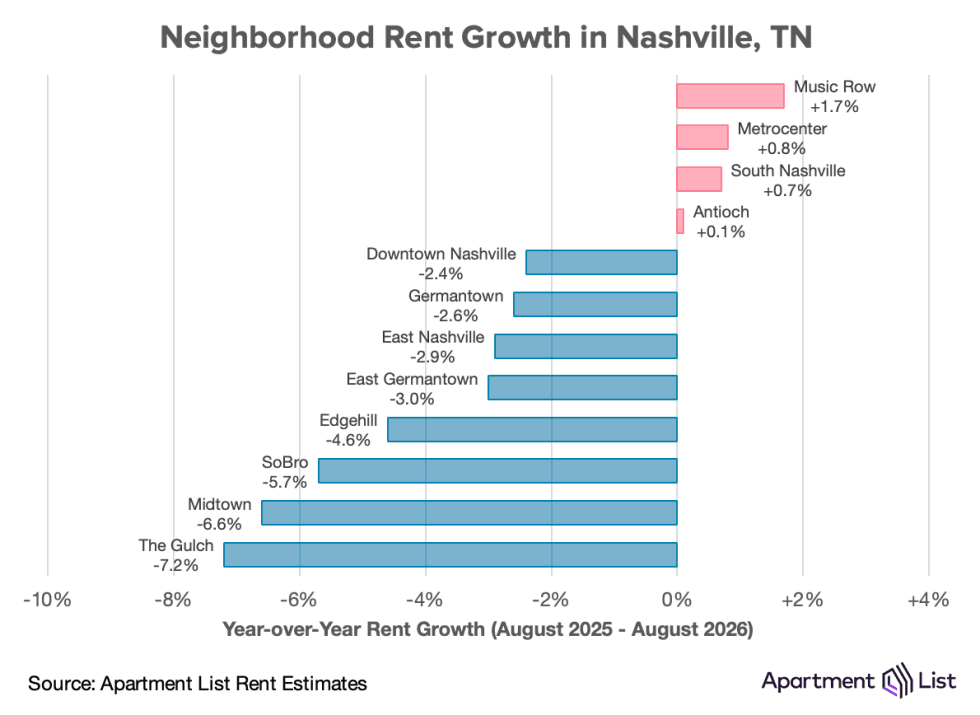
- As of August 2026, four Nashville neighborhoods – Antioch, South Nashville, Metrocenter, and Music Row – have seen rents return to positive year-over-year growth. These neighborhoods are experiencing higher demand because they have more affordable offerings and benefit from strong demographic shifts.
- Meanwhile, Nashville’s dense central neighborhoods continue to struggle. Rents in Midtown, The Gulch, and SoBro remain >5% lower than one year ago. These are neighborhoods where new developments at the upper-end of the price spectrum have struggled to fill vacancies.
Nashville’s rental market at a glance
Nashville has been largely a renter’s market for the last 4 years. Rents have steadily trended down since they peaked in the summer of 2022, as rapid housing construction and tepid demand has put downward pressure on housing costs. The city does appear to be turning a corner, but for now there are still good deals to be had. According to Apartment List data in August 2026:
- The median 1-bedroom apartment in Nashville rents for $1,230 (down 2.9% compared to one year ago).
- Nashville’s apartment vacancy rate is 8.3% (up from 8.0% one year ago).
- The typical Nashville apartment will be listed for 32 days before getting leased (up from 30 days one year ago).
- One or more months of free rent are being offered by 49% of Nashville apartments (up from 42% one year ago).
But anyone who is familiar with a local housing market will tell you that neighborhoods matter; certain neighborhoods might experience rapid demand and increasing rents while others see little activity. Here we zoom in on Nashville and take a closer look at neighborhood-level data to identify emerging hotspots and provide renters more-granular information to make informed decisions about their housing choices. We cover twelve popular neighborhoods core to the identity of Nashville: Downtown Nashville, Germantown, East Germantown, Metrocenter, East Nashville, Antioch, Music Row, SoBro (South of Broadway), The Gulch, Edgehill, Midtown, and South Nashville.
Downtown Nashville
Downtown is the best option for Nashville renters who want to ditch the car (or the commute altogether). Census data confirm that 15% of workers who live in Downtown Nashville get to work by biking, walking, or taking transit, and another 30% work from home. But this convenience comes at a premium, with the average price of a one-bedroom apartment running north of $2,000 per month. Fortunately, a large volume of nearby construction has created some opportunities for renters looking to move into Downtown Nashville. With a neighborhood vacancy rate of 10.7%, and the typical apartment taking 42 days to lease, rents are down 2.4% over the past 12 months and 64% of apartments are offering a rent discount on new leases. For renters who want to live in the middle of the action, now is a good time to be hunting for Downtown deals.
- Downtown Nashville 1-br median rent: $2,096/mo
- Downtown Nashville 2-br median rent: $2,869/mo
- Downtown Nashville year-over-year rent change: -2.4%
- Downtown Nashville apartment vacancy rate: 10.7%
- Downtown Nashville time on market: 42
- Downtown Nashville concession rate: 64%
Germantown
Germantown provides close proximity to the attractions of Downtown Nashville but with more of a historic feel. The neighborhood is known for its brick-lined streets and dense, walkable amenities. This shows up in the latest apartment data: rents in Germantown are comparable to Downtown Nashville, but with a lower vacancy rate, fewer communities are offering concessions suggesting that landlords have less need to sweeten the deal to attract renters. Over the years Germantown has become popular among successful, well-educated residents who value a denser neighborhood and aren’t as interested in owning a home. Census data tell us the median household income in Germantown exceeds $100,000 but 75% of households are renters.
- Germantown 1-br median rent: $2,029/mo
- Germantown 2-br median rent: $2,913/mo
- Germantown year-over-year rent change: -2.6%
- Germantown apartment vacancy rate: 8.0%
- Germantown time on market: 37
- Germantown concession rate: 36%
East Germantown
Tucked between historic Germantown and the Cumberland River is East Germantown, a rapidly-developing neighborhood that stands out as one of the most affluent in this report. According to census data, East Germantown has the highest personal income ($75,888), highest household income ($108,901), and highest share of residents with a college degree (85%) than any other area covered here. Rents are marginally higher here than in nearby Germantown, but have trended down 3.0% over the past year in response to high volumes of new construction. A quick turnaround time – 26 days between when apartments in East Germantown are listed and leased – suggests that there is healthy demand for new construction at this higher price point.
- East Germantown 1-br median rent: $2,160/mo
- East Germantown 2-br median rent: $3,000/mo
- East Germantown year-over-year rent change: -3.0%
- East Germantown apartment vacancy rate: 7.4%
- East Germantown time on market: 26
- East Germantown concession rate: 39%
Metrocenter-North Rhodes Park
From Germantown, if you travel north and cross I-65 you’ll find yourself in another one of Nashville’s newer neighborhoods: Metrocenter - North Rhodes Park. Less centrally-located, rents in Metrocenter tend to be lower than in the downtown neighborhoods, with the median one-bedroom apartment renting for $1,750. But census data show the neighborhood growing quickly and pulling in new residents; 29% of Metrocenter residents moved in the last two years, more than any other neighborhood in this report. It is also a family-friendly neighborhood, with 21% of households having a child under the age of 18. This is in stark contrast to other central neighborhoods where child-at-home rates are in the low-single digits. Accordingly, Metrocenter is one of few Nashville neighborhoods where rents have increased (albeit slightly) year-over-year. Rent growth here stands at +0.8%, in contrast to the citywide trend of -2.9%.
- Metrocenter 1-br median rent: $1750/mo
- Metrocenter 2-br median rent: $2,250/mo
- Metrocenter year-over-year rent change: +0.8%
- Metrocenter apartment vacancy rate: 8.5%
- Metrocenter time on market: 37
- Metrocenter concession rate: 62%
East Nashville
East Nashville has exploded in popularity in the past few decades. It is a much older, lower-density neighborhood compared to what lies on the western side of the Cumberland River, and has long attracted creatives, artists, and families looking for more-affordable living. East Nashville’s neighborhood character is reflected in the housing and demographic data: roughly half of its homes were built before 1970, single-family homes make up 68% of the housing mix compared to just 10% in large apartment complexes, and more than one-quarter of households have children. The renter rate is just 44%, so renters looking to move to East Nashville won’t find as many large, amenity-rich apartment complexes compared to more-central neighborhoods. But they will find cheaper options: East Nashville’s median 1-bedroom rent is $300 lower than Downtown Nashville’s.
- East Nashville 1-br median rent: $1,715/mo
- East Nashville 2-br median rent: $2,417/mo
- East Nashville year-over-year rent change: -2.9%
- East Nashville apartment vacancy rate: 8.1%
- East Nashville time on market: 30
- East Nashville concession rate: 42%
Antioch
Located in the southeast corner of Nashville, Antioch is one of the city’s most budget-friendly options, with rents averaging $1,177 for a one-bedroom apartment and $1,532 for a two-bedroom. Owing to the relatively low cost, rental options in Antioch are a bit tighter than other parts of the city. Only 40% of rentals are offering concessions (compared to 49% citywide) and rents have stayed relatively flat year-over-year (compared to -2.9% citywide). Antioch features a low-slung housing stock and a more-suburban, spread-out feel than Nashville’s denser core. 61% of the homes in the neighborhood are single-family residences, compared to just 11% of homes that belong to large apartment complexes. Being a bit further away from the action of Downtown, Antioch is naturally well-suited for families, with 36% of households including a child under the age of 18, and a relatively even mix of renters and homeowners.
- Antioch 1-br median rent: $1,177/mo
- Antioch 2-br median rent: $1,532/mo
- Antioch year-over-year rent change: +0.1%
- Antioch apartment vacancy rate: 7.4%
- Antioch time on market: 38
- Antioch concession rate: 40%
Music Row
Music Row lives up to its name as a hub for the city’s music industry, and sits close to Belmont and Vanderbilt universities. Its demographics therefore reflect a young, single crowd: the median age in Music Row is just 23, only 8% of adult residents are married, and a mere 1% of households have a child under the age of 18. This does not mean it’s a cheap place to live, however; it commands high rents similar to Downtown and Germantown and is one of just a few Nashville neighborhoods that have seen prices increase over the past year. But it is also a neighborhood where a savvy renter can offset these high costs by finding a good deal. Since vacancies are high (13%) and Music Row apartments spend an average 51 days on market, landlords are amenable to offering rent discounts for new tenants. Music Row is a great option for renters who are plugged into the music industry or are just looking for a central, youthful scene close to the action.
- Music Row 1-br median rent: $2,116/mo
- Music Row 2-br median rent: $3,056/mo
- Music Row year-over-year rent change: +1.7%
- Music Row apartment vacancy rate: 13.0%
- Music Row time on market: 51
- Music Row concession rate: 69%
SoBro
SoBro – short for South of Broadway – puts renters in the heart of Downtown’s entertainment district and its household makeup reflects that young, urban lifestyle: 88% of households are either single occupants or roommates living together, and few households contain young children. The neighborhood offers mostly high-rise residential options, with 89% of homes existing in large apartment complexes and 78% occupied by renters. This category has been a major driver of wider market dynamics in Nashville. Rents in SoBro are down 5.7% year-over-year, and the concession rate – the percentage of multifamily properties offering at least one month of free rent – has jumped to 77% to attract renters amidst a slow market.
- SoBro 1-br median rent: $2,046/mo
- SoBro 2-br median rent: $2,809/mo
- SoBro year-over-year rent change: -5.7%
- SoBro apartment vacancy rate: 6.5%
- SoBro time on market: 29
- SoBro concession rate: 77%
The Gulch
The Gulch offers many of the same housing and lifestyle characteristics as nearby Downtown Nashville and SoBro. It is the city’s newest neighborhood, with more than half of its homes built within the last decade. It has the densest concentration of high-rise rental options, with 91% of homes in large multifamily complexes. This newness comes with a premium, as two-bedrooms run $2,744 per month. But in recent years this premium has shrunk as Nashville’s rental market falters. Rents in The Gulch are down 7.2% year-over-year, the sharpest decline among any neighborhood in this report. This is welcomed news for a neighborhood that sees a lot of turnover. 21% of residents moved in within the last 2 years, drawn in part by these favorable market conditions that give renters a lot of leverage in negotiating lease terms. For this particular type of renter – one attracted to sleek, amenity-rich housing in a young, mixed-use neighborhood – now is a great time to be searching for deals in The Gulch.
- The Gulch 1-br median rent: $2,060/mo
- The Gulch 2-br median rent: $2,744/mo
- The Gulch year-over-year rent change: -7.2%
- The Gulch apartment vacancy rate: 8.1%
- The Gulch time on market: 37
- The Gulch concession rate: 68%
Edgehill
Edgehill is a rapidly-evolving neighborhood that offers renters easy access to other bustling neighborhoods while maintaining a quieter, more-residential character for itself. It has a balanced housing mix: 40% single-family homes, 33% large multifamily buildings, and the rest smaller apartments. Two-thirds of the neighborhood rents, while one-third are homeowners. Like much of the rest of the city, rents are trending down in Edgehill at a pace of 4.6% year-over-year. But as the market turns a corner, and new businesses continue to open, Edgehill will be an attractive option for renters who appreciate the feel of the city’s southern neighborhoods.
- Edgehill 1-br median rent: $1,913/mo
- Edgehill 2-br median rent: $3,250/mo
- Edgehill year-over-year rent change: -4.6%
- Edgehill apartment vacancy rate: 5.6%
- Edgehill time on market: 76
- Edgehill concession rate: 58%
Midtown
Midtown is popular with Vanderbilt students, healthcare professionals, and younger renters who are drawn to its mix of walkable attractions, active nightlife scene, and easy access to Downtown. It is also notably cheaper than some of the pricier neighborhoods nearby, with the median one-bedroom apartment listed for $1,601 and the median two-bedroom apartment listed for $2,451. And these relatively-low prices are sinking lower, with year-over-year rent change at -6.6%. Great deals can be found for renters who want the “college town” experience and don’t mind sacrificing the quieter neighborhood character offered elsewhere in the city.
- Midtown 1-br median rent: $1,601/mo
- Midtown 2-br median rent: $2,451/mo
- Midtown year-over-year rent change: -6.6%
- Midtown apartment vacancy rate: 7.1%
- Midtown time on market: 33
- Midtown concession rate: 58%
South Nashville
South Nashville is characterized by a varied housing stock, with a roughly even mix of single-family homes and apartments. Nearly one-quarter of households here have a child under 18, and nearly one-third are homeowners, pointing to a solid family presence. South Nashville has also emerged as a hotspot amidst an otherwise struggling Nashville rental market. While citywide rents are down 2.9% year-over-year, rents in South Nashville are up 0.7%. While the citywide vacancy rate sits at 8.3%, in South Nashville it is just 5%. Apartments turnover quickly in South Nashville as well, with the median time on market just 25 days. Local renters appear very willing to trade the location and amenities of the city’s central neighborhoods to live slightly further away in South Nashville.
- South Nashville 1-br median rent: $1,943/mo
- South Nashville 2-br median rent: $3,099/mo
- South Nashville year-over-year rent change: +0.7%
- South Nashville apartment vacancy rate: 5.0%
- South Nashville time on market: 25
- South Nashville concession rate: 87%
Complete Nashville Neighborhood Data
| Neighborhood | Median Rent, 1br | Median Rent, 2br | YoY Rent Change | Vacancy Rate | Days on Market | Concession Rate |
|---|---|---|---|---|---|---|
| Nashville (Citywide) | $1,230 | $1,368 | -2.9% | 8.3% | 32 | 49% |
| Antioch | $1,177 | $1,532 | 0.1% | 7.4% | 38 | 40% |
| Downtown Nashville | $2,096 | $2,869 | -2.4% | 10.7% | 42 | 64% |
| East Germantown | $2,160 | $3,000 | -3.0% | 7.4% | 26 | 39% |
| East Nashville | $1,715 | $2,417 | -2.9% | 8.1% | 30 | 42% |
| Edgehill | $1,913 | $3,250 | -4.6% | 5.6% | 76 | 58% |
| Germantown | $2,029 | $2,913 | -2.6% | 8.0% | 37 | 36% |
| Metrocenter-North Rhodes Park | $1,750 | $2,450 | 0.8% | 8.5% | 37 | 62% |
| Midtown | $1,601 | $2,451 | -6.6% | 7.1% | 33 | 58% |
| Music Row | $2,116 | $3,056 | 1.7% | 13.0% | 51 | 69% |
Data Sources & Methodology
The rental market data in this report – median rents, year-over-year rent growth, apartment vacancy rates, time on market, and concession rates – are built by the Apartment List Economics Team using proprietary data from our rentals marketplace. Complete methodologies and data download options are available on our research blog.
Median rent represents the median price for all active listings in a neighborhood in August 2026. Year-over-year rent growth compares median rents in August 2026 to August 2025.
The multifamily vacancy rate is the share of units that are available for rent across all stabilized Apartment List properties in a neighborhood. A stabilized property is defined as one that has been active on our platform for at least six months and has reached 85% occupancy at least once.
Time on market is calculated as the median number of days between a unit’s listing data and its lease date.
The concessions rate is calculated as the share of apartment communities in a neighborhood advertising at least one month of free rent upon lease signing. Other concessions, like discounted parking or waived fees, are not considered.
All other demographic and housing data points related to household composition, building mix, incomes, and mover rates, are sourced from the Census Bureau’s 2024 American Community Survey. Tract-level data from this survey are mapped to Nashville neighborhoods using proportional population weighting.
FAQs
Is Nashville a renter’s market in 2026? Yes. Comparing August 2026 to August 2025, rents in Nashville are down 2.9% while vacancies increased to 8.3%, time on market increased to 32 days, and the reported concession rate increased to 49%.
Which Nashville neighborhoods are getting more expensive? Our analysis of 12 Nashville neighborhoods highlights four that are experiencing positive rent growth: Music Row (+1.7% year-over-year), Metrocenter (+0.8%), South Nashville (+0.7%), and Antioch (+0.1%).
Which Nashville neighborhoods are getting cheaper? Eight of the 12 neighborhoods surveyed in this report are seeing rents decline on a year-over-year basis. The steepest declines can be found in The Gulch (-7.2%), Midtown (-6.6%), and SoBro (-5.7%).
What are the most-expensive neighborhoods in Nashville? In terms of median 1-bedroom rent in August 2026, Nashville’s most-expensive neighborhoods are East Germantown ($2,160), Music Row ($2,116) and Downtown ($2,096).
What are the cheapest neighborhoods in Nashville? In terms of median 1-bedroom rent in August 2026, Nashville’s cheapest neighborhoods are Antioch ($1,177), Midtown ($1,601), and East Nashville ($1,715).
How much does a one-bedroom apartment cost in Downtown Nashville? The median one-bedroom rent in Downtown Nashville was $2,096 per month as of August 2026. Its median two-bedroom rent was $2,869.
Share this Article