Nashville Is Still A Renter's Market, But It May Be Turning A Corner

The rental market in Nashville has been in a years-long slump, and as of July 2026, prices have fallen 3.6% in the last 12 months. But the latest market indicators suggest that Nashville, alongside many other markets across the country, is finally turning a corner in the 2nd half of 2026.
Key Stats
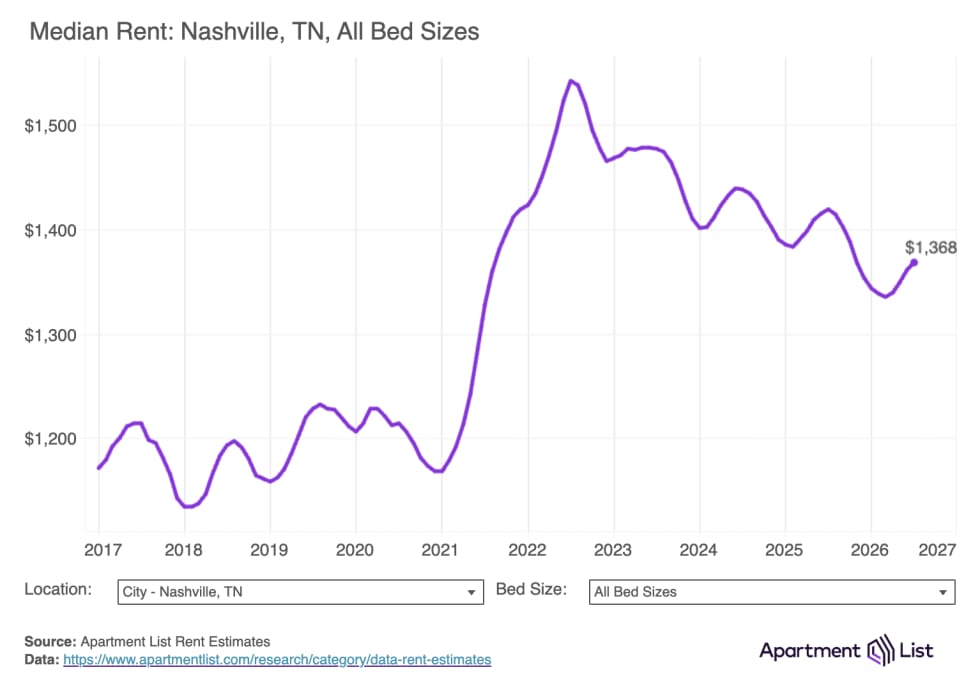
- Nashville Median Rent: $1,368 per month as of July 2026, which is just slightly below the national average.
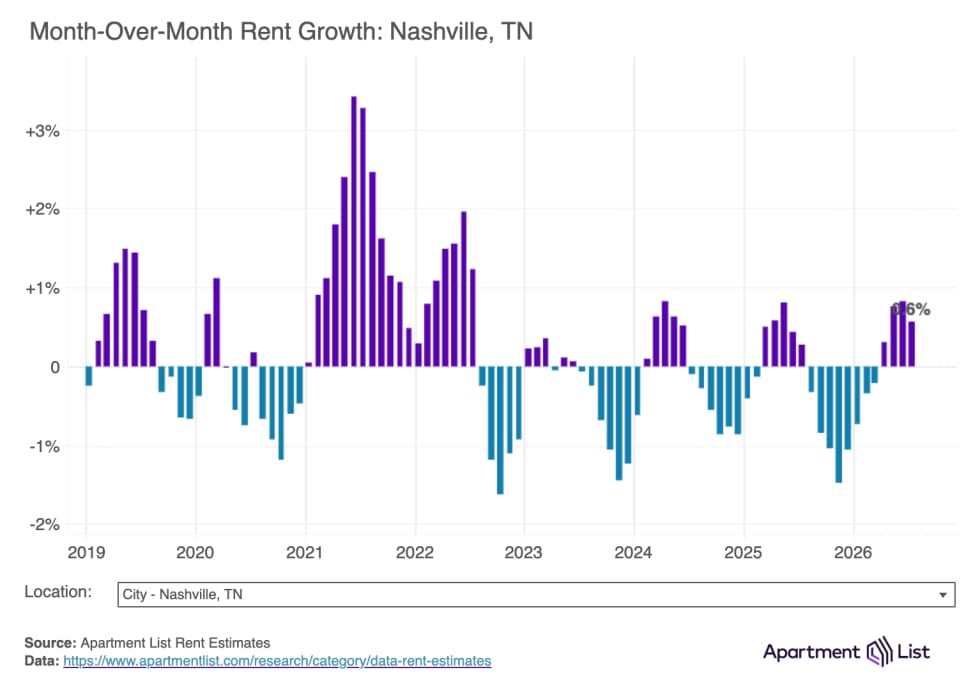
- Month-Over-Month Rent Growth: Nashville rents increased 0.6% in July 2026, outpacing the national average for the third straight month.
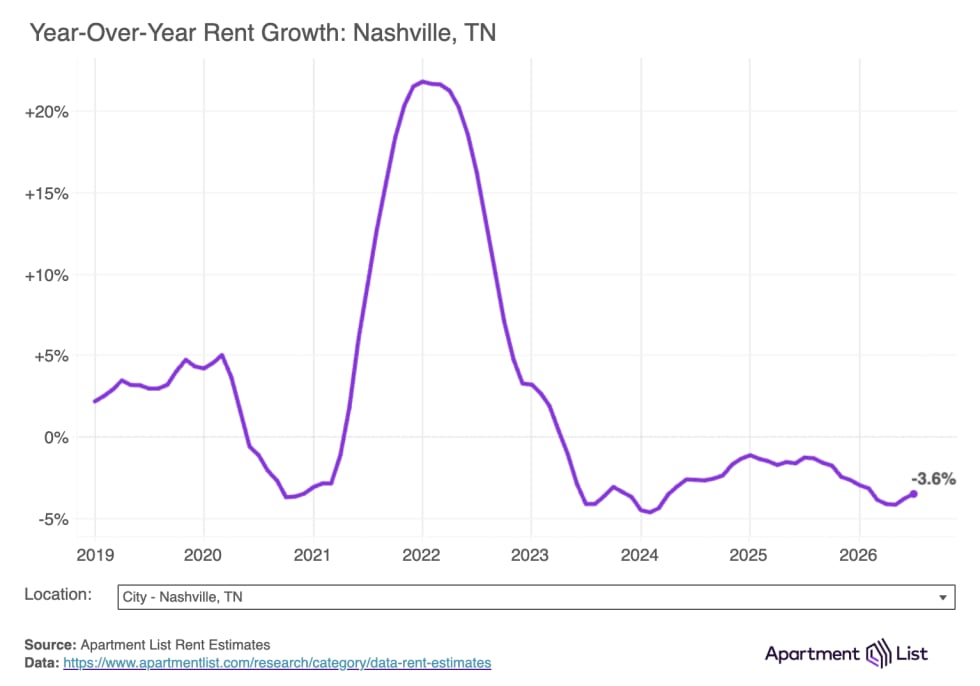
- Year-Over-Year Rent Growth: Rents in Nashville fell 3.6% from July 2025 to July 2026, ranking 11th for the biggest decline among the 100 largest cities in the U.S.
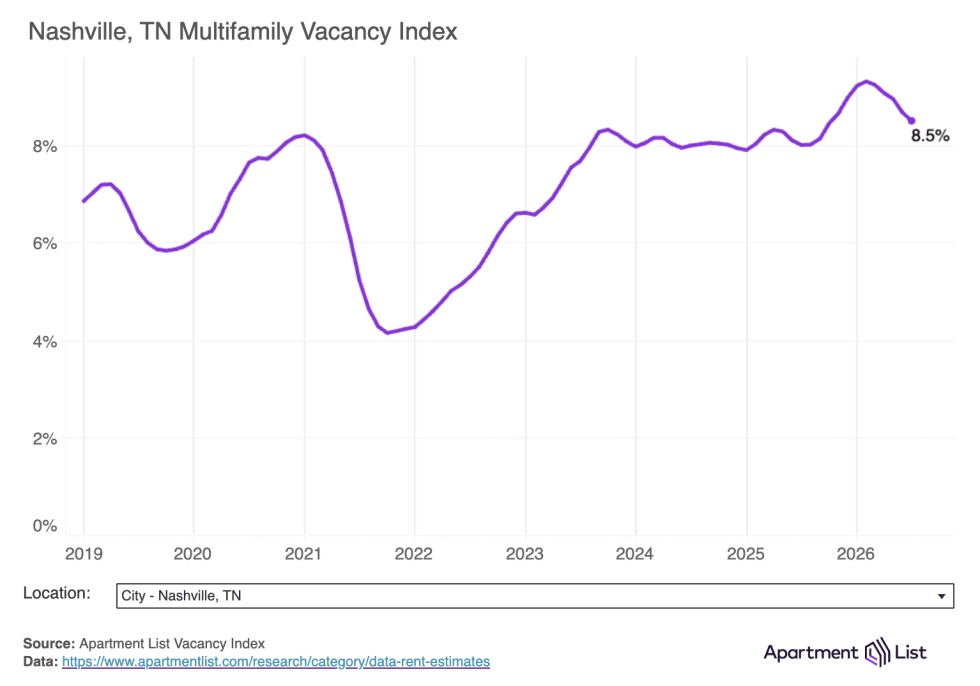
- Vacancy rate: The multifamily vacancy rate in Nashville stood at 8.5% in July 2026, but is now declining from a recent peak of 9.3%.
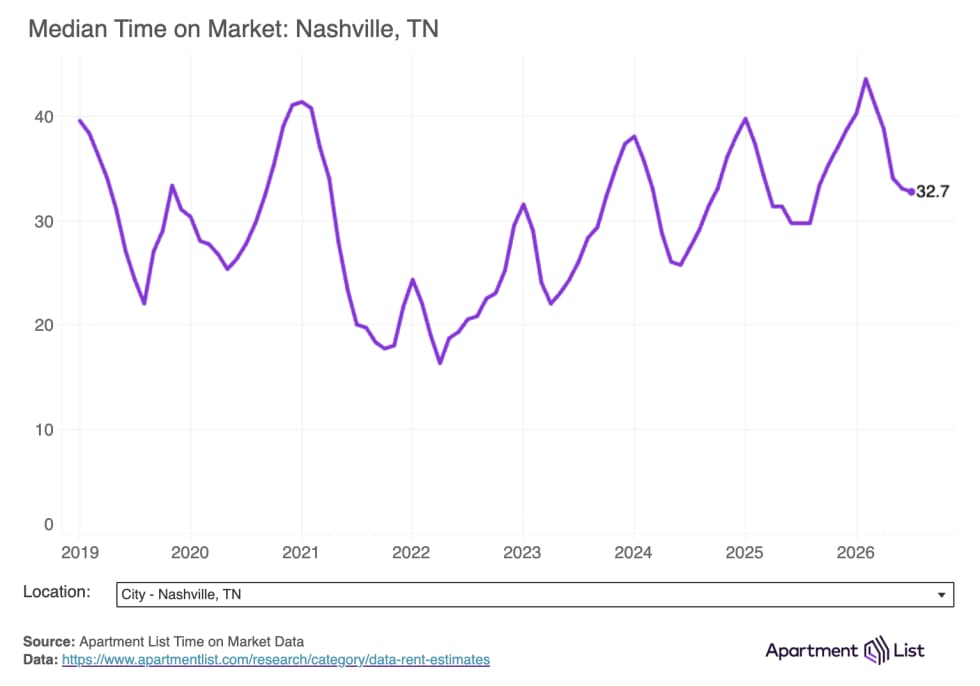
- Time on Market: The typical apartment in Nashville takes 33 days to get leased after being listed, slightly longer than the national average of 30 days.
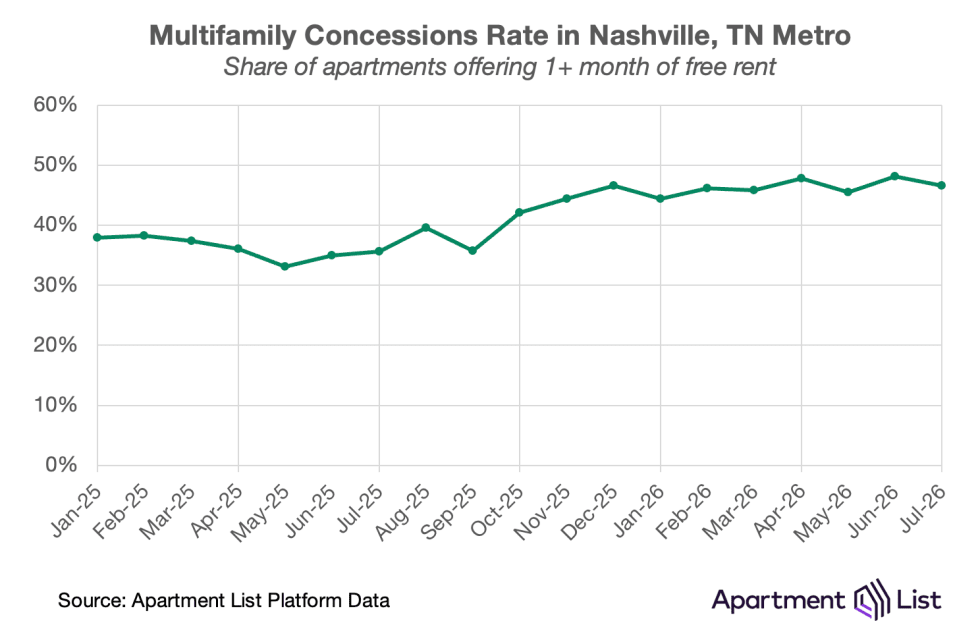
- Concessions: Over 40% of Nashville multifamily communities are offering at least one free month of rent in order to attract new tenants.
How we got here: after a hot stretch in the early 2020s, a construction wave slowed Nashville’s rental market considerably
Nashville was one of a handful of rental markets that exploded in popularity in 2021. It was a premier destination for many of the millions of Americans who moved during this period, be it to work remotely, start a new job in Nashville’s fast-growing local labor market, cut down on cost of living, or simply get a fresh start. Nashville’s metro population has grown by more than 175,000 people since 2020, putting it among the 10 fastest-growing large metros in the country. This placed immense pressure on the local housing market, both rentals and for-sale homes. At the peak in 2021, Nashville rents were increasing more than 3% a month, and year-over-year rent growth topped out above 20%.
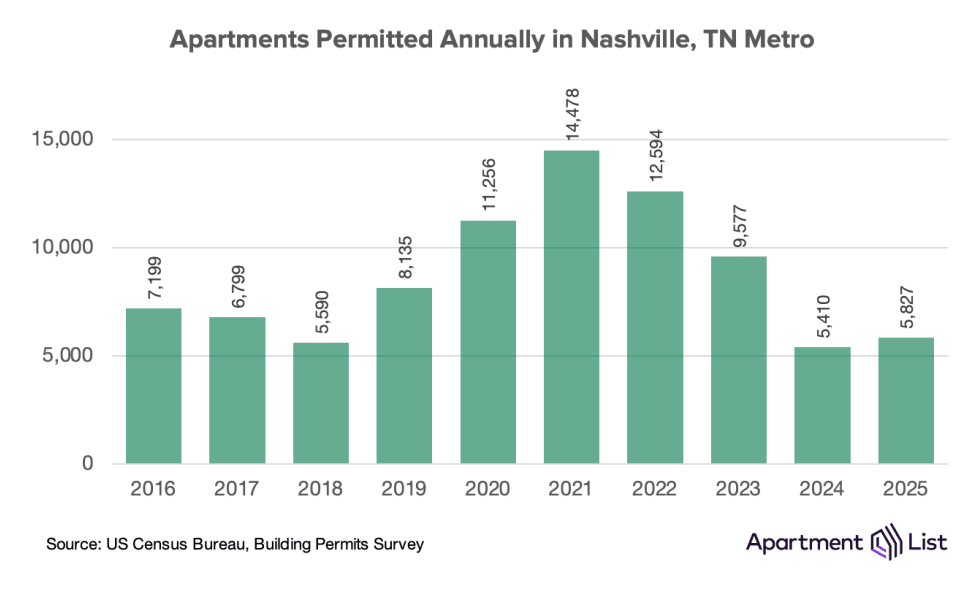
With rent revenues rising and the cost of borrowing at all-time lows, development investment poured into Nashville. The early 2020s construction wave was a nationwide phenomenon – over 1.5 million apartments were built across the country in just three years – and Nashville was one of the leaders. In 2021 alone, nearly 15,000 new apartments were permitted across the metro area, ranking second-fastest in the nation (on a per-capita basis) behind only Austin, TX. All of these new apartments were set to come online and be quickly absorbed by the seemingly unending demand for housing in Nashville.
But things changed quickly in 2022. Inflation spiked, interest rates jumped, and migration (both domestic and international) slowed. Like groceries and gasoline, the rising cost of housing became a financial pain point facing American families. Just as these factors drove a slowdown in housing demand, the tens of thousands of new units that broke ground in the years prior began to reach completion. Property managers who were once enjoying record rent growth suddenly found it difficult to fill vacancies amid this surge of new apartments, and prices fell in an attempt to attract and retain tenants.
These soft market conditions have persisted in Nashville since late-2022, as the market works to absorb the thousands of new apartments that came online during the pandemic construction wave. Each year, the summer moving season has produced less demand than historical averages, leaving mid-year rent increases modest. To offset low demand, winter rent declines have been especially steep, slowly pulling Nashville’s median rent down more than $200 from a peak of $1,542 in July 2022 to a recent low of $1,335 in March 2026.
Soft market conditions are visible in many of Nashville’s key market indicators
Year-over-year rent growth flipped negative in Nashville in early 2023 and has yet to fully recover. Twice it dipped close to -5%, and over the past few years has consistently been among the lowest of any major American rental market. As of July 2026, Nashville rents are down 3.6% on the year, despite ticking up slightly for two months.
In this high-supply renters’ market, vacant units are turning over slowly. We track “list-to-lease” time, which is the number of days between when an apartment is listed and when it is leased. Nationwide, the typical list-to-lease time in July 2026 was 30 days; in Nashville, apartments are turning over in 33. A highly seasonal measure, time on market has been trending longer for years in Nashville, contributing to the slump in rents. This reflects an increasingly patient renter population that knows they have some leverage in the market and are not rushing to sign a lease like they were in early 2022.
Concessions are another clear signal of market dynamics. In similar markets that have experienced rapid supply growth over the past few years, property managers leverage concessions to attract tenants and differentiate themselves in a crowded market. Our team tracks concessions that offer one or more months of free rent, which tangibly move the needle on affordability for renters. Throughout 2026 so far, they are being offered by more than 40% of apartment communities in Nashville, which is about 10 percentage points higher than one year ago and substantially higher than the national average (31%).
The vacancy rate points to a potential turnaround for Nashville’s Rental Market
Despite trudging through three years of slow performance, there is reason to believe Nashville’s rental market is on the brink of a rebound. One key signal is the vacancy rate: the average share of units available for rent in stabilized multifamily buildings across Nashville.1 As of July 2026, the vacancy rate in Nashville is elevated at 8.5%, but has been trending down for the past six months as the pipeline of new construction slows.
This is important because vacancies correlate tightly with rents: more vacancies encourage lower rents, and fewer vacancies encourage higher rents. Nashville’s rent inflation of 2021-2022 lines up with the city’s vacancy rate shrinking by more than half, and rent deflation since 2023 lines up with vacancies gradually rising as the city built up its housing stock. And here in 2026, the vacancy rate has declined meaningfully from 9.3% to 8.5% as rent growth has increased from -4.2% to -3.6%. These are incremental changes that alone have not yet flipped the script on Nashville’s rental landscape, but the current trajectory now points toward tighter market conditions on the foreseeable horizon.
Another reason to suspect Nashville’s rental market is stabilizing is because many of its demand indicators remain strong. Net migration into Nashville remains positive, with over 70 new residents moving to the metro area every day last year. The local unemployment rate is one of the lowest in the nation: just 2.7% in May 2026 according to the Bureau of Labor Statistics. And affordability challenges in the for-sale market mean many households are staying in the rental market for longer. As the construction wave passes and more units get absorbed by Nashville’s growing population base, vacancies and rents should continue to trend towards a more-stabilized market.
What this means for Nashville property managers: if you’ve been struggling, the market is finally turning a corner
Soft market conditions don’t reverse immediately, but relief may be on the horizon for property managers who have been trudging through the past few years. Nashville remains a desirable market with a strong underlying economy that will continue to pull renters in the coming months and years. The construction wave that bolstered supply competition and put downward pressure on rents is finally fading, and vacancies have topped out as the market trends toward more-balanced supply and demand. There are still an estimated 10,000 units in Nashville’s construction pipeline, but their delivery will spread out over the coming years and should be absorbed by Nashville’s steady influx of new residents. If current trends hold, property managers can expect winter 2026 to be milder than the previous years, and can approach spring 2027 with more leverage to pull back on concessions and push harder on price.
What this means for Nashville renters: good deals are still out there, but don’t wait too long
A soft market is a renter’s market, and Nashville renters are taking advantage. We see list-to-lease time trending up, renter urgency trending down, and many apartments offering free rent to entice new tenants. This suggests renters are taking time with their search, weighing their options, and only signing leases when they are confident they are getting a good price.
As long as vacancies are elevated and rent growth low, renters will continue to enjoy this leverage. Now is a great time for renters to approach a new lease as an opportunity to find a great deal. Whether that means lower rent, better amenities, or flexible lease terms, renters should enter their apartment search equipped with the latest data. Low rent growth and a high concessions rate are signals that Nashville landlords are willing to negotiate to find the right tenant.
But market indicators are stabilizing, and while a rapid price crunch is unlikely, renters who wait too long to make a move might find themselves in a much tighter market and with much less negotiating power.
Complete Nashville Data & National Comparison
| Statistic | Nashville | USA |
|---|---|---|
| Median Rent, overall | $1,368 | $1,388 |
| Median Rent, 1-br | $1,226 | $1,220 |
| Median Rent, 2-br | $1,363 | $1,374 |
| Rent Growth, Month-over-Month | +0.6% | +0.2% |
| Rent Growth, Year-over-Year | -3.6% | -1.1% |
| Vacancy Rate | 7.2% | 8.5% |
| Median Days on Market | 33 | 30 |
| Concession Rate | 47% | 30% |
Data Sources & Methodology
The data in this report – median rents, rent growth, vacancies, time on market, and concessions – are built by the Apartment List Economics Team using a combination of public data and proprietary platform data. Complete methodologies and data download options are available on our research blog. All data refer to the city limits of Nashville, unless otherwise specified.
Median rent represents the estimated lease price for all rental properties within a market. Rent estimates are kept up-to-date using a combination of census data and real-time price changes observed on the Apartment List platform. Month-over-month rent growth compares July 2026 and June 2026, while year-over-year rent growth compares July 2026 with July 2025.
The multifamily vacancy rate is calculated as the share of units that are available for rent across all stabilized Apartment List properties in a market. A stabilized property is defined as one that has been active on our platform for at least six months and has reached 85% occupancy at least once.
Time on market or list-to-lease time is calculated as the median number of days between a unit’s listing data and its lease date.
The concessions rate is calculated as the share of apartment communities in a market advertising at least one month of free rent upon lease signing. Other concessions, like discounted parking or waived fees, are not considered.
Migration data comes from the Census Bureau’s Population and Housing Units Estimates. Building permits data comes from the Census Bureau’s Building Permits Survey. Unemployment data comes from the Bureau of Labor Statistics’s Local Area Unemployment Statistics.
FAQs
What was the median rent in Nashville in July 2026?
Nashville’s citywide median monthly rent was $1,368 in July 2026. The median for one-bedroom apartments was $1,226 and the median for two-bedroom apartments was $1,363.
Are Nashville rents rising or falling in 2026?
The rental market is very seasonal. Nashville rents increased 0.6% from June to July 2026, as is typical during the summer. But Nashville rents remain 3.6% lower than their July 2026 level.
What was Nashville’s vacancy rate in July 2026?
Nashville’s multifamily vacancy rate was 8.5% in July 2026, down from a recent peak of 9.3% earlier in the year.
How common are apartment concessions in Nashville?
In July 2026, 47% of apartments in Nashville were offering a significant discount of one or more free months of rent. Additional concessions like fee reductions and discounted amenities are also common.
Was Nashville a renter’s market in 2026?
Yes. Compared to the same time last year, rents in Nashville were down 3.6%, time on market increased from 30 to 33 days, and the concessions rate increased from 36% to 47%. These indicators mean renters gained meaningful negotiating leverage.
Is the Nashville rental market recovering?
Apartment List data shows early signs of stabilization in July 2026, but the market has not fully recovered. Population growth and low unemployment suggests housing demand remains strong, and the apartment vacancy rate is starting to fall. But the market must continue absorbing the thousands of apartments built in the last few years before rent growth turns positive.
Is Nashville building a lot of new apartments?
Yes, Nashville is one of many Sun Belt markets that experienced a multifamily construction boom following the onset of the pandemic. Between 2020 and 2023, across the broader Nashville metropolitan area, nearly 48,000 new apartments were permitted for construction.
- Stabilization is important here. Our vacancy rate methodology only considers buildings that have been active on our platform for some time and reached 85% occupancy at least once. So as new apartments get built, the vacancy rate does not capture those brand new units, but rather the effect of those new units on existing (stabilized) supply.↩
Share this Article