The Competitive Case for LIFT: How Search Ranking Works on Apartment List

The properties filling units right now share one advantage: they hold position in front of the right renter at the right time across a search journey that now spans smart leasing platforms, AI-powered interfaces, and conversational tools.
Search visibility is no longer just about being listed. It’s a competitive position that shifts continuously based on renter behavior, market conditions, and how aggressively other operators in your comp set are competing for attention.
LIFT is Apartment List's premium placement product. It puts you into an auction-based layer that determines search rank within your specific comp set, ensuring your property appears more prominently in relevant searches rather than broad, untargeted exposure. Here's what you need to know.
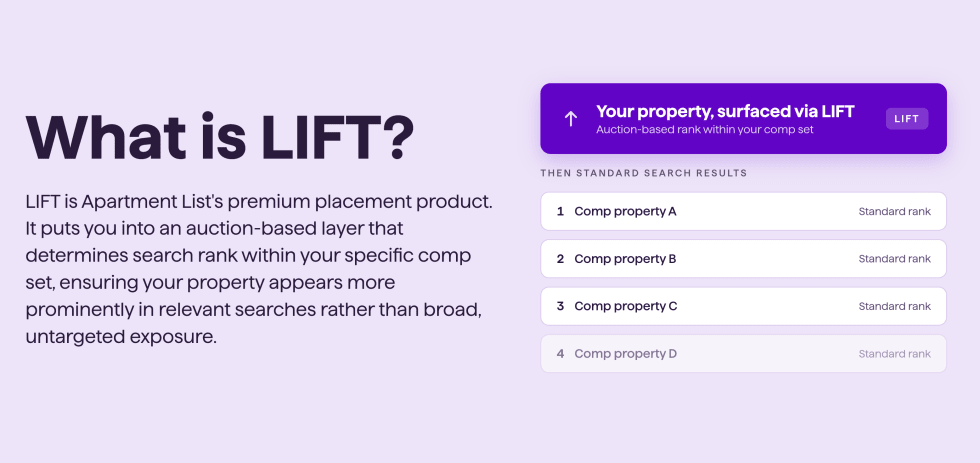
How Search Ranking Works on Apartment List
Search position is now a managed, competitive variable. Here’s how it works on Apartment List:
- Apartment List ranks properties by match probability, with position shifting based on how your comp set competes for visibility.
- Search position shifts based on how aggressively your comp set is competing for visibility, and LIFT is where that competition actually happens.
- LIFT pricing reflects your specific comp set, submarket demand, and vacancy conditions, not a flat rate.
- Properties using LIFT see a 50% average increase in leases and a 24x average ROI.
- You pay on verified move-ins only, with month-to-month flexibility and no long-term obligation.
Why Leasing Outcomes Are Now Decided by Search Position
In a high-vacancy market, leasing outcomes increasingly come down to whether your property is consistently in front of renters while they’re deciding.
Across those environments, rank determines whether you’re even part of the consideration set. That pressure has intensified as renter behavior shifts:
- Renters have more options and less urgency than in prior cycles.
- Decision timelines are longer and more sensitive to price and value tradeoffs.
- More properties are evaluated before a renter engages.

51.8% of renter households in the U.S. are now cost-burdened, spending more than 30% of their income on rent. That constraint is extending decision timelines, increasing comparison across properties, and making leasing behavior less predictable.
Each renter who engages with a property ranked above yours is a higher-cost missed opportunity than it used to be.
As a result, when and where your property appears in search carries more weight than it did in prior cycles. Small differences in position now have a greater impact on leasing outcomes than they did in prior cycles.
How Does Apartment List Search Ranking Work?
Apartment List ranks communities by match probability: how likely a given renter is to lease at your property based on their preferences and behavior. Position determines how frequently and how high your property appears, and LIFT allows you to compete more actively for that position within your comp set.
Two renters searching the same submarket can see different results depending on how well each property fits their profile.
How Search Is Changing Beyond Apartment List
Beyond the Apartment List platform itself, as search becomes more conversational and AI-driven, how listings are surfaced is changing. Instead of scrolling through a full ranked list, renters increasingly encounter a smaller, curated set of options.
Fewer properties are surfaced at once, which raises the threshold for being shown. This shift makes competitive positioning something operators now have to actively manage, not just a channel-specific tactic. Keep in mind that different environments have different levers for influencing that position.
The same pressure holds true on Apartment List, where position determines how often and how high you’re seen within your comp set.
Why Does My Apartment List Rank Drop When A Competitor Enrolls In LIFT?
Apartment List runs an auction-based premium placement layer on top of its ranking system. Even modest differences in competitive activity can shift relative position within a comp set. This matters now because:
- The leasing calendar is less seasonal.
- Move-ins are spread more evenly across the year.
- Demand is less concentrated into predictable peaks.
In a market where your comp set likely includes properties that have been on LIFT for months, less active may already describe your current level of competition within that group.
Staying at your current enrollment level while comp set properties get more aggressive in search can shift your relative position over time, often before it is visible in top-line metrics.
LIFT improves your competitive position within your search set, with rank varying by renter and by search. Position is calculated per renter and varies by search. Rank is live and renter-relative, so competitor enrollment affects your position whether you act on it or not.
How LIFT Pricing Determines Your Search Position
LIFT pricing determines how high you show up relative to your comp set. In markets where LIFT participation is high, properties not using it are still competing, just without controlling their position
Most ILS premium products charge a flat rate for placement. LIFT pricing adjusts to your comp set, reflecting submarket demand, your vacancy position, and how aggressively other properties are competing.
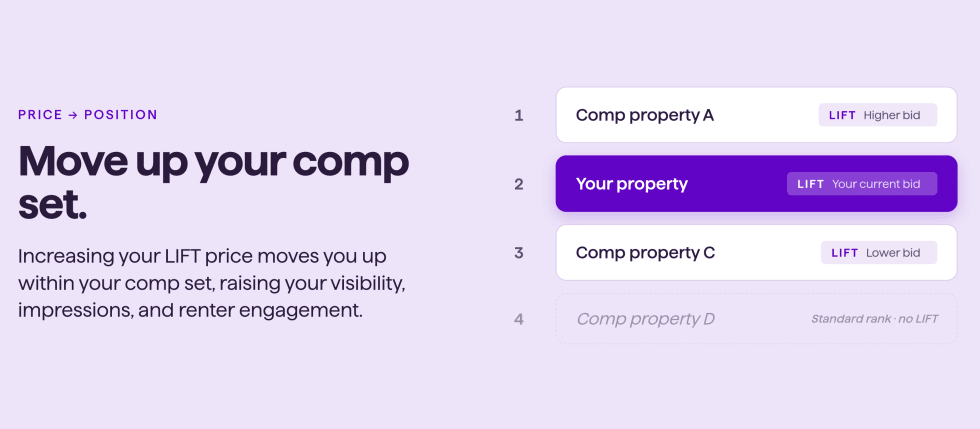 Increasing your LIFT price moves you up within your comp set, raising your visibility, impressions, and renter engagement. Pricing is calibrated to current market conditions at the time of enrollment, rather than fixed in advance.
Pricing Aligns Directly to Leasing Outcomes
Billing is tied to verified move-ins, so your spend tracks directly to leasing outcomes.
You Can Adjust Your Position As Market Conditions Change
You can increase your price at any time directly in the A-List Portal, with changes taking effect within your enrollment cycle. Adjust your position during a lease-up push, and scale back once occupancy stabilizes.
Those changes in position translate directly into leasing outcomes.
What Results Does LIFT Drive?
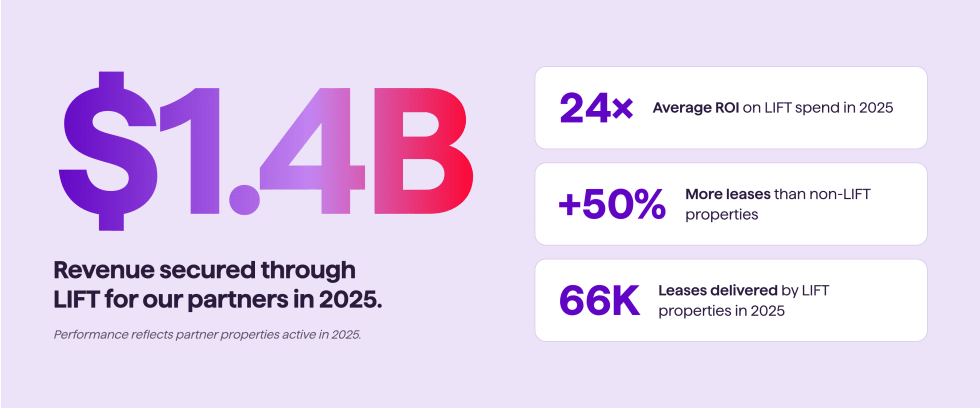
LIFT's impact shows up across the full visibility-to-leasing pipeline. Performance data reflects Apartment List partner properties active in 2025 unless otherwise noted. Results may vary by market, comp set, and enrollment level.
- LIFT properties see a 50% average increase in leases compared to non-LIFT properties.
- The average ROI on LIFT spend in 2025 was 24x.
- Total revenue secured through LIFT for our partners in 2025: $1.4B.
- LIFT properties averaged 838 impressions per community per month in 2025, compared to 399 for non-LIFT properties.
- That visibility gap carries through to contacts: LIFT properties averaged 97 contacts per community per month versus 42 for non-LIFT, a 2.3x difference.
- LIFT-enrolled properties secured 66K leases in 2025, and more than 282K since 2019.
- These gains are most visible in competitive markets, where maintaining position determines whether demand converts or moves elsewhere.
FourSite Property Management used LIFT as the reliability layer across their portfolio. Premium placement kept their communities visible and competitive in key markets while A-List Market drove lead volume. LIFT outperformed Apartments.com in cost-per-lead by a wide margin, and the combined approach produced a 30x average ROI.
What Market Signals Tell You It’s Time To Enroll In LIFT?
The operators who get the most from LIFT act before performance shifts are fully visible. Common signals include:
1. Properties in Your Comp Set are Already Enrolled
If comparable properties in your search group have enrolled in LIFT and you haven't, your relative position may already be shifting. The difference is how quickly you respond.
2. Your Lead Volume Has Dropped Without A Clear Explanation
Before you adjust your pricing or rethink your product-market fit, check your visibility. A drop in impressions usually comes before a drop in contacts. That dynamic is amplified when renters are more selective about when and where they engage.
If your comp set has become more active in search while your approach has stayed consistent, that shift in visibility is often the underlying driver. Once visibility comes back, conversion depends on how you handle the leads that come in.
3. New Supply Has Come Online Nearby
When new properties enter your search group, your average rank can soften even if your property hasn’t changed. If you've watched your days on market climb without a clear pricing or product reason, new supply entering your search group is often the explanation. LIFT helps you maintain a more competitive position while new supply is absorbed.
4. You Have a Lease-Up or a Vacancy Target With a Hard Deadline
The month-to-month structure makes LIFT practical for a defined push. Run it while you're filling units, step back when you've hit your number.
How LIFT Helps You Compete More Actively For Search Position on Apartment List
Position within a comp set is uneven and constantly shifting based on how actively each property competes for it.
A-List Market ensures your property is matched to the right renters. LIFT influences how often and how high your property appears, and how consistently it shows up across renter journeys.
For operators managing lease-up timelines or responding to increased competition, it offers a direct way to adjust visibility without relying solely on pricing or concessions.
How Do I Enroll In LIFT Through The A-List Portal?
LIFT is available through the LIFT pricing tab in the A-List Portal. You can:
- View recommended pricing tiers.
- Model projected rank changes.
- Enroll without a long-term commitment.
Already on A-List Market? Connect with your rep to review your current position and understand how your comp set is competing right now.
Not yet on A-List Market? See how A-List Market works and get started.
LIFT FAQs: Pricing, Ranking, and Enrollment
How Do I Know If Properties in My Comp Set Are Already Enrolled in LIFT?
The Search Competitor Insights dashboard in Looker shows your active comp set and which properties are currently using LIFT. Your account rep can provide this view if you don't have direct access.
Do I Have Access to LIFT?
LIFT is available to all properties on an active A-List Market contract. You can check your enrollment status and activate directly in the A-List Portal. Your account rep can confirm if you're unsure.
How Is My LIFT Price Determined?
LIFT pricing is based on three factors: comp set competitiveness, submarket demand, and your current vacancy level. The A-List Portal shows recommended pricing tiers and lets you model projected rank changes before enrolling.
Will Enrolling Guarantee I Rank Above My Competitors?
No. Apartment List calculates rank per renter, so two people searching the same area can see different results depending on how well each property fits their profile. LIFT moves your position within your comp set on average, with rank varying by search. It makes you more competitive across the searches where a renter's profile closely matches your community. The performance simulation in the portal shows projected rank improvement so you can set realistic expectations going in.
How Often Should I Review and Adjust My Price?
Most operators adjust LIFT pricing as market conditions change — new supply, occupancy shifts, or increased comp set activity. Pricing can be increased at any time directly in the portal, with reductions taking effect at the end of the current enrollment period.
What Does It Look Like to Use LIFT When Submarket Conditions Shift?
When new supply enters your search group and days on market starts to creep up, enrolling in LIFT or increasing your price tier helps you hold rank while the new inventory gets absorbed. When you're running a lease-up and need to move units quickly, LIFT increases your search presence without a long-term spend commitment. Step back once you've hit your occupancy target. When contact volume softens without an obvious cause, check your visibility first. A drop in impressions usually precedes a drop in inquiries.
What Happens If I Want to Pause or Cancel?
You can opt out directly in the portal up to five days before your renewal date with no penalty. Apartment List bills based on leads generated during your active enrollment period. If a renter who came through LIFT moves in after you've cancelled, that move-in still bills at your LIFT price. Outside of that, there's no long-term obligation.
Share this Article