Despite softening rents, the number of cost-burdened renters continues to climb

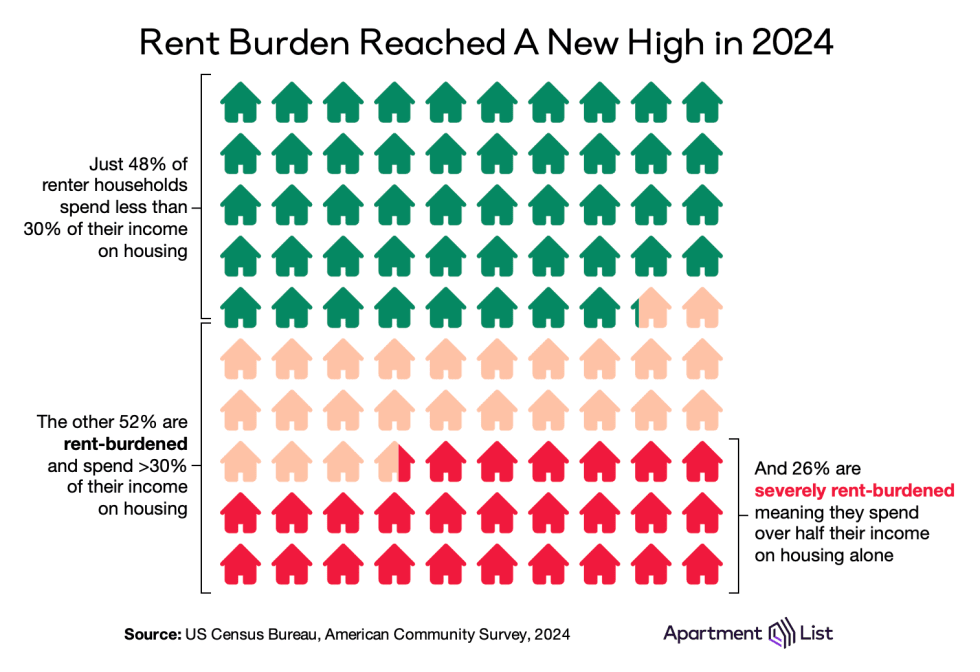
- 22.2 million renter households – 51.8% of all renter households in the U.S. – are considered cost-burdened, spending more than 30% of their monthly income on rent. 11.2 million spend more than half of income on rent, making them severely cost-burdened.
- The national cost burden rate increased meaningfully from 2019 to 2022, erasing years of gradual progress made over the course of the 2010s. Despite rents having since softened from their 2022 peak, the national cost burden rate has not budged, and the number of cost-burdened households continues to rise.
- Cost-burden rates are worst along the pricey coasts, and increasingly throughout the Sun Belt markets where affordability has waned amid rapid growth. Florida is home to the three major markets with the worst cost burden rates (Miami, Orlando, and Tampa).
- Since 2019, the cost burden rate has worsened in all of the nation’s 25 largest metros and in 49 of the largest 50. Tampa has seen the most severe worsening, with the cost burden rate there surging from 52.6% to 61.2%.
Widely accepted financial wisdom dictates that a household should spend no more than 30 percent of its gross monthly income on housing costs. This rule of thumb is cited broadly – from government agencies to personal finance blogs. Unfortunately, more than half of American renter households spend above the 30 percent threshold, qualifying them as “cost-burdened.” And more than one-in-four renter households spend over 50 percent of their income on rent, making them “severely cost-burdened.” After a decade of gradual improvement during the 2010s, cost burden rates worsened as rent prices soared during the pandemic years. Rent growth has softened more recently, but the national cost burden rate has remained essentially unchanged.
The number of cost-burdened renter households hits an all time high
As of 2024 – the most recent year of Census ACS data currently available – 22.2 million renter households are spending more than 30 percent of their income on rent. This represents an increase of 213 thousand households compared to 2023, putting the number of rent-burdened households at an all-time high. That translates to 51.8 percent of all renter households in the U.S., a rate that has held virtually unchanged since 2022 and which remains meaningfully elevated above pre-pandemic levels. 11.2 million of these cost-burdened households (26.1 percent of all renter households) are severely cost-burdened, spending more than half of their monthly income on rent.
The prevalence of rent burden has long been a significant issue, but the trend in recent years is especially troubling because it represents a reversal of modest progress that was made over the course of the 2010s. In the aftermath of the Great Financial Crisis, the renter cost burden rate hit a peak of 53.4 percent in 2011. But in the ensuing years, it gradually improved, eventually dipping to 48.4 percent in 2019.
Unfortunately, that progress was reversed by the record-setting rent growth that occurred in 2021 and 2022. Rent growth has since moderated amid a wave of apartment construction, and in many Sun Belt markets, rents are now more affordable than they were at the 2022 peak. But despite this, the number of rent-burdened households is still on the rise. There are currently 2.4 million more cost-burdened renter households than there were in 2019. Even though the current rent burden rate is slightly lower than it was from 2010 to 2012, the number of renter households who are burdened by their housing costs has never been higher.
And in some ways, the cost burden rate could even be underestimating the degree to which housing affordability has worsened. A lack of affordability has deterred new household formation in recent years, as Americans are increasingly doubling up with family or roommates to save on housing costs. These individuals are struggling with housing affordability, but because they don’t represent their own households, they are not captured in cost burden statistics.
Additionally, as the affordability of for-sale housing has eroded even more rapidly than that of rentals, more prospective homebuyers are continuing to rent. This subset of renters who have been sidelined from the for-sale market tend to be higher-income, and their presence in the denominator of the renter cost-burden rate could be depressing that rate slightly.
Florida and California are epicenters of the cost-burden crisis
Rent burden is a significant issue across the country, but its severity also varies meaningfully by geography. In general, markets along the coasts and in many parts of the Southern U.S. tend to have renter cost burden rates exceeding the national average. The nation’s coastal markets have long been among its most expensive, but an influx of renters to the Sun Belt has now also driven rapid cost burden increases in markets that were once affordable. Meanwhile the Midwest and Mountain West generally have cost burden rates below the national average, with markets in these regions serving as some of the last bastions of housing affordability.
At the state level, the issue is most extreme in Florida, where 62.1 percent of renters are cost-burdened, and roughly one-in-three renter households spend more than half of their income on rent. Florida is also home to all three of the major metropolitan areas with the highest cost burden rates – Miami tops the list at 65.8%, followed by Orlando at 62.1%, and Tampa at 61.2%.
California also jumps out as a cost burden hot spot. The state is home to 2.6 million rent-burdened households – the most of any state in absolute terms – and its cost burden rate ranks third worst at 55.8% (Nevada ranks 2nd, driven almost entirely by the Las Vegas metro). Among California’s large metros, cost burden rates are worst in Riverside (60.2 percent) and Fresno (58.6 percent). These markets have relatively more affordable housing costs compared to San Francisco and Los Angeles, but that housing cost advantage is more than offset by lagging incomes in these areas (more on that below).
At the other end of the spectrum, Pittsburgh, PA has the nation’s lowest renter cost burden rate among the nation’s 50 largest metros. But even here, 44.9 percent of renters struggle with excessive rent costs and more than one-in-five spend more than half of income on rent – housing affordability is a major issue even in the parts of the country that are performing best. Many of the other metros where renters enjoy relatively low cost burden rates are scattered across the Midwest, like St. Louis MO (45.8 percent), Minneapolis MN (47.4 percent), and Oklahoma City (48 percent).
The notable exception to this trend is San Jose CA, which has the nation’s 2nd lowest renter cost burden rate (45.1 percent) despite having the highest metro-wide median rent. This counter-intuitive combination of astronomical rents and below-average cost burden is attributable to the fact that the San Jose metro – home to Silicon Valley – also boasts some of the nation’s highest salaries. Meanwhile many of the region’s low-income residents have already been priced out to farther-flung inland markets. We see a similar trend in neighboring San Francisco, where rents are currently skyrocketing yet cost burden ranks seventh-lowest at 48.1 percent. This example demonstrates another way in which cost burden rates – while an important and useful indicator – are not a comprehensive measure of housing affordability.
Renter cost burden rates have worsened virtually everywhere
As discussed above, the troubling prevalence of cost burden among American renters is compounded by the fact that the issue has worsened in recent years. That national trend is mirrored in just about every major housing market in the country. From 2019 to 2024, the renter cost burden rate increased in 49 of the nation’s 50 largest metros (Richmond, VA being the lone exception).
Among the 25 largest metros in the U.S., Tampa has experienced the most severe worsening of renter cost burden. In 2019, Tampa had the 6th highest rent burden rate at 52.6 percent; as of 2024, Tampa’s rent burden rate had increased by 8.7 percentage points to 61.2 percent, placing it third highest among the 25 largest metros. This worsening has been driven by skyrocketing rent prices – Tampa is tied for first among the 25 largest metros for fastest rent growth from 2019 to 2023, with the median rent there up by a staggering 53 percent in total over those years.
Phoenix had the 2nd fastest increase in its renter cost burden rate, with a 7.4 percentage point jump from 46.6 percent in 2019 to 54 percent in 2023. The top five is rounded out by San Antonio, Atlanta, and Orlando. This list of markets testifies to how the exploding popularity of the Sun Belt has delivered a serious blow to the region’s affordability. These markets have seen a swell of new units hit the market in recent years to meet heightened demand, which has helped to temper rent growth. But most new construction falls into higher price tiers, and may not be doing as much to alleviate affordability woes for the renters who are struggling most.
Wage growth struggling to keep pace with rents
To understand cost burden, it is important to look not just at rent prices, but also at how they compare to incomes. The chart below plots metro median rent growth from 2019 to 2024 against renter income growth over the same period (both in nominal terms). Each marker represents one of the nation’s 100 largest metros, sized by population, and shaded based on the change in the metro’s cost burden rate during those same years. Red indicates worsening cost burden and green signals improvement. In metros sitting above the diagonal line, rents have grown faster than incomes in recent years, whereas in metros below the diagonal, incomes have grown faster than rents.
Since 2019, rents have grown faster than renter incomes in 85 of the nation’s 100 largest metros. The markets with the widest gaps are those that have seen the most extreme worsening of rent burden rates. Tampa is again a good example – the median renter income in the Tampa metro increased meaningfully by 34 percent from 2019 to 2024, but the metro’s median rent rose significantly faster over the same period (+53 percent). It’s also important to note that the wage gains reported here do not necessarily accrue uniformly to all renters – a market’s median renter income can also be driven up by an influx of new renters who earn more than the area’s existing renters, a dynamic almost certainly at play in fast-growing markets such as Tampa and the other Sun Belt metros where rent burden is worsening most rapidly.
Conclusion
In 2021, the national median rent spiked by a record-setting 18 percent in a single year, erasing nearly a decade of gradual improvement in the nation’s renter cost burden rate. Since then, rent growth has slowed considerably, and since mid-2022 rents have actually come down 6 percent from their peak. Nonetheless, the number of cost-burdened renter households is still on the rise, and hit a new record in 2024. With more than half of renters spending an unhealthy share of their income on rent, it is clear that significant work must be done to alleviate a housing affordability crisis that has now extended to virtually every part of the country.
Share this Article