Exposure Without the Concessions: Rethinking Leasing Cost Structure in a High-Vacancy Market

Leasing performance is breaking down in two places at once: getting the right renters in front of available units, and converting the ones who engage into signed leases. Most operators are solving both with tools where the cost of exposure and the cost of conversion aren’t tied to actual leases.
The result is a leasing model where spend is disconnected from signed leases, and where both exposure and conversion become more expensive than they should be.
TL;DR: The Traditional Leasing Approach Is Misaligned with Outcomes
- Concessions have shifted from a tactical lever to a baseline cost of exposure, reducing net revenue without guaranteeing leases.
- A growing share of renter inquiries happens outside business hours, and without immediate follow-up, many qualified prospects never convert.
- Most leasing spend is still incurred before a lease is signed, leaving operators paying for visibility and engagement regardless of outcome.
- Pay-per-lease models paired with automated follow-up tie both exposure and conversion costs directly to signed leases.
The Leasing Model That Used to Work: Why Multifamily Leasing Is Harder Right Now
For the better part of the past decade, the approach worked. Concessions were a periodic tool, not a standard expectation. Demand was strong enough that slower response times and missed follow-ups rarely cost occupancy. There were enough inquiries behind the ones that fell through that the model forgave its own inefficiencies.
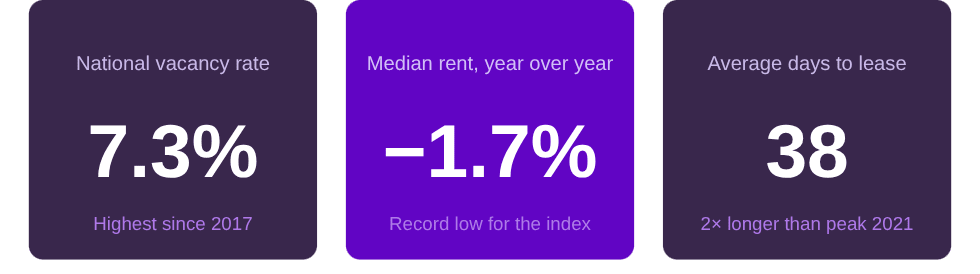
That cushion has eroded. The national multifamily vacancy rate now sits at 7.3%, the highest level in Apartment List's tracking going back to 2017. Median rents are down 1.7% year-over-year, also a record low for the index. Units are taking an average of 38 days to lease after listing, more than twice as long as at the market's peak in mid-2021. In this environment, concessions have shifted from a lever operators could pull when needed to a baseline expectation, which changes the math considerably.
The Exposure Problem: Why Concessions Are Becoming the Cost of Visibility
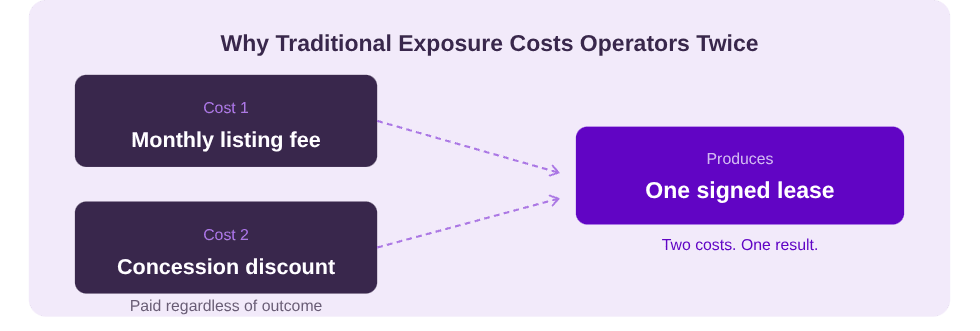
Concessions increase visibility by lowering net effective rent, which moves a property up in the price and location filters renters use most. The problem is what it costs: operators are paying for leasing exposure twice, once in listing fees and once in the revenue given up on every unit where the discount works.
What is leasing exposure? Leasing exposure refers to how frequently a property appears in renter search results and consideration sets. On most platforms, exposure is determined by price competitiveness and location filters, which means operators who need visibility often have no lever other than discounting net effective rent.
According to Apartment List data cited by the Wall Street Journal, over a third of properties nationwide are now offering a concession equivalent to at least one month free, the highest share in years.
Using discounts as the primary way to generate exposure means giving up long-term revenue on every unit where the strategy works. On platforms that charge a monthly listing fee on top of that, the math compounds: you're paying to be listed regardless of outcome, and then giving up margin to be competitive enough to be chosen. The result is two costs layered on top of each other to produce one lease.
In Sun Belt markets, where vacancy pressure is sharpest, this dynamic is most visible. Austin's median rent is down 6% over the past year. San Antonio, Denver, Phoenix, Tampa, and Orlando are among the metros seeing similar softening. What Apartment List's own search data shows is more specific: nearly half of renters in Austin are actively searching outside the metro, with San Antonio as the top destination. On platforms that charge a flat listing fee regardless of outcome, you're paying to be seen by renters who may already be planning to leave.
Where Is Renter Demand Actually Going?
Most operators are working from lagging indicators: vacancy rates, days on market, year-over-year rent comps. In New York, 11% of outbound renters are searching in Florida, making it the top destination ahead of New Jersey for the first time.
When search demand is moving toward other markets and you're discounting to compete for renters already looking elsewhere, you're paying for exposure that was never going to convert.
The alternative is a model where you only ever pay the value of the renter. Pay-per-lease (PPL) exposure means spend aligns to a signed lease, not to the right to be seen. Right exposure, predictable ROI.
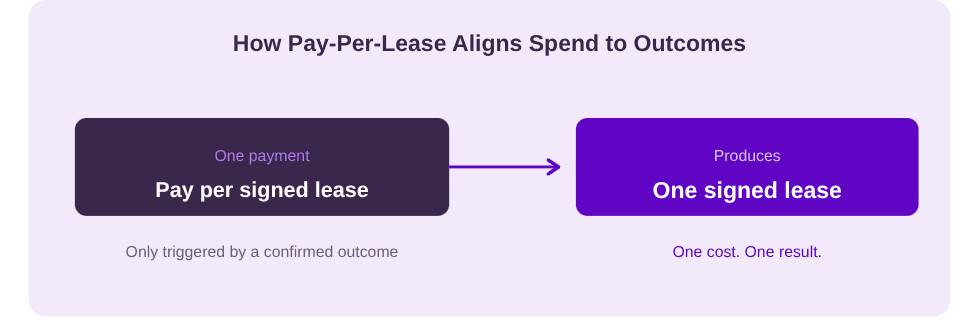
What Is Pay-Per-Lease (PPL)? PPL is a leasing model where operators pay only when a signed lease executes; not for impressions, clicks, or the right to be listed. Unlike flat-fee ILS subscriptions, which charge regardless of outcome, PPL aligns marketing spend directly to a confirmed revenue outcome.
Operator Takeaway: If visibility depends on price, you're paying for exposure twice; once in listing fees and once in the revenue lost on every lease the concession closes.
The Conversion Problem: Why Leasing Teams Are Missing Qualified Leads
Many multifamily operators are seeing lower leasing conversion rates even when lead volume holds steady. The structural issue is response time: more than half of renter inquiries arrive outside business hours, and teams without automated follow-up are losing prospects before a leasing agent ever engages.
Speed matters more than it ever has. 55% of renter engagement handled by A-List Nurture happens after hours, meaning more than half of the inquiries your leasing team can't respond to are still being worked. More than half of inquiries arrive outside standard business hours. That response gap shows up directly in occupancy, regardless of how strong the top-of-funnel exposure is.
Hitting the same occupancy goals likely requires more top-of-funnel volume than it used to, faster and more consistent follow-up than most teams can sustain manually, and a willingness to stay in contact with renters who aren't yet ready to tour. Without that infrastructure, exposure converts at a lower rate than it should.
Operator Takeaway: Top-of-funnel investment only holds if the infrastructure exists to work what comes in: at any hour, at any volume.
What Pay-Per-Lease Actually Changes in Leasing Economics
Both problems point to the same underlying issue: spend is misaligned to outcomes. Giving up long-term revenue to generate visibility, with no guarantee of a signed lease at the end of it, is an expensive way to run a leasing operation. So is a manual follow-up process that can't keep pace with inbound volume or after-hours inquiries.
The alternative aligns spend to the lease itself. Operators pay the value of the renter when a lease signs, not for the right to be seen. Early-stage leads that aren't yet tour-ready get handled automatically, so the leasing team's attention concentrates on prospects closest to converting. More top-of-funnel volume becomes manageable because the infrastructure exists to work it.
The Apartment List Smart Platform works across the full leasing funnel:
- A-List Market connects operators with move-ready renters on a pay-per-lease basis. Spend aligns to a signed lease, not to the right to be listed. LIFT adds prioritization on top, using intent signals to surface the highest-priority leads and keep high-demand communities visible to the renters most likely to convert.
- A-List Nurture handles everything after a lead comes in. It engages renters via email, phone, and chat whether the office is open or not. Across the platform, A-List Nurture drives a 30% increase in lead-to-tour conversion, a 60% after-hours tour booking rate, and saves leasing teams an average of 42 hours per week per property. 55% of all Nurture engagement happens after hours.
Operator Takeaway: Spend aligned to a signed lease is a different cost structure than spend aligned to the right to be seen.
The Apartment List Smart Platform: What It Looks Like in Practice
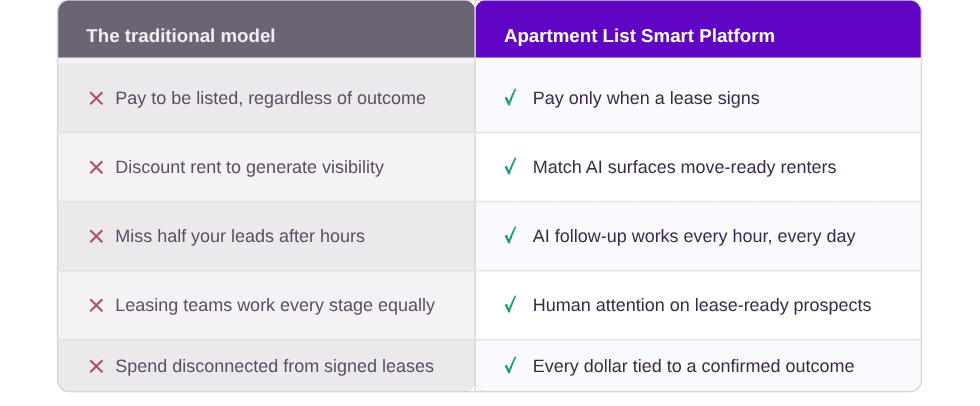
Two operators using our platform in different market conditions show what the shift produces.
Asset Living manages more than 450,000 units across 40+ states. Facing intensifying competition across Atlanta, Dallas, Denver, Houston, and Phoenix following the post-COVID construction surge, the operator expanded from 180 to 300 properties on Apartment List and achieved a 25x ROI in 2025. A-List Market matched high-intent renters with available communities and accelerated leasing velocity. LIFT kept high-priority communities visible and consistently surfaced to the renters most likely to convert. Early-stage leads went to automation. Human attention concentrated on prospects closest to signing.
Essential Property Management runs 100 to 150-unit communities in Detroit with one- and two-person site teams. The constraints are real: limited headcount, no margin for leads that go cold. Running the same infrastructure at smaller scale, the team achieved a 36% tour conversion rate, a 3.3-day average from lead to tour, and a 30x+ ROI without adding headcount.
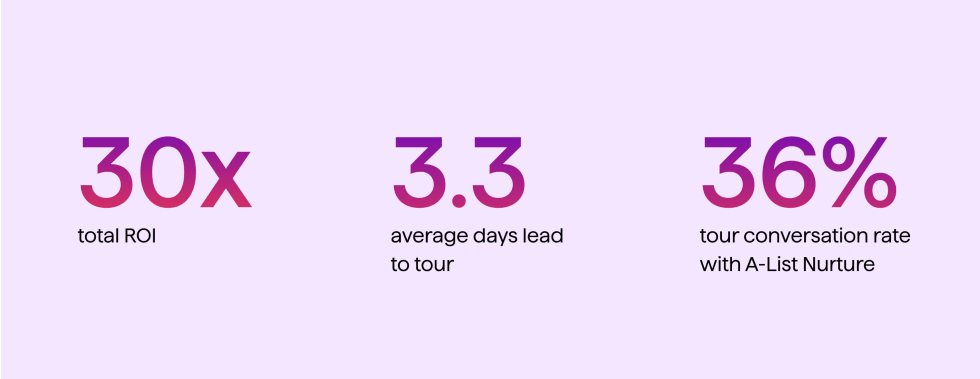
Neither operator technically needed more leads to hit their numbers. Neither leaned on deeper concessions to move units. They got the right exposure and converted what came in.
How Leading Operators Stay Competitive in a Soft Market
The operators pulling ahead right now share three advantages:
- Pay-per-lease exposure that aligns spend to signed leases.
- AI-powered conversion infrastructure that works around the clock.
- Human leasing attention concentrated on prospects closest to signing.
The national vacancy rate is at a record high, units are taking longer to lease than at any point in recent memory, and year-over-year rent growth is at its lowest level since Apartment List began tracking it in 2017. The operators who have already shifted aren't waiting for conditions to improve. They're building a leasing operation that holds regardless of what the market does next.
Ready to Build a Leasing Operation that Goes Beyond the Concession Reflex?
If your current model depends on concessions to generate visibility, you’re paying for exposure twice. The alternative is a cost structure where spend aligns to signed leases, and every lead gets worked without adding headcount.
Connect with our team to see how that could perform across your portfolio.
Multifamily Leasing Cost Structure FAQs
Q: Why are concessions getting harder to turn off in multifamily?
In high-supply markets, discounting has shifted from a tactical lever to the baseline cost of visibility. When every competing property offers a month free, concessions stop differentiating and start being the price of participation, with long-term revenue going out the door on every unit where the strategy works.
Q: How do I know if my market is actually absorbing the demand I'm paying to attract?
Most operators are working from lagging indicators: vacancy rates, days on market, year-over-year rent comps. Apartment List search data shows demand in motion before it settles. In Austin, nearly half of renters on the platform are actively searching outside the metro. In New York, 11% of outbound renters are searching in Florida, making it the top destination ahead of New Jersey for the first time. When inbound demand is shifting and you're discounting to compete for renters already looking elsewhere, the concession isn't closing the gap. It's subsidizing the wrong outcome.
Q: Why are leasing teams missing qualified leads even when top-of-funnel exposure is strong?
Many multifamily operators are seeing lower leasing conversion rates even when lead volume is stable or increasing. The core issue is structural: more than half of renter inquiries arrive outside business hours, and manual follow-up processes can't keep pace with renter timelines.
Q: What is pay-per-lease, and how does it change leasing economics?
Pay-per-lease (PPL) is a leasing model where operators pay only when a signed lease executes; not for impressions, clicks, or the right to be listed. Unlike flat-fee ILS subscriptions, PPL aligns spend directly to a confirmed revenue outcome.
Q: What is after-hours lead response and why does it affect leasing conversion?
After-hours lead response is the practice of engaging renter inquiries that arrive outside standard leasing office hours, typically through AI-powered email, chat, or phone follow-up. On the Apartment List platform, 55% of renter engagement happens after hours. For leasing teams without AI-powered follow-up infrastructure, that means more than half of inbound inquiries are going unworked until the next business day.
The conversion impact is direct. Renters searching for apartments are often evaluating multiple properties at once. A same-night response keeps your property in consideration. A next-morning response frequently doesn't. Teams using A-List Nurture see a 30% increase in lead-to-tour conversion and a 60% after-hours tour booking rate, without adding headcount.
Share this Article