Why Answer Engine Optimization (AEO) Matters for Multifamily Leasing
When renters research apartments with AI and that information is wrong, your leasing team ends up fixing it. Extra calls, extra emails, extra clarification before a leasing conversation ever starts.
Increasingly, renters are encountering your property information through AI-generated summaries before they ever decide to visit a listing page.
How Renters Use AI to Find Apartments
AI assistants now sit between renters and the apartment listings they're evaluating, acting as a new layer between a renter's question and the property information used to answer it.
This isn't niche behavior anymore:
- 60% of U.S. adults use AI to search for information (July 2025 AP-NORC survey).
- 62% of U.S. adults interact with AI at least several times a week (September 2025 Pew Research).
- AI platforms generated over 1.1 billion referral visits to the top 1,000 websites in June 2025, up 357% year over year (Similarweb).
Younger renters skew even heavier toward AI tools, making it increasingly likely they encounter an AI assistant before they reach your website.
Here's what that process actually looks like for a renter searching for an apartment:
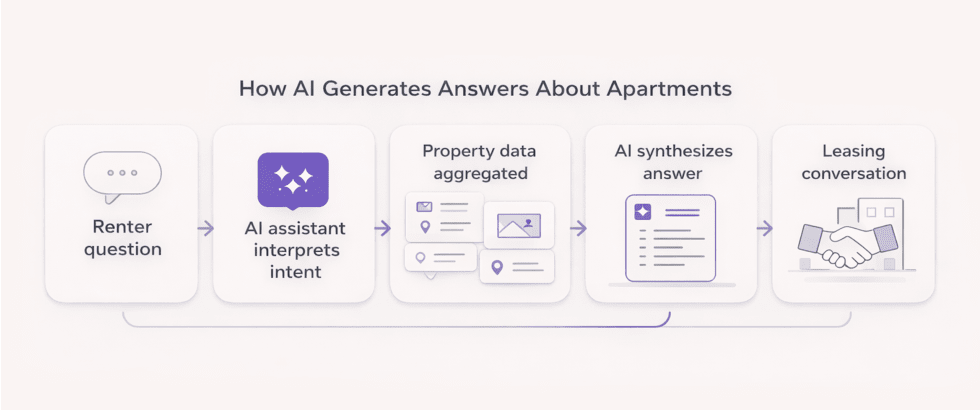
By the time a leasing conversation starts, expectations are already formed. Whether those expectations are accurate depends on AEO.
What is Answer Engine Optimization (AEO) for Multifamily?
Answer Engine Optimization (AEO) in multifamily marketing means ensuring your property information is structured, consistent, and trustworthy across every platform where AI systems can find it, so when a renter asks about your pet policy or move-in costs, the answer they get is correct.
How SEO Differs from AEO
| SEO | AEO | |
|---|---|---|
| Goal | Drive clicks to a website | Ensure accurate AI-generated answers |
| Success looks like | Your property ranks #1 for a search | Your property info is correct in the answer, even if not clicked |
| Failure looks like | Renter doesn't find listing | Renter finds your listing but gets wrong info about pet policy |
SEO focuses on driving clicks to a website. A property might rank #1 for "luxury apartments in Austin" and still lose the deal if an AI summary gets the pet policy wrong.
SEO determines which page a renter clicks. AEO determines what answer they see before they ever click.
Why Better-Informed Renters Are Actually Creating More Friction
Better-informed renters should move faster through the leasing process. The data says otherwise (Apartment List Rent Report):
- National vacancy: 7.3% — record high
- List-to-lease timeline: 41 days — longest since 2019
- Year-over-year rent growth: -1.4% — negative for over two years
Even with more information and more choice, renters are taking longer to convert. They arrive with expectations already formed about pricing, fees, policies, and timelines. When those expectations don't match reality, leasing conversations shift into correction mode instead of moving forward.
Small inconsistencies compound fast. A pet policy described differently across platforms triggers back-and-forth. An outdated fee structure derails a tour conversation. A vague approval timeline erodes trust before a lease is signed. None of this shows up as a search problem in your metrics, but it slows deals and increases cognitive load on leasing staff.
In a softer market, every lost day costs you. AEO is an operational efficiency play.
What Happens When AEO Goes Wrong in Multifamily?
When information is inconsistent or poorly structured, AI systems tend to simplify, generalize, or ignore it entirely. In housing, where pricing, policies, and availability change frequently and decisions are governed by standards like Fair Housing compliance, those inaccuracies carry real operational consequences for leasing teams.
The operational impact:
- Increased clarification work: Your leasing team spends more time explaining exceptions and resetting expectations because renters arrived with incorrect information from AI summaries.
- Slower tours: Renters who've encountered conflicting information online often arrive skeptical or confused, making conversations longer and less productive.
- Lower confidence: Renters trust properties less when information feels scattered or contradictory. That skepticism carries straight into pricing conversations and lease signatures.
All of this stems from a root cause: renters are increasingly relying on AI‑generated answers as the “first draft” of your property’s story, and your team has to clean up any inaccuracies downstream.
In a softer market, every clarification conversation is a day you're not closing. That's the operational case for AEO.
The Four Pillars of AEO for Multifamily Leasing
While AEO strategies vary by industry, in multifamily leasing they typically come down to four operational fundamentals.
1. Consistency Across Platforms
Because AI answers synthesize information from multiple sources, inconsistencies across platforms surface quickly. This includes your website, major listing platforms, your business profile, and any other properties data sources where your information appears.
- Best practice: Spot-check quarterly. When a fee changes, update everywhere, not just your site.
- Why it matters: When an AI engine pulls your pet policy from one source but your approval timeline from another, renters see conflicting answers before they even reach out.
2. Clear Structure for Summarization
State policies in plain language. Be specific. No hedging. The clearer and more structured your information, the more accurately AI systems can summarize it.
- Good example: "Dogs and cats allowed, $500 deposit per pet, maximum 2 pets per unit"
- Vague example: "Pets considered on a case-by-case basis"
- Why it matters: Vague policies get oversimplified or ignored when AI tools try to turn them into short answers, which means your property disappears from the answer even if your listing technically exists.
3. Authority Signals
Keep information current and clearly signal when it was last updated. Most search engines and AI systems favor information that appears current and clearly maintained.
- Approval timelines: Be specific ("3–5 business days," not "varies")
- Fee changes: Update everywhere immediately
- Track staleness: Signal when information was last refreshed
Outdated policies tank your credibility and drop you lower in AI-generated answers.
4. Coverage of Real Questions
Answer the questions renters actually ask. Some of these questions are transactional (fees, policies, approval timelines). Increasingly, others are qualitative: questions about lifestyle fit, commute convenience, or specific pet breed policies that AI systems are now expected to interpret.
These are exactly the kinds of questions renters now ask AI assistants directly.
- What are total move-in costs?
- What's the parking policy?
- How long does approval take?
- How long is the lease term?
- Which fees are negotiable?
- What utilities are included?
Why Multifamily AEO Requires Cross-Team Coordination
What's the Real Challenge with AEO?
AEO isn't something the marketing team can own alone. Maintaining information integrity for AI discovery requires coordination across leasing, operations, accounting, and the systems that distribute property data.
Your leasing team knows policies. Your accounting team knows fees. Your IT team manages what gets pushed to listing platforms. They aren't always aligned.
Here's what typically happens: A fee changes. Your website gets updated in 2 weeks. Major listing platforms update in a month. Your property profile still shows the old fee for 6 weeks. Meanwhile, renters are seeing three different answers to the same question.
The Solution?
Treat AEO as an operational process. Establish a clear workflow:
- Ops team notifies affected departments
- Simultaneous updates across all platforms
- Quarterly audits to catch drift
- Assign clear ownership (someone owns consistency)
The cost of inconsistency is far higher than the cost of getting it right.
How to Implement AEO: Three Concrete Steps for Multifamily Teams
These three steps are your foundation. They'll address the most common AEO gaps, though a full strategy may require deeper audits and refinement based on your portfolio size and complexity.
Step 1: Audit Your Information
Compare your information across every platform where renters encounter it: your website, listing platforms, business profiles, and any other data sources. Document the inconsistencies in policies, fees, and timelines.
Step 2: Pick Your Three Most Critical Details
Focus on three details: pet policy, parking, and approval timeline. Make sure these are stated consistently and clearly everywhere.
Step 3: Establish a Quarterly Review Cadence
When policies or fees change, update consistently across all platforms immediately. Make it someone's job. Make it a process.
Beyond AEO: From Information Accuracy to Leasing Performance
Keeping your information accurate is the foundation, but accuracy alone doesn't close leases.
The multifamily operators pulling ahead have built efficiency across their entire leasing funnel. They're using smarter matching to route high-intent prospects instantly, AI-powered nurture to keep momentum flowing 24/7, and outcome-based economics to align incentives around what matters: closed leases.
Apartment List's Smart Platform brings these three elements together. The result: 30% higher lease conversions on average, with 57% of tours booked after-hours through intelligent automation.
AEO gets renters to your door with the right expectations. Whether they sign depends on what comes next: how fast you respond, how well you match, how consistently you follow up.
Get Started with Apartment List & Build Your Leasing Advantage
When you’re ready to layer in a full efficiency toolkit, Apartment List can help. We work with operators across portfolio sizes to turn interest into leases, consistently and without adding strain to onsite teams.
Ready to move forward? Get in touch with Apartment List to discuss how the Smart Platform can drive efficiency and ROI for your properties.
Share this Article