Qualified Apartment Leads: What the Definition Means for Multifamily Operators in 2026

Not every inquiry is a lead, and not every lead is qualified. The difference comes down to three things: how specifically a prospect has signaled intent, whether their move window (ideally inside 60 days) matches your availability, and whether they've responded and confirmed a tour. When all three align, you have someone worth directing to a human team member.
For many leasing teams over the better part of the last decade, a lead was understood as someone making contact, whether via call, email, or a guest card submission. Teams flagged them, worked on them, and carried them through the process.
That approach made sense when demand could absorb the inefficiency. When demand is high, a missed follow-up or poorly prioritized prospect doesn't necessarily cost occupancy, because there are always more inquiries coming behind it.
The buffer is gone. The national vacancy rate is at a record high and units are sitting longer. Conversion discipline is now a primary driver of performance. That starts with a sharper definition of what a qualified lead actually is, and a routing system capable of acting on it at volume.
What Operators Need to Know
- A qualified apartment lead clears three dimensions: Intent Signal (two or more specific behavioral signals before contact), Timing Alignment (move window of 30–60 days matching available inventory), and Conversion Readiness (response within 24 hours, confirmed tour, specific qualifying questions). All three must clear. Any single gap changes the routing.
- Most pipelines miscount. Of a typical 200-inquiry pipeline, roughly only 30–80 prospects are ready for human leasing attention right now. The rest belong in automated nurture until their classification changes.
- Misclassification has a direct cost. The national multifamily vacancy rate stands at 7.3% as of March 2026, and units are taking an average of 38 days to lease. Operators can no longer absorb the conversion losses that come from treating all inquiries as equivalent.
- AI leasing agents removed the capacity ceiling. Early-stage leads no longer get dropped, they get routed to automation, held warm, and re-evaluated as signals develop. The qualified pipeline expands, not contracts.
- Operators who classify more precisely widen their funnel without adding headcount. For example, Asset Living generated a 25x ROI across 300 properties. Essential Property Management achieved a 36% tour conversion rate and 3.3 days from lead to tour with one- and two-person site teams.
Why the Definition of Qualified Apartment Leads Matters Now
Precise classification is now possible at the volume that previously made it impractical. AI leasing agents can handle the majority of early-funnel activity: initial response, qualification questions, availability checks, tour scheduling, and follow-up sequences.
The capacity ceiling that once made aggressive filtering at the top necessary no longer applies. Operators can work the full pipeline with more precision, letting automation carry early-stage leads until their classification changes, while human attention concentrates on prospects who have cleared all three qualification dimensions.
Misclassification that was costless in a strong market now shows up directly in occupancy performance. The definition has to do real work.
What Makes an Apartment Lead Qualified? The 3 Criteria That Determine Conversion
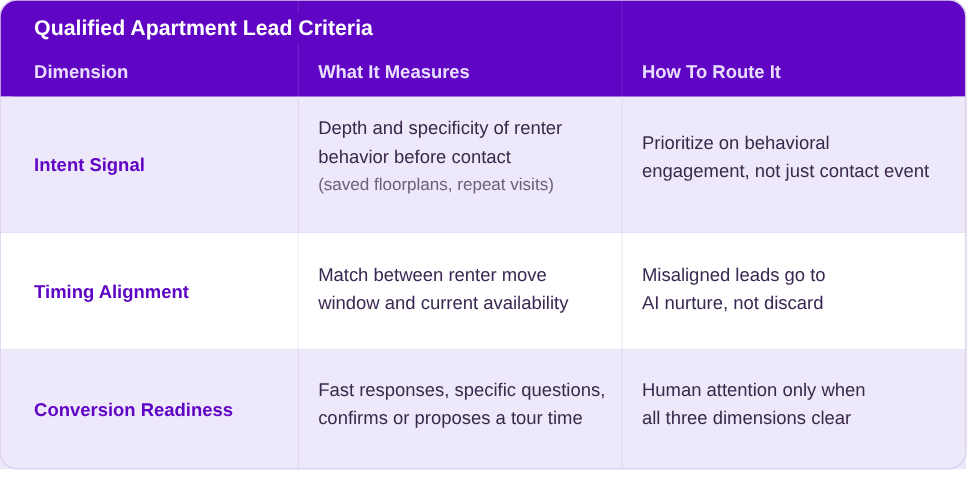 Together, the following three dimensions produce a definition that is operationally useful. Every lead gets classified. Classification then determines what happens next, not whether anything happens at all.
1. Intent Signal: How Renter Behavior Indicates Real Demand
Intent signal evaluates the depth and specificity of engagement, not the fact of contact. A renter who searches for two-bedrooms in a specific submarket, saves a floorplan, and returns to compare pricing has communicated something before submitting any form. Behavioral signals that precede the contact event carry as much information as the contact itself. High intent is measurable, not assumed.
2. Timing Alignment: When a Renter’s Move Window Actually Matches Availability
Timing alignment evaluates if there is a match between a renter's move window and the property’s availability. A renter planning a move in six months and a renter who needs a unit in three weeks generate identical contact events, but their 30-day conversion probability is not comparable.
Timing misalignment does not disqualify a lead, it correctly categorizes it. A six-month prospect belongs in a nurture sequence with automated re-engagement keyed to their stated timeline, inventory-match alerts when availability shifts, and a handoff to active pursuit when the window closes.
Correct categorization is not a demotion. Instead, it keeps a qualified prospect from going cold.
3. Conversion Readiness: How to Identify Prospects Likely to Lease
Conversion readiness evaluates a prospect's demonstrated willingness to complete the steps between inquiry and lease. For example, a prospect who does not confirm a tour after two follow-ups has communicated something and that signal is information, not failure.
Conversion readiness is visible in behavior such as response rate, confirmation behavior, the specificity of questions asked. A prospect who responds within the hour, asks about parking and pet policy, and proposes a specific tour time is showing you something a contact event alone never could. High conversion readiness is usually visible before a human ever gets involved. That's what makes it a routing signal, not a retrospective observation.
How Do You Classify Apartment Leads in a Leasing Pipeline?
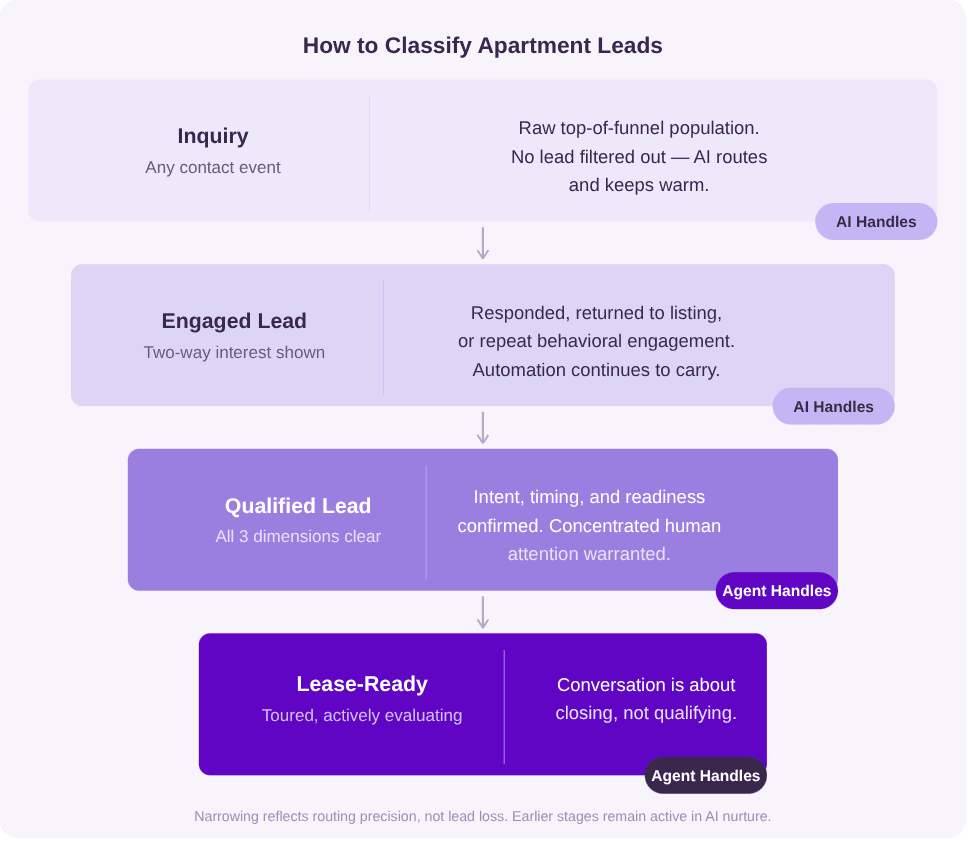 Every pipeline contains distinct groups. The exact terminology may vary by organization, but most leasing operations can be understood across four core phases. Don't think of these phases as a new funnel. Think of them as a map for how demand actually moves through your operation, and a reference point for calibrating your own internal standards.
Inquiry: What Counts as an Apartment Lead at the Top of the Funnel
An inquiry is any contact event, regardless of intent signal. This is the raw top-of-funnel population. Under an AI-enabled operation, this population does not get filtered out. It gets routed by AI, kept warm, and re-evaluated as signals develop. No lead gets abandoned.
Engaged Lead: When a Renter Shows Meaningful Follow-up Behavior
An engaged lead is one with two-way demonstrated interest. The prospect has responded to follow-up, returned to the listing, or shown repeat behavioral engagement consistent with rising intent. This population is meaningfully different from raw inquiries. Automation continues to carry them; the threshold for human involvement is rising but not yet cleared.
Qualified Lead: When Intent, Timing, and Readiness All Align
A qualified lead has cleared meaningful thresholds on all three dimensions: intent signal is specific and behavioral, timing alignment is confirmed, and conversion readiness is visible. Conversion probability is high enough to justify concentrated human attention. This is the population that should drive leasing agent activity and resource allocation decisions.
Lease-ready: When the Leasing Conversation Is Closing
A lead is considered lease-ready after having completed a tour, and is actively evaluating. The conversation is now about closing, not qualifying.
Why “Lease-Ready” Is a Much Smaller Group Than Your Pipeline Suggests
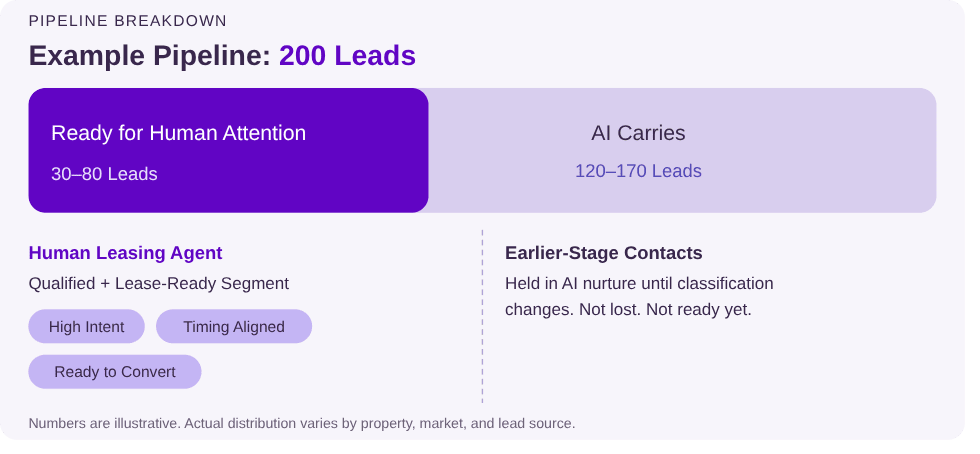
Most pipelines that appear to contain 200 inquiries have a larger population of earlier-stage contacts automation can carry. Somewhere between 30-80 of those prospects are actually ready for human attention right now. The remainder are earlier-stage contacts that automation can handle until their classification changes. Treating all 200 as equivalent is where human resource time gets diluted and where conversion metrics become misleading.
When a team operates against a four-phase structure like the one above instead of a raw inquiry count:
- The pipeline becomes easier to manage and more reflective of actual demand.
- Routing logic separates prospects by stage rather than by source.
- Follow-up sequencing aligns to demonstrated behavior across the three dimensions, not elapsed time.
- Human attention can concentrate where conversion probability is highest, while automation carries the rest.
What Happens When You Correctly Classify Apartment Leads?
Here's what precise classification looks like when operators run it.
Asset Living manages more than 450,000 units across 40-plus states. Over 12 months, the operator expanded from 180 to 300 properties and generated a 25x ROI in 2025.
Why it works: routing early-stage leads to automation while concentrating human resources on prospects who had cleared all three dimensions: intent confirmed, timing aligned, conversion readiness demonstrated. The result was a wider effective funnel, not a narrower one.
Essential Property Management operates 100 to 150-unit communities in Detroit with one- and two-person site teams. The operator achieved a 36% tour conversion rate, an average of 3.3 days from lead to tour, and a 30x-plus ROI, without adding headcount.
Why it works: classifying the leads they already had across intent, timing, and conversion readiness, then routing each population to the right resource. For a two-person team, the leverage is immediate. Automation handles the volume that would otherwise consume the day, and human attention lands where it actually moves applications.
Both operators widened their effective funnel by classifying more precisely. Neither need to generate “more” leads, instead they reclassified the demand they already had.
Why the Definition of a Qualified Apartment Lead Shapes Leasing Performance
When a qualified lead means something specific, the downstream decisions follow. Agent time goes where conversion probability is highest, and automated systems carry the volume that hasn't yet cleared all three dimensions. Metrics then reflect actual pipeline performance, not just top-of-funnel activity.
If the definition is wrong, the metrics are wrong. And if the metrics are wrong, the resource decisions will likely be wrong.
Apartment List’s A-List Nurture handles early-stage leads across every channel: voice, text, email, and chat. It keeps prospects warm, schedules tours, and follows up, so human attention concentrates on prospects who have cleared all qualification dimensions. More of the demand you already have, working harder.
For operators who want to see what a precisely classified pipeline looks like at portfolio scale, we'd like to show you.
Share this Article