$3,850
5201 Kinnabeck Lane, Columbus, OH 43220(380) 205-0733Rent Savings
- 4 units available
- 4 bed
- Amenities
In unit laundry, Patio / balcony, Pet friendly, 24hr maintenance, Garage, Stainless steel + more
Verified listing
Verified
Yes, rent is often negotiable, especially if you ask at the right time, bring the necessary data to the conversation, and give the landlord a reason to say yes.
Rent is rising. In April 2026 alone, the national median increased by around 0.5%.If you're staring down a lease renewal or hunting for a new place, you might be wondering, is rent negotiable?
The short answer? Yes. Rent prices aren’t set in stone—and learning how to negotiate apartment rent could make a real difference and keep your budget in check.
This guide breaks down everything you need to know, from when and how to bring it up to what to say (including a rent negotiation email template you can copy and paste).
It’s always possible, but not always easy. Success often depends on two factors: how competitive the local rental market is and how appealing you are as a tenant.
In a tight market with many applicants, negotiations may not get far. Landlords can simply go with someone willing to pay the full asking price. But if you have leverage, like strong renter credentials or favorable timing, you’ve got a real shot.
Because small savings can compound fast, and the worst answer you can get is “no.”
Even if a landlord doesn’t reduce the base rent, they might waive a fee, throw in parking, offer a longer price lock, or make an upgrade that saves you money in another way.
It’s important to get the timing right. January and February are typically the best months to find the lowest rents.
The same apartment might go for $1,000 in July and $850 in January. That’s a 15% difference, which could save you $1,800 over the course of a year.
Fannie Mae’s January 2025 National Housing Survey also found that consumers expected rental prices to rise 6.0% on average over the course of 2026, which is why it makes sense to negotiate before an increase becomes your new baseline.
There are two useful timing windows:
Winter usually has the lowest rents of the year, while summer tends to offer the most inventory but also the most competition.
The 30–60 day renewal window is a time when you can still compare other options, give proper notice if needed, and talk before the landlord starts planning for the next tenant. Some leases require 30–60 days’ notice to vacate, so starting there also keeps you from negotiating too late.
Even if you already believe you have a strong case for paying less, you still need to know how to negotiate apartment rent correctly.
If you’re shopping for a new place, November through February is usually the best window to do so. This is called the seasonality of renting, and it can be used to your advantage when negotiating.
If you’re renewing, start the conversation about 30 to 60 days before your lease ends. The point is to ask while the landlord still has time to make a deal.
You want to come to negotiations armed with as much information as possible about the rental market in your area.
Your rental application should convince your landlord or property manager that you are the best possible tenant for the unit.
You'll need to spend time gathering the necessary materials to ensure that your rental application stands out. Reference letters, a cosigner, sufficient income, and a high credit score are all factors that will boost your rental application and improve your chances when negotiating rent.
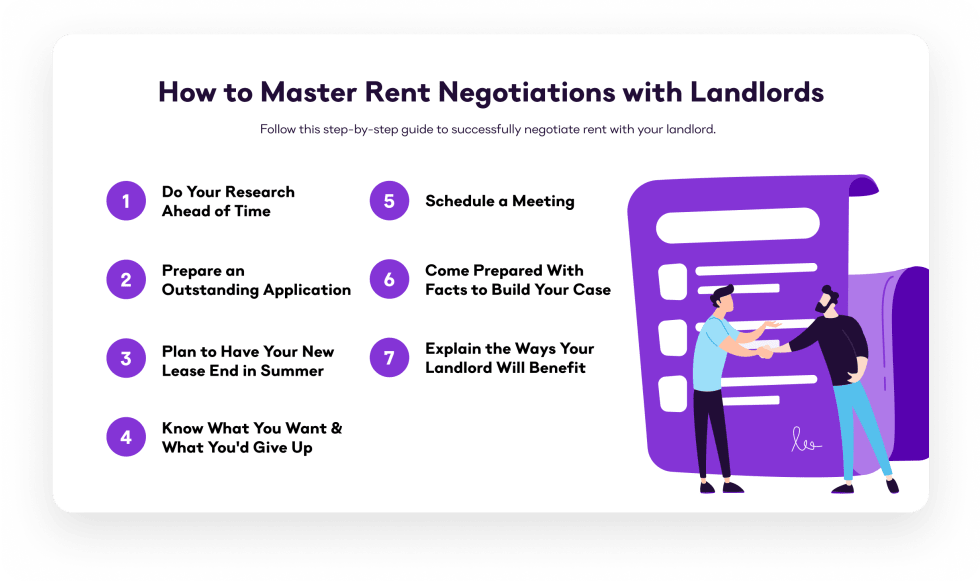
Your case should be built on facts about the rental market as well as proof of your outstanding history as a tenant.
Remember, a landlord operates their apartment like a business, and they’re more likely to respond well to data rather than emotion.
Negotiating apartment rent is a give-and-take process. You should be willing to offer something in exchange for a better rate.
Have a number in mind. A vague “Is there any flexibility?” is easy to brush off. A specific ask, on the other hand, such as $100 less per month or waived parking, gives the conversation a jumping-off point.
If they say no, that doesn’t necessarily mean the conversation is over. Sometimes the better result is a smaller discount or a longer price lock. If they go quiet, give them a week before following up.
| Offering | What to Do | Expected Impact |
|---|---|---|
| Longer lease | Offer 14–18 months instead of 12 | Better chance of a lower monthly rate |
| Fast move-in | Offer to start quickly on a vacant unit | Better shot at fee waivers or a small cut |
| Strong tenant history | Show on-time payments and low-maintenance history | More helpful at renewal than on a new lease |
| Comparable listings | Show nearby units priced lower | Strongest direct support for a lower rate |
| Prepaid rent | Offer a few months upfront if realistic | Sometimes helps with smaller private landlords |
| Taking a less-updated unit | Ask for an older unit at a lower price | A potential lower rate without a fight |
| Ask for perks instead of rent | Parking, storage, waived fees, upgrades | Often easier for a landlord to swallow than a rent reduction |
| Soft-season timing | Ask in November–February | Better leverage on both new leases and renewals |
Note that these expected impacts will change with the market.
Hi, I’m really interested in the unit, and I wanted to ask about the rent before I move forward. Based on similar units nearby, I was hoping to see whether you could do $X instead of $X, or something close to that. I’d be ready to move quickly if we can make the numbers work.
Dear [Landlord name],
I’m very interested in [unit/building], and I wanted to ask about the rent before moving forward. Based on comparable units nearby, I was hoping you’d consider $X per month instead of $X. I’d be ready to apply quickly, and I think that number is more in line with the current market for similar apartments in the area.
If that exact number doesn’t work, I’d still be open to discussing a smaller adjustment or other concessions that could help with the overall cost.
Thanks, [Your Name]
Hi, I’m really interested in the unit. Based on similar rentals nearby, I wanted to ask whether you’d consider $X instead of $X. I’d be ready to move forward quickly if we can get close on the price.
Thanks for getting back to me. I understand if $X is too low. If you can’t get there, would you consider meeting me in the middle at $X, or offsetting the difference with waived fees, parking, or a longer rate lock?
Be realistic with your expectations. A good working range is:
Even $50 per month can add up to $600 per year in savings.
Renewal talks are usually more about retention, while new-lease talks are more about speed and vacancy.
For renewals, your best arguments are:
If you are negotiating a renewal, this is where you can take advantage of the 30-60 day timeline.
Even if you present a well-researched and compelling offer, there's always a chance your landlord might say no. But don't be discouraged! A “no” isn't necessarily the end of the conversation.
If the landlord rejects your ask:
Make sure to document everything so you have a clear record of the conversation and avoid misunderstandings.
If you think your landlord's rejection is unreasonable, and you believe you have a very strong case for lowering your rent, then consider seeking advice from a tenants’ rights organization or a fair housing agency. They can offer guidance and support specific to your situation.
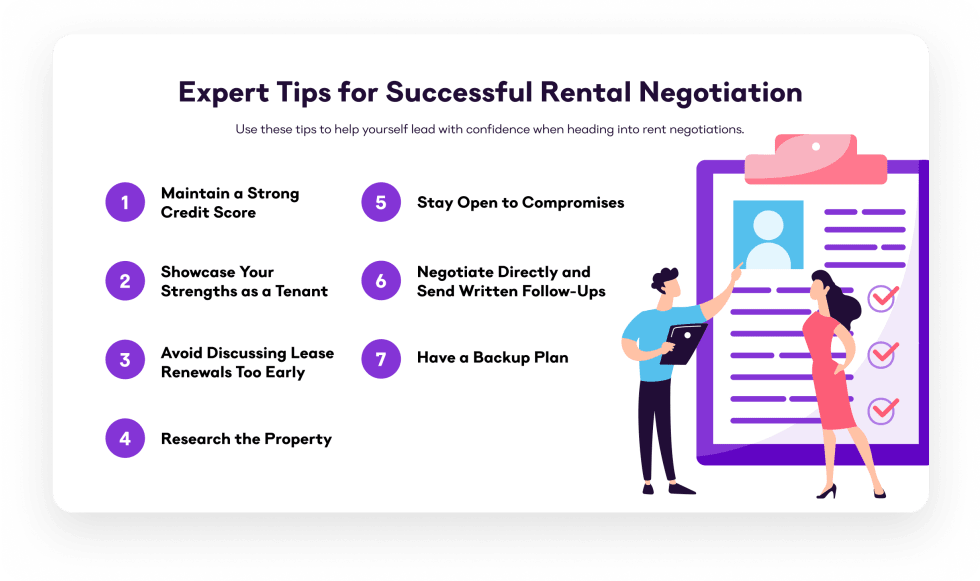
So, can you negotiate rent? Yes! But remember, your landlord or property manager is running a business, so it’s your responsibility to convince them to lower your rent. Make sure to outline ways your negotiation benefits your landlord to build confidence and clarity during your conversation about getting cheaper rent.
Ready to find the perfect place for you at the best possible price? Sign up with Apartment List now to find the right apartment for your budget.
Yes. In fact, this is often your best shot. Be polite, show market research, and be ready to walk if the price doesn’t align with your budget.
Sometimes. Larger companies tend to follow set pricing guidelines, but you can still ask for move-in specials, fee waivers, or lease flexibility.
The best windows are November through February for a new lease and 30–60 days before renewal for an existing one
3% to 8% off, depending on the market, is a pretty reasonable ask. Or you can go for a specific dollar amount, like $50 to $100 per month.
Ask whether there is any flexibility on fees, parking, upgrades, or lease length. You may still get something even if the rent stays fixed.
It’s unlikely, but if your circumstances drastically change, it never hurts to ask. You may be able to negotiate a lease break or sublet option.
No, but it helps a lot. Comparable listings and a strong tenant track record make your case much stronger.
Yes. Calling your landlord on the phone or meeting in person can be more persuasive, but email works well if you want a clear paper trail.
Yes, especially if the landlord is trying to fill a vacancy quickly. However, there may be less room for long-term savings.
No—if you’re experiencing hardship, market conditions change, or your landlord wants to retain you, it’s worth having the conversation early.
It varies widely, but successful negotiations often yield $50–$150/month in savings or one-time perks like free rent or waived fees.
Not if done respectfully. Many landlords appreciate honest, upfront communication and may see your initiative as a sign of responsibility.
Clues include long vacancy periods, repeated listings, or off-season timing. Privately owned units are often more flexible than corporate ones.
That depends. If a lower rent isn’t possible, perks like free utilities or flexible lease terms can still provide real value.
Potentially. If major maintenance problems arise or amenities aren’t as advertised, you may have leverage to ask for a rent adjustment.
They’re tougher, but not impossible—especially if you offer something in return, like a longer lease or early payment.
Try to negotiate a capped increase or longer lease to lock in your rate. Point to comps or offer incentives like early payment.
Yes, especially if you have a stable job or strong rental references. Offering a larger security deposit can also help.
Sometimes—but be aware they often work for landlords. If you’re using an agent, ask if they’re willing to negotiate on your behalf.


In unit laundry, Patio / balcony, Pet friendly, 24hr maintenance, Garage, Stainless steel + more
In unit laundry, Patio / balcony, Pet friendly, Stainless steel, Walk in closets, Gym + more