Learn how to spot rental scams and rental fraud before you lose money. Real red flags, verification steps, and how to report a fake listing.
What Is a Rental Scam?
A rental scam is when someone posing as a landlord or agent tries to collect money or personal information for a property they don't own, don't have the right to rent, or that doesn't exist.
Most scams don't look like scams. They look like a really good deal you won't want to miss. Maybe it's cheap rent, great photos, or a perfect location that makes you think, "I need to submit an application ASAP!" If an apartment seems too good to be true, it probably is.
A below-market listing lands especially hard right now. Apartment List research found that 22.2 million renter households, or 51.8% of all U.S. renter households, spend more than 30% of their income on rent. When rent already strains your budget, a listing priced well under everything else can feel like real relief. That can make a below-market listing especially tempting, and especially worth slowing down to verify.
This isn’t a rare problem. Since 2020, people have reported nearly 65,000 rental scams to the FTC, with about $65 million in losses, and most scams are never reported.
Many rental scams follow the same three-part play: an appealing offer, something you can't independently verify, and pressure to pay or share information fast. Recognizing that pattern can help you catch problems before you pay or share sensitive information.
What Are the Most Common Types of Rental Fraud?
Knowing the common patterns is the best way to avoid getting caught. Most rental fraud falls into four types:
- Phantom and hijacked listings: The unit doesn't exist, exists but isn't for rent, or is a real listing the scammer copied and re-posted with their own contact information. Some are ads for homes that are actually for sale.
- Upfront fee and deposit scams: A "landlord" collects an application fee, deposit, or first month's rent before you can confirm the unit or their authority to rent it. Sometimes the same unit is sold this way to several people at once.
- Application and identity-theft scams: The goal isn't your rent money. It's your Social Security number, bank details, and ID, collected through a fake application and used for fraud later. A related version pushes you to a "credit check" link that signs you up for recurring charges.
- Bait-and-switch and misrepresentation: You apply for one unit and get steered toward another, or the listing advertises amenities the unit doesn't have to get you to commit before you notice.
Red Flags to Watch For
No single item below proves fraud on its own. A low price, an out-of-state landlord, or an application fee can all show up in real listings. The warning sign is a cluster: several appearing together, verification that keeps failing, and pressure to act before you've confirmed anything.
1. It seems too good to be true. You're scrolling through listings when one apartment is way cheaper than everything else in the area, and somehow nicer too.
What's happening and what it means: An unusually low price is a classic lure. If a listing is wildly out of sync with rents around it, slow down and look for the other flags below.
2. Vague or incomplete listing details. Listings without photos exist, but they're uncommon. No address, no exterior photos, and one blurry interior shot is a reason to proceed carefully.
What's happening and what it means: Scammers keep details thin on purpose, because specifics are what let you fact-check. A real listing gives you a real address and photos you can cross-check against Google Street View or other sites.
3. Pressure for a large payment before you can verify anything. A modest application fee can come before a tour, and that alone isn't alarming.
What's happening and what it means: The stronger signal is pressure to send a deposit, holding fee, first month's rent, or another substantial payment before you can independently confirm the listing. Confirm who you're paying and their authority to rent before sending money. Someone rushing you to pay first and ask questions later is running the scam as designed.
4. Pressure toward hard-to-reverse payments. Everything's going fine until the "landlord" asks you to pay with cryptocurrency, gift cards, or a wire transfer.
What's happening and what it means: Gift cards, cryptocurrency, or an insisted-upon wire transfer are strong scam indicators, because those payments are difficult to reverse once they're sent. Payment method alone doesn't prove anyone is legitimate, though. Any payment is risky until you've independently verified who you're paying and their authority to rent.
5. They won't show you the unit. Or they'll show it, but only after you send money.
What's happening and what it means: Scammers lean on excuses: current tenants they don't want to disturb, renovations, being out of state, sometimes a sympathetic backstory. Some even set up a self-guided tour using a lockbox code copied from a real listing, to seem legitimate. The real goal is to get your money before you can confirm anything. Insist on confirming the unit and who controls it before you pay.
6. Manufactured urgency. "Lots of interest." "Need a deposit today." "This deal won't last."
What's happening and what it means: When a great opportunity feels like it could vanish, it's harder to slow down and think. Competitive units can move quickly. Urgency becomes a warning when someone pressures you to skip basic verification or pay before you can complete it.
How to Verify a Listing (Before You Pay Anything)
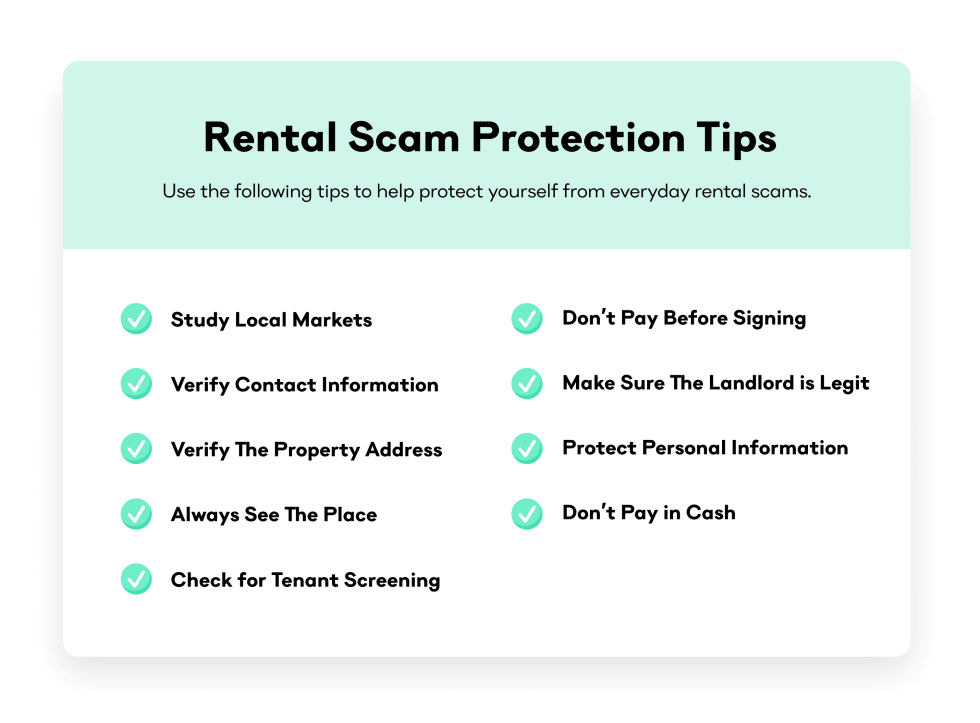
Verification answers two separate questions. First, is the property real and actually for rent? Second, is the person collecting your money or information authorized to rent it? A scam can pass the first test and fail the second, so check both.
- Search the exact address online. If the same property shows up with different prices, photos, availability, or contact details, that mismatch is a strong scam signal. If it's listed for sale rather than for rent, treat that as a serious warning.
- For a building or complex, contact the management company independently. Find their phone number or website on your own rather than using the listing's contact info, then confirm the unit, the price, and who's handling it.
- For a private rental, start with local property records. County or city records show the recorded owner. Confirm the person you're dealing with is that owner or can show a clear connection to them.
- Tour in person when you can. For a remote search, use a live video tour where they answer questions and show details on request, or send a trusted local to look. No tour format on its own proves someone has the authority to rent the unit, so pair it with the checks above.
- Get material terms in writing before you pay. Ask for the rent, deposit, fees, and lease details in writing, and request a copy of any lease you're asked to sign. Rules on leases, deposits, and application fees vary by state and locality, so confirm what applies where you're renting.
- Pay and share sensitive information only through a verified official process. Send money or documents only after you've independently confirmed the payment method and application are legitimate. Until you've agreed to rent a place, a landlord does not need your Social Security number, credit score, or other sensitive information. Most landlords normally pull credit themselves rather than telling you to retrieve or pay for a score.
- Report suspicious listings. If you spot one on Apartment List, report it to support@apartmentlist.com. Our team reviews flagged listings quickly to help keep the platform safe.
How to Report a Rental Scam
If you already paid or shared information
Act quickly, and treat money and personal information as two separate problems.
Money sent: Contact your bank, card issuer, payment app, wire service, or gift-card company immediately and ask whether the payment can be stopped, disputed, or recalled. Speed matters most with cards and bank transfers. There's no guarantee of recovery, but fast action gives you the best odds.
Personal information shared, like your Social Security number, bank details, or a photo of your ID: go to IdentityTheft.gov for a step-by-step recovery plan. You can also consider a free fraud alert or credit freeze, which can make it harder for someone to open new credit accounts in your name.
Either way: Save the listing, messages, screenshots, receipts, names, and contact details. That record is what investigators and your bank will work from.
Then report the scam. Reporting helps stop the same scammer from reaching someone else:
- File a report with the IC3.
- Report it to the FTC.
- Contact the listing website. They can remove the listing and often flag the account behind it.
- Contact local police and your state consumer protection agency so they have a record.
| IC3 (Internet Crime Complaint Center) | Serves as the FBI's central intake point for cyber-enabled crime complaints. Analysts review complaints and may forward them to law-enforcement or partner agencies; IC3 does not itself conduct investigations | ic3.gov |
| FTC (Federal Trade Commission) | Collects consumer fraud reports to identify patterns, support enforcement, and provide consumer guidance | reportfraud.ftc.gov |
| Listing website | Removes fraudulent listings and can suspend the account responsible | Use the site's "report listing" tool, or email support directly (Apartment List: support@apartmentlist.com) |
| Local police department | Can take a report and may investigate; the report may also support a payment dispute or identity-theft recovery process | File a report at your local precinct or non-emergency line |
| State consumer protection agency | Tracks complaint patterns and can pursue enforcement against repeat offenders | Find yours through usa.gov/state-consumer |
Federal agencies usually can't recover your money directly, but your report helps investigators spot patterns and shut down repeat scammers faster.
The Bottom Line on Rental Scams
Most scams run the same three-part play:
→ An appealing offer
→ Something you can't independently verify
→ Pressure to pay or share information fast
Scammers work by making renters feel rushed and a little embarrassed to ask too many questions. Getting caught by one doesn't mean you were careless. These listings are built to look real.
The right landlord welcomes your questions, and a legitimate listing holds up under a closer look. Take your time. A legitimate unit may be rented while you verify it, but that's safer than paying someone whose authority you cannot confirm.
Frequently Asked Questions
Is it illegal to scam a renter?
Yes. Rental scams involve fraud and, depending on the details, can violate federal laws like wire fraud statutes as well as state consumer protection laws. That's why reporting to the IC3 and FTC matters: it creates a record investigators can act on.
Can I get my money back after a rental scam?
It depends on how you paid. Credit card and bank payments can sometimes be disputed or reversed if you act quickly. Cash, wire transfers, cryptocurrency, and gift cards are often impossible to recover, which is exactly why scammers push for them.
What's the difference between rental scams and rental fraud?
They describe the same thing. "Rental scam" is the more common term, while "rental fraud" shows up more in legal contexts. Both refer to someone trying to collect money or information for a rental property under false pretenses.
How can I tell if a landlord is legitimate before signing anything?
Verify the property address, ask to see the unit in person or by live video, confirm ownership through public records or a building manager, and talk to current tenants if you can. If someone resists basic verification or pressures you to skip it, treat that as a warning.
What should I do if I already sent money or shared personal information?
Treat them separately. For money, contact your bank or payment provider immediately, then file with the IC3 and FTC. For personal information, start a recovery plan at IdentityTheft.gov and consider a fraud alert or credit freeze. Save everything either way, and act fast.