Garage apartments, coach houses, and garage suites are great for renters who don't want to fight for parking. Learn more about them and how to find one.
Updated October 2026. Originally published September 11, 2025.
The Short Version: When a Garage Pays Off, What It Costs, and How to Find One
- A garage is worth the extra cost if you drive most days, live with snow, ice, or hail, or need storage your apartment can't give you.
- Private garages at apartment communities typically cost $50 to $100 a month on top of rent, and covered spots run $25 to $75, based on Apartment List's amenity fee guidance as of October 2026.
- Attached garages are usually priced into rent, so compare the rent against a similar unit without one.
- Garages are scarce and go fast. Start your search two months out and filter for "garage."
Is an apartment with a garage worth the extra rent? If you drive most days, live somewhere with real winters or hail, or need storage your apartment can't give you, yes. If your car mostly sits and the building already has safe parking, it's a nice-to-have you can skip.
This guide covers when a garage earns its fee, what it costs, the six questions to ask before you pay for one, and how to actually find one in 2026 (start early, filter for "garage," and tour before you commit).
Is an Apartment With a Garage Worth It?
Is it important to have an apartment with a garage? It depends on how often you drive, what the weather does to your car, and whether you need the space. A garage is worth it when it solves a problem you deal with every day. If you commute by car, your city has real winters, or your car is worth protecting, the monthly fee usually buys back time, hassle, and repair bills. If your car mostly sits, or you live somewhere mild with decent parking, that money does more for you in the apartment itself.
A Garage Is Worth It If
- You drive most days. Circling the block for street parking twice a day is a tax on your time.
- Your city gets snow, ice, or hail. Scraping a windshield at 6 a.m. gets old fast, and hail damage is expensive even with insurance.
- You own a newer or high-value car, a motorcycle, or bikes that need a locked space.
- You need storage. Camping gear, holiday bins, a workbench: a garage holds what a closet can't.
- You get home after dark. Pulling into a lit, enclosed space beats a long walk from the lot.
Skip the Garage If
- You don't own a car, or you drive about once a week.
- Your climate is mild and the building already has covered or gated parking.
- The garage fee would push your rent past the 30% of income most renters budget around.
- The garage is detached and across the lot. You'd pay the premium without the convenience.
Garage vs. Covered Spot vs. Open Lot: What You Get and What You Pay
| Weather protection | Full: snow, hail, sun, wind | Roof only, open sides | None |
| Security | Enclosed, usually lockable | Open, sometimes gated | Open |
| Storage | Yes, if the lease allows it | No | No |
| Guaranteed spot | Yes | Usually assigned | Often first come, first served |
| Typical monthly cost | $50 to $100 as a separate fee; attached garages are usually priced into rent | $25 to $75 | Usually included |
Typical added monthly costs at U.S. apartment communities, from Apartment List's amenity fee guidance as of October 2026. Your building sets the actual fee, and prices run higher where parking is scarce. For the full rundown on carports and canopies, see What Is Covered Parking?
Before You Pay for a Garage, Ask These Six Questions
- Attached, detached, or shared structure? Attached means you walk straight into your unit. Detached means a walk across the lot. Shared means a gate code and a hunt for your assigned spot.
- Is it included in rent or a separate fee? If separate, ask whether the fee can rise at renewal.
- Can I use it for storage, bikes, or a workbench? Many leases and HOAs allow cars only.
- Does it have an outlet, and can I charge an EV? Ask who pays for the electricity.
- Is there a waitlist? Private garages often get claimed before units do.
- What does a locked garage do to my car insurance? Some insurers discount comprehensive coverage for garaged cars. Ask yours for the number before you decide.
What Are Garage Apartments?
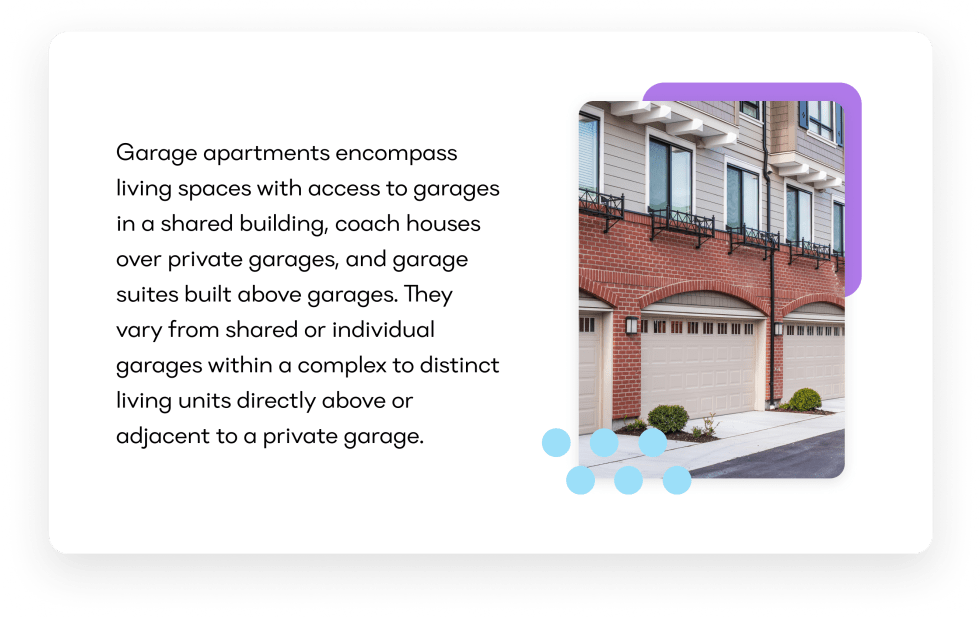
"Garage apartment" usually means one of three things:
- An apartment with a garage somewhere in the building or complex. That can be a large parking garage shared by residents, or individual garages that stand alone or in a row.
- An apartment or townhome built over a private, attached garage, also called a coach house.
- A living space built above a detached garage, also called a garage suite.
This guide focuses on the first two. Garage suites are usually rented by private landlords and vary too much to generalize, and most renters searching for a "garage apartment" want covered, private parking rather than a home above a garage.
Who Rents Garage Apartments?
Mostly people with cars who are done fighting for parking. A private garage or an assigned spot in a structure means no competing with neighbors, no street sweeping tickets, and no scraping ice.
Plenty of renters without a car want one too, because a private garage doubles as storage, a home gym, or a workshop (if the lease allows it). Either way, expect to pay more than you would for a comparable apartment without one.
A private garage at an apartment community typically adds $50 to $100 a month as a separate fee, and covered parking adds $25 to $75, based on Apartment List's amenity fee guidance as of October 2026. In most communities the garage is optional, so you pay only if you rent one.
Attached garages work differently. In coach houses and townhome-style rentals, the garage is built into the rent rather than billed separately. The simplest way to see what you're paying for it is to ask what a comparable unit without a garage rents for; the difference is your garage premium. Expect that premium to run higher in cities where parking is scarce and in newer buildings where garages are a selling point.
How Can You Find Apartments With Garages?
Apartments with garages are scarce and in demand, so landing one takes a plan. The steps below focus on private garages, since those are the hardest to find, but they work for buildings with parking decks too.
Which Type of Garage Should You Look For?
Decide what kind of garage you want before you start, because it changes where you look. If you only want a private garage, your options are:
- A coach house or townhouse-style layout where the garage is attached, usually right below the living space.
- An apartment complex where garages stand alone or in rows in the parking lot, separate from your unit or building.
If you want to walk from your car straight into your home, you want a townhouse. If you mostly want a place to stash your stuff, a garage a short walk from your door works fine. One warning: listings that advertise garages often leave them out of the photos if they're detached, so confirm on the tour.
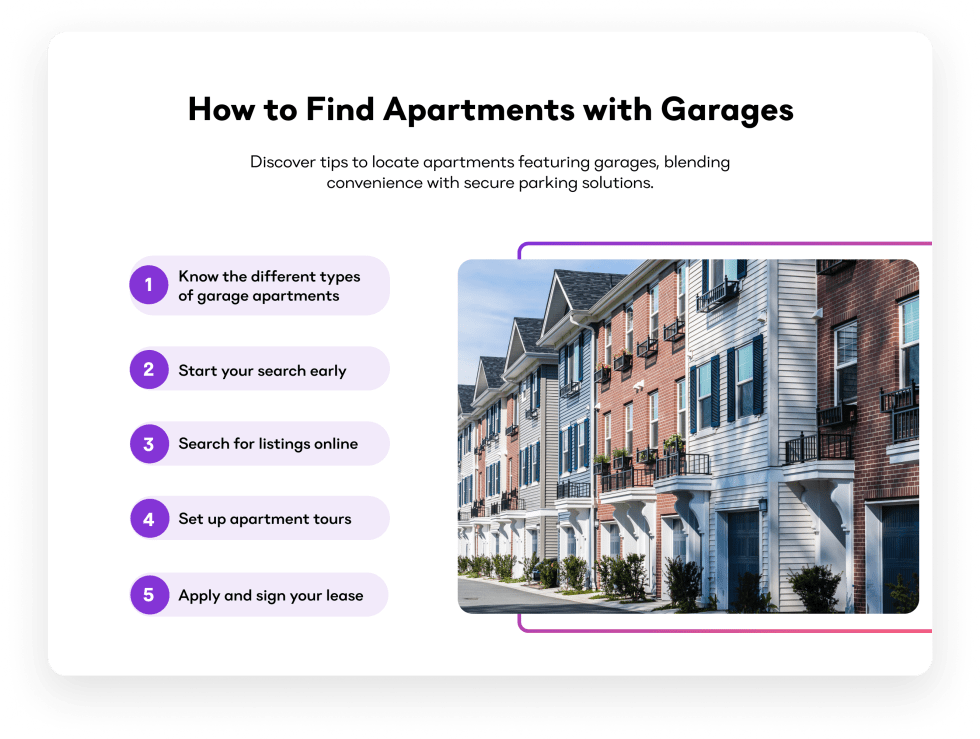
1. Start Your Search Early
Start looking at least two months before you'd like to move. Private garages are in high demand, and some communities keep waitlists for them. Starting your apartment hunt early gives you room to compare instead of settling.
Timing matters too. Thanks to the seasonality of the rental market, the best time to rent with the most availability is summer, before August. Land it right and you may catch a few move-in specials.
2. Search for Listings Online and Use Filters
Use a rental platform with real-time listings, like Apartment List, and filter for "garage" so you only see places that have one. Stack filters for price, location, and other amenities to narrow it down.
For a faster start, take the Apartment List quiz and select "garage" as a preferred amenity. You'll get a curated list of matches based on everything you told us.
3. Schedule Apartment Tours
If a listing you like mentions a garage, tour it as early as you can. Many listings leave the garage out of the photos, so the tour is where you find out what you're actually getting.
Bring the six questions from above, plus the usual questions to ask when renting an apartment. Since the garage will likely add to your rent, treat it like any other part of the unit: check the door, the lighting, the outlet, and the lock. While you're at it, look for the stuff that costs you later, like bed bugs or mold.
4. Apply and Sign Your Lease
Applying for an apartment with a garage works like any other application. Have your ID, proof of income, employment details, and rental history ready, and know that other documents may be required. Expect a background and credit check, so know your score before you apply, and give your rental references a heads-up.
If you're approved, you'll sign a lease, pay the associated fees, and put down a security deposit. Read the lease agreement closely before you sign, including anything about garage use, fees, and renewal, because you're bound to those terms for the full lease length.
What Are the Pros and Cons of Apartments With Garages?
A garage sounds great on paper. Here's the honest version of both sides.
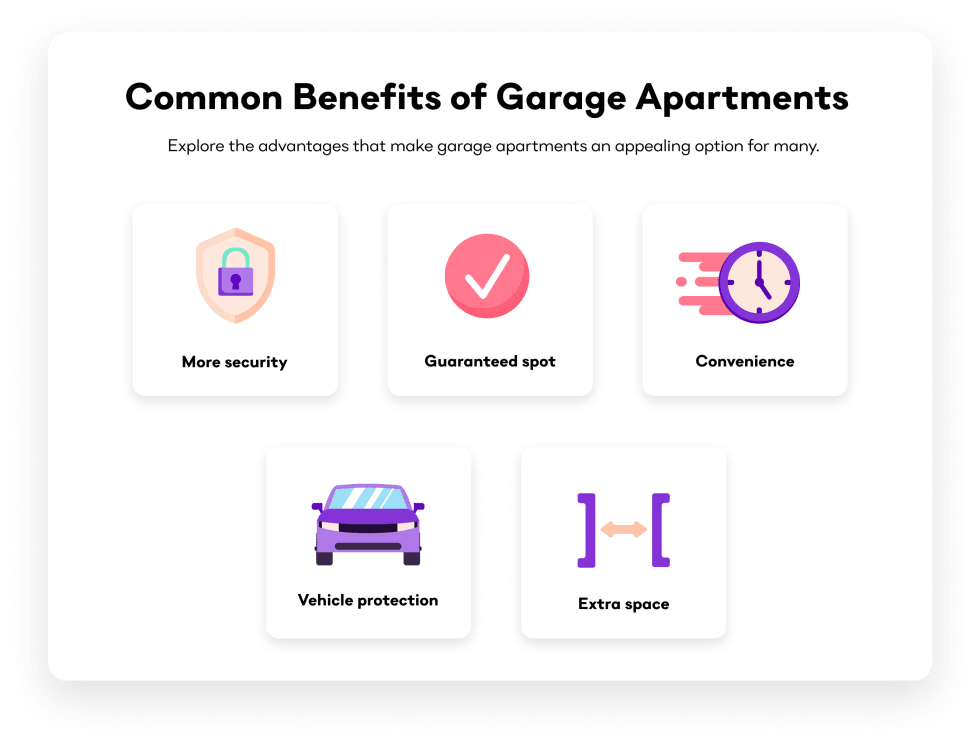
What Are the Pros of Apartments With Garages?
- More security: Break-ins and hit-and-runs are more common on the street. A locking garage takes your car out of the lineup.
- Guaranteed spot: No cruising the neighborhood after work hoping someone left. Your spot is always yours.
- Convenience: With an attached garage, your car is steps from your door. No slogging through rain, no trying to remember where you parked.
- Vehicle protection: No snow to brush off, no ice to scrape, no hail to worry about.
- Extra space: Home gym, bike storage, or the overflow from your closets. A garage is square footage you don't have to live in.
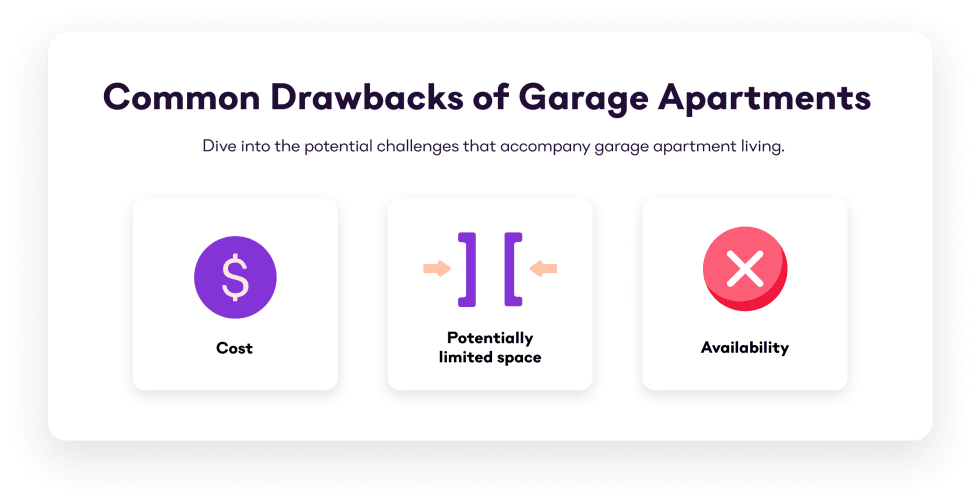
What Are the Cons of Apartments With Garages?
- Cost: Apartments with garages cost more than those without, and in cities where parking is scarce, you'll compete for them.
- Limited space: If you drive a large vehicle or your household has more than one car, a single garage may not cover you.
- Availability: Garages are far from standard. They show up most in newer buildings, which adds to the cost and the competition.
Ready to Find an Apartment With a Garage?
Only you can decide whether a garage is worth it. If you have a car and want secure parking every night, or you could use the extra space, go for it. If you don't, skip the fee and spend it on the apartment itself.
Either way, your search starts with your preferences. Use Apartment List to filter for "garage" under amenities, or take our quiz to get matched with places that fit everything you need.
Frequently Asked Questions About Garage Apartments
Is it important to have an apartment with a garage?
Only if your daily routine makes it important. Daily drivers in cold or hail-prone cities get the most out of one; occasional drivers in mild climates rarely miss it. Covered or assigned parking covers the middle ground at a lower price.
Garage or covered parking: which should you choose?
Pick covered parking if sun and light rain are your main worries and you'd rather spend less. Pick a garage if you need security, storage, or protection from snow and hail. What Is Covered Parking? has the full comparison.
Does a garage lower your car insurance?
It can. Some insurers discount comprehensive coverage when your car lives in a locked garage. The size of the discount depends on your insurer, your car, and your address, so ask before you sign.
Can you negotiate the garage fee?
Sometimes. The property sets the fee, and a community with unrented garages may reduce or waive it as a move-in special, especially in slower months. Ask before you sign, when you have the most room to bargain.
What is another name for a garage apartment?
Coach house is the most common. It's a historic term for a carriage house with living space above. You'll also hear garage suite, and for apartments built above a garage, granny flat or in-law suite.
What is a garage with living space above it called?
A finished living space above a garage is usually called a garage suite when the owner or their family uses it, and sometimes a garage apartment when the owner rents it out.
Do apartments come with a garage?
Some do, most don't. Never assume an apartment includes a garage unless the listing or amenities say so, and confirm whether it's included in rent or billed separately.
Do garages count as livable space?
No. A standard garage doesn't count as livable square footage, so a listing's square footage won't include it.