Not ready to commit to a 12-month lease? This guide covers how to find a short-term apartment rental that’s right for your lifestyle.
If you’re on the search for a short-term apartment rental, you’ve got options for lease lengths: month-to-month, three months, and six months. The perks of short-term rentals come down to convenience, comfort, and variety. If you’re in the middle of relocating or not sure how long you want to stay, you don’t need to lock yourself into a 12-month lease. But if you need more stability, a short-term rental may not be the best fit.
In this guide, we’ll explain everything you need to know about short-term apartments, including the pros and cons of short-term apartment rentals and how to find short-term rentals near you.
A Guide To Short-Term Apartment Rentals
What Are Short-Term Rentals?
A short-term rental is any apartment with a lease that's shorter than the typical 12 months. Apartments that offer traditional 12-month leases may also offer short-term lease options, so it’s always worth asking your prospective landlord about lease length.
Generally, short-term rentals are intended as a stop-gap for renters who prefer flexibility over long-term commitment.
How Long Is A Short-Term Lease?
Common lease lengths for short-term rentals are one, three, and six months. Month-to-month and even week-to-week rentals also exist, though they’re harder to find and often come at a premium cost.
The takeaway: the shorter the lease, the more flexibility you’ll get—and the more you’ll likely pay for it.
What Are The Pros And Cons Of Short-Term Rentals?
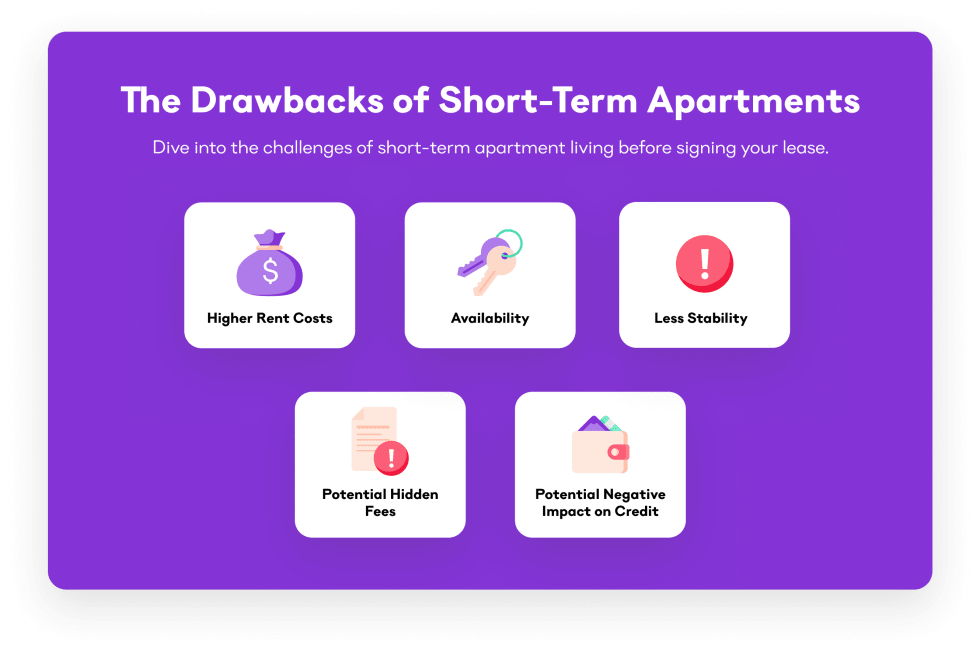
Short-term rentals definitely have their perks: more convenience, flexibility, and the opportunity to live somewhere new without the long-term commitment. The cons? They tend to be more expensive, harder to find, and could even hurt your credit score.
However, it’s important to have a full picture of both pros and cons, and what a short-term lease can offer before you make a final decision.
What Are The Advantages Of Short-Term Apartment Rentals?
The pros of short-term rentals include added flexibility, the chance to explore a new area, and the option to rent a fully furnished apartment.
Added flexibility: Short-term leases free you from the commitment of a year-long lease, allowing you to move after a few months without incurring extra fees.
Explore before you commit:Moving to a new state? A short-term rental lets you get to know the area, attend in-person job interviews, and figure out where you actually want to live before locking in a 12-month lease.
Furnished Apartments: Short-term apartments often come furnished—a huge plus if you don’t want to haul furniture cross-country, or don’t own any furniture yet.
The pros of short-term rentals can outweigh the cons for many people because of the added flexibility and overall ease that comes with these types of apartments. However, there are important cons to consider before making a final decision.
What Are The Disadvantages Of Short-Term Apartment Rentals?
The disadvantages of short-term rentals include cost, rarity, and the fact that they're so temporary.
More expensive: Short-term rentals will almost always come at a premium compared to a 12-month lease. This is because landlords have to offset the loss of 12 full months of rent and the time it takes to find another renter when you end your lease.
Harder to find: Short-term leases are hard to find because they aren’t as lucrative as long-term rentals and generally cause landlords more hassle. Give yourself extra time to find a short-term rental before making your move.
Moving more often: More moves mean more moving costs, more stress, and more time spent searching for another new place.
Credit score impact: If you rent multiple short-term rentals in a short period, each hard pull on your credit can negatively impact your credit score.
The cons of short-term rentals make them less appealing to renters looking for stability and lower monthly rent. But if you have the time to search and the budget to support your move, this could be a great option for you.
Before making your final decision, we recommend you weigh the pros and cons between short- and long-term leases, too:
Factor
Short-Term Lease
Long-Term Lease (12+ Months)
Monthly rent
Higher (10-30% above typical 12-month lease)
Lower and more predictable
Flexibility
High; move when your lease ends
Low; lease-break fees apply
Availability
Limited
More widely available
Furnished options
Common
Rare
Credit impact
More frequent hard pulls if you move often
One hard pull, longer stability
Stability
Lower
Higher
What Are The Legal Requirements For Short-Term Apartment Rentals?
Short-term apartment rentals have the same legal requirements as any apartments, except that your lease will be less than twelve months or on a month-to-month basis. You may also be expected to pay a higher rate. Finally, it may be easier to find no credit-check apartments available for short-term leases, meaning that the landlord may waive a standard credit check.
How Do I Find Short-Term Rentals Near Me?
Short-term apartment rentals carry the same legal requirements as any lease, just with a shorter term and, often, a higher rate. You’ll need a credit check (bill payment history, debt levels, or financial red flags), proof of income (pay stubs and/or W-2), personal or professional references, a letter of recommendation from a previous landlord, a rental application, and a government-issued ID.
In New York City, for example, any rental under 30 days has a special designation and requires landlord registration with the Office of Special Enforcement. Rules vary by city, so check local regulations before signing.
Some landlords may waive the standard credit check for short-term leases, but don’t count on it. Come prepared with your documents either way. If you’re worried about hard pulls on your credit report, it could be worth looking for a no credit-check apartment available for a short-term lease.
How Do I Find Short-Term Rentals Near Me?
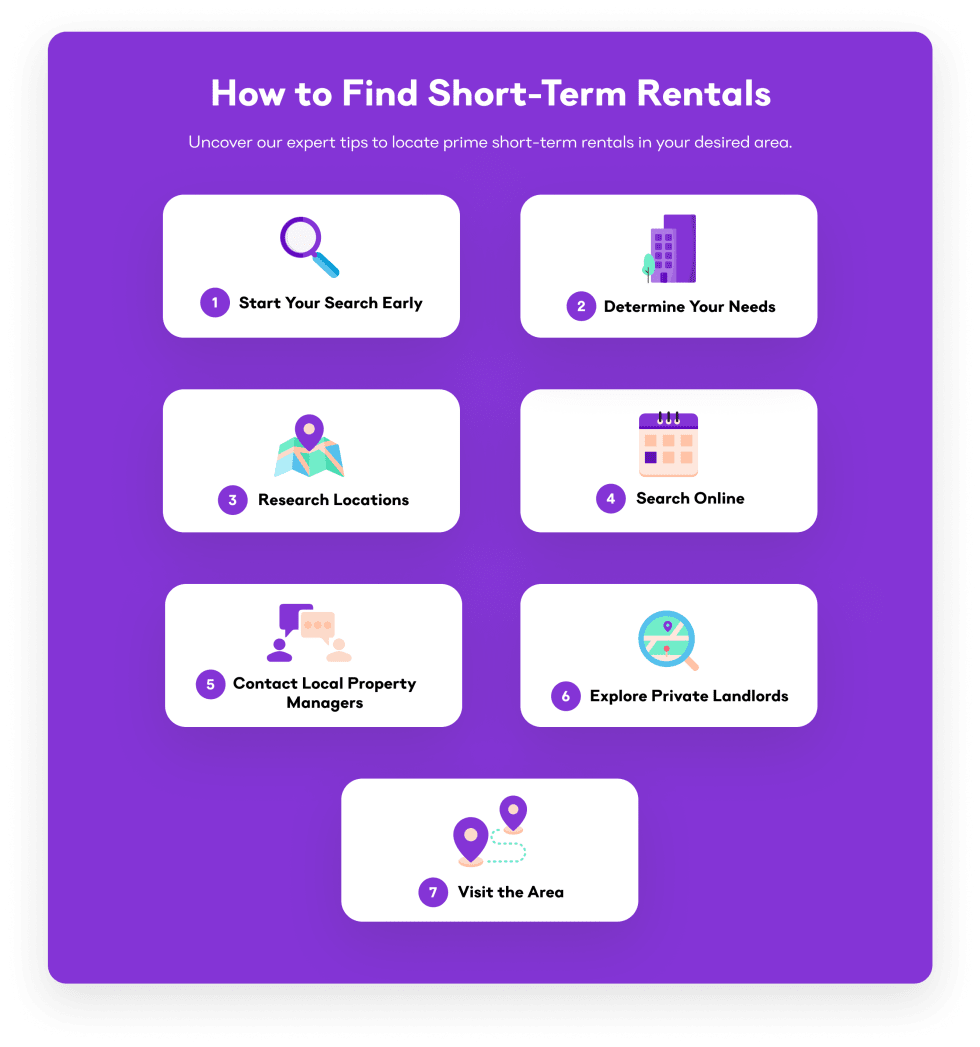
You can find a short-term apartment rental right here on Apartment List. Heads up: it’ll take a little more legwork than your typical apartment search, so we’ve broken down the exact steps to make it easier to find a short-term rental:
Ask specifically: “Do you offer leases shorter than 12 months, and is there a premium?”
If an apartment complex doesn’t advertise short-term leases, ask anyway
Step 4: Negotiate
Ask if the short-term premium decreases with a longer, short-term commitment (for example, six months instead of three)
Ask about waived application fees if you’re signing quickly, and what the renewal process looks like if you want to extend
Step 5: Know What To Expect at Signing
Get the exact lease length and end date in writing
Ask about the notice period required before move-out (typically 30-60 days)
Clarify whether the security deposit terms differ from a standard lease
If you already have a specific place in mind, reach out to the leasing office directly and ask if they have any short-term leases available. It never hurts to ask.
How Do I Find Short-Term Rentals That Allow Pets?
If you’re searching for a short-term rental on Apartment List, filter your search for pet-friendly places that accept dogs or cats. Before you contact the leasing office, it helps to have a few things ready.
Ask about pet rules: Breed restrictions, weight restrictions, number of pets allowed, and whether they have on-site pet areas are worth asking about upfront.
Have your pet's documents ready: Some landlords and property managers may want to see vaccination records, or ESA or service animal documentation, if your pet is a service animal.
Budget for pet-related costs: Be prepared to pay a pet deposit (refundable), pet fee (non-refundable), and monthly pet rent, which can range from $25-$75 per month, per pet.
Again, you can customize your preferences for a pet-friendly place at any time in your renter profile.
Find A Short-Term Rental That’s Perfect For You
A short-term apartment rental can offer the flexible living situation that you’re looking for. Remember: go in with a budget that can handle the premiums, give yourself time to search, and come prepared to make a strong case to your future landlord.
You can stay in a short-term rental for the length of your lease, whether it’s one, three, or six months. However, if you decide to stay longer, it’s possible to renew your short-term lease the same way you would with a traditional 12-month lease, but always check with your landlord first.
Month-to-month leases automatically renew each month until you or your landlord gives notice.
Is a three-month lease considered short-term?
Yes. Any lease less than 12 months is considered short-term. Three months is one of the most common short-term lease lengths, as well as one, six, and nine months.
Can I negotiate a short-term lease?
Yes. If your lifestyle fits better with a short-term rental, it’s worth asking about. You could also ask if a longer short-term commitment (say, six months instead of three) lowers your monthly premium. Some landlords will also negotiate on fees if you’re signing quickly or have strong rental history.
What should I expect if I need to move out of my apartment early?
You’re responsible for rent through the end of your lease term. Early termination fees typically run one to two months’ rent. Platform-based rentals (like Airbnb or VRBO) have their own refund and cancellation policies, which vary by host. Always read the fine print before signing.
How does a short-term lease affect my credit?
Every time you apply for a new apartment, most landlords run a hard credit pull, which can temporarily lower your credit score by a few points. Applying to multiple short-term rentals in a short amount of time can compound this, so space out your applications when possible, and consider getting a copy of your own credit report to share instead.
Do short-term rentals usually include utilities?
It depends. Furnished short-term rentals are more likely to include utilities like electricity, internet, and sometimes even streaming services. Unfurnished short-term rentals typically don’t.
How do I get a refund for a short-term apartment rental?
It’s usually not possible to get a refund for a short-term rental, unless you use a platform like VRBO or Airbnb. However, if your apartment was uninhabitable due to damages or unsafe conditions, you may have legal grounds to pursue compensation.
What is a short-term rental in New York City?
In New York City, a short-term rental is a special designation for lease agreements under 30 days. Landlords renting to tenants on platforms like VRBO or Airbnb for periods shorter than 30 days are required to register with the Office of Special Enforcement.
Dr. Katherine Blake is a content editor with Apartment List, where she helps ensure our renter and rental management content is fresh and informed by the latest data. Read More
Tristian Brown is a Senior Content Marketing Associate at Apartment List, where he manages high-quality content that helps modern renters find the perfect home. He brings an immense wealth of knowledge to the team, having earned a Bachelor of Arts in Marketing and European Management from the University of San Diego and EM Strasbourg Business School. Read More
Nathalia is a Freelance Brand & Marketing Copywriter at Apartment List, where she develops brand-aligned messaging across multiple channels to help guide renters to their perfect home. With a diverse background spanning real estate, CPG, tech and more, she blends creative and strategy to craft distinct moments of connection between brands and audiences. Read More