Struggling to find an apartment in your budget? Use these smart, renter-first tips to narrow your search, save money, and land a place that fits your needs.
Updated October 21, 2026
The most reliable ways to find an apartment in your budget are to set a rent ceiling first, search outside the priciest neighborhoods, and time your search for the slower months of the year. Apartment List Research (published July 9, 2025) found that November and December are generally the cheapest months to rent, although seasonal trends vary by market. The thirteen tips below cover roommates, rent specials, older buildings, and landlords who list directly.
Key Takeaways
- Set a rent ceiling: Spending around 30% of your gross monthly income on housing is a standard starting point. Use the Apartment List Rent Calculator to estimate what fits your budget.
- Focus on the biggest savings opportunities: Neighborhood, moving dates, and whether you share your home with roommates can all affect your housing costs.
- Compare the full cost: Rent is only part of your housing budget. Account for utilities, parking, move-in fees, and recurring amenity charges before signing a lease.
- Stay flexible, but protect your priorities: Adjusting your location or must-have amenities can expand your options without forcing you to compromise on essentials.
How Much Should You Budget for Rent?
A common starting point is to spend no more than 30% of your gross monthly income (your income before taxes and other deductions) on housing. The U.S. Department of Housing and Urban Development (HUD) considers households spending more than 30% of their income on housing costs to be cost-burdened. Your ideal budget also depends on debt payments, savings goals, and transportation costs. Be sure to subtract utilities and other housing charges to find your individual rent ceiling.
| $3,000 | $900 |
| $4,000 | $1,200 |
| $5,000 | $1,500 |
| $6,000 | $1,800 |
Read our guide to how much you should spend on rent for a closer look at the 30% rule. Utilities, parking, renter's insurance, and other fees can push your total housing costs above the listed rent, so see our guides to the hidden costs of renting and estimating apartment utility costs.
How Do You Search for Budget-Friendly Apartments?
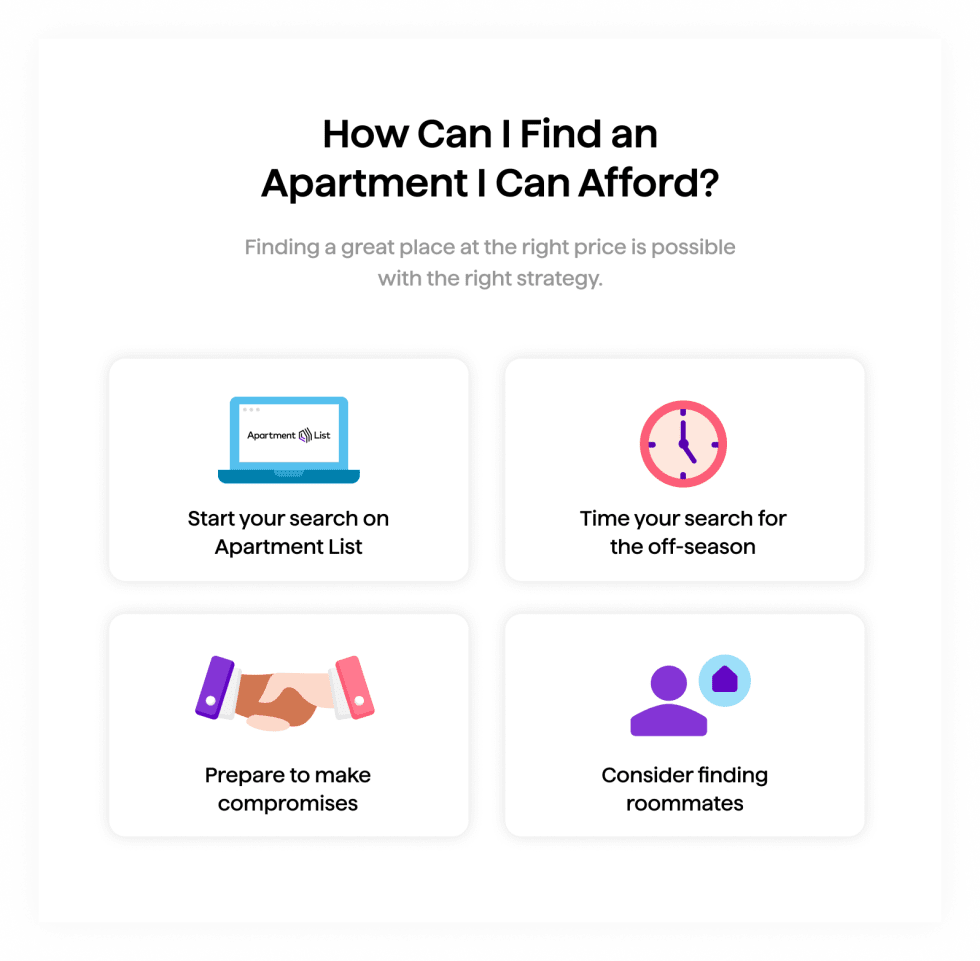
1. Start Your Search on Apartment List
Apartment List uses a personalized quiz to match you with rentals that actually fit your needs, including your budget, preferred location, commute time, and must-have amenities. Once you complete the quiz, you'll get a curated list of options ranked by how well they match your preferences. You can also track your favorite listings, get notified when prices change, and compare apartments side by side.
2. Time Your Search for the Off-Season
According to Apartment List Research, rents are generally lowest in November and December, with the national median rent falling about 1.6% from its summer peak to its November low. The amount you can save depends on your location, and seasonal patterns aren't identical in every market.
That drop in demand gives you more leverage. Landlords are often more flexible on rent, move-in dates, and fees just to fill vacancies. You may also find incentives such as a free month of rent or waived fees, but these offers aren't guaranteed, so compare the full lease terms. Summer is typically a busier time to move, which means more competition for available apartments.
Our guide to when to start your apartment search can help you build a timeline. If you need to move on a tighter schedule, read how to find an apartment fast.
3. Prepare to Make Compromises
Unless you have an unlimited budget, finding the perfect apartment usually means making a few compromises. The key is knowing where you're flexible and where you're not. Would you trade in-unit laundry for a lower monthly rent? Could you live a bit farther from downtown if it means more space or utilities included?
List the things you can't live without versus your nice-to-haves, then prioritize what will have the biggest impact on your budget. Small trade-offs, like choosing an older building with fewer amenities or a walk-up instead of a building with an elevator, can sometimes help you find a more affordable option. Compromising doesn't mean settling. It means focusing on what matters most to your day-to-day life while still finding a place that won't stretch your finances too thin.
4. Consider Finding Roommates
Finding a roommate (or two) can help bring your rent within budget. Splitting rent, utilities, and internet can lower each person's share of housing expenses, and it can open up neighborhoods or buildings that might be too expensive to live in alone. Roommates aren't just for college students. Plenty of renters share spaces to keep costs manageable.
Before committing, talk through budgets, preferred neighborhoods, cleaning expectations, and daily routines. Make sure everyone understands how rent and utilities will be divided, whose name will appear on the lease, and what happens if someone needs to move out early. Our guide to finding a roommate can help you get started.
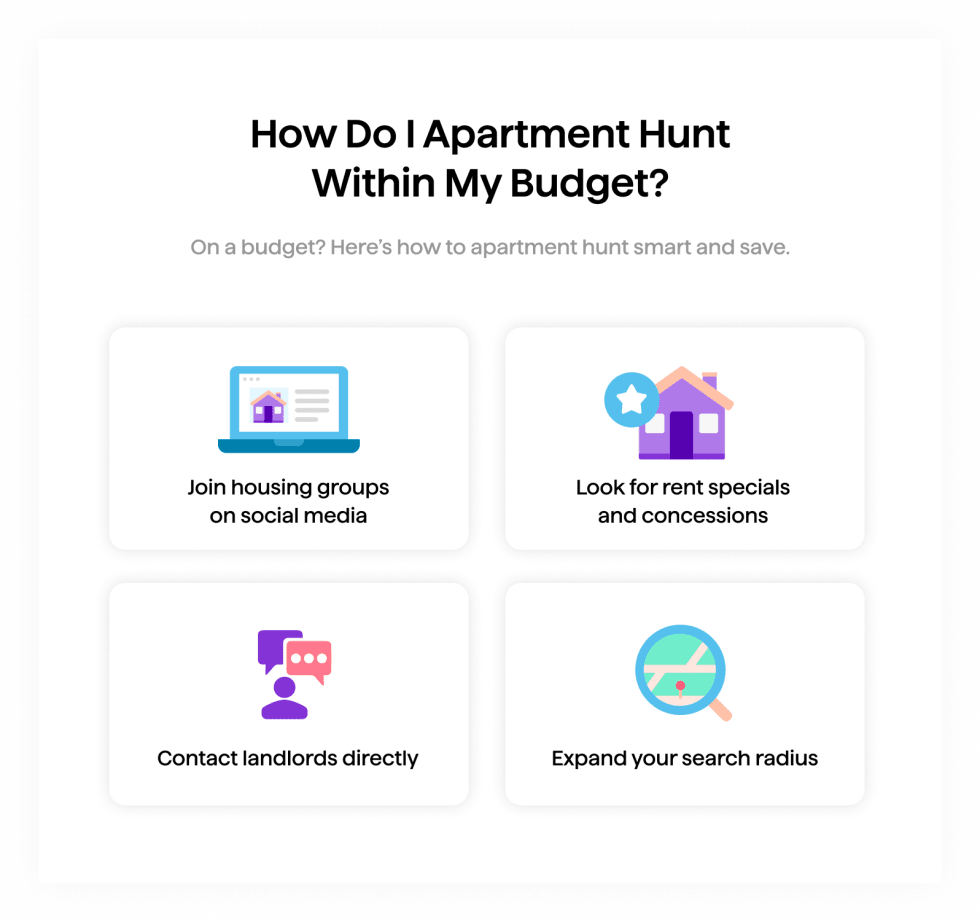
Rental opportunities sometimes appear in local housing groups before they show up on major listing sites. Facebook is one place to start. Search for groups focused on your city or neighborhood, such as local apartment-hunting or roommate groups, and review the listings that match your budget and move-in date.
Be cautious, though. A low rent or a landlord who wants to move quickly doesn't automatically mean you've found a good deal. Scammers may post fake listings, copy photos from legitimate rentals, or ask for money before you can verify the apartment. Never send a deposit or personal information before confirming the listing and the person offering it are legitimate. Read our guide on how to spot and avoid rental scams before responding to unfamiliar posters. If you want temporary housing, you can also explore short-term rentals.
6. Expand Your Search Radius
If you're only looking in the trendiest or most central neighborhoods, consider nearby areas that may offer different price points, more space, or a better fit for your budget. Look at areas outside your preferred neighborhood that are still accessible by public transit, bike, or car. A longer commute may be worthwhile if the savings and convenience balance out, so factor in transportation costs and travel time.
The goal isn't simply to find the lowest advertised rent. It's to find a place where the rent, commute, and day-to-day expenses work together.
7. Look for Rent Specials and Concessions
One of the best-kept secrets in apartment hunting? Rent specials and move-in concessions. Landlords sometimes offer deals like one month free, a reduced rent rate, or a waived fee to fill vacancies. These offers may be more common during slower rental periods, but availability varies.
A concession can lower your overall housing costs. For example, one month free on a 12-month lease works out to an 8.3% discount on the total rent over the lease term, assuming the other 11 months are charged at the advertised rate. When browsing, watch for phrases like "move-in special," "$0 deposit," "first month free," and "limited-time offer."
Read the fine print before signing. Find out when the concession applies, whether it changes the amount due at move-in, and whether the advertised rent reflects a temporary discount. For more ideas, see our guide to finding apartment move-in specials.
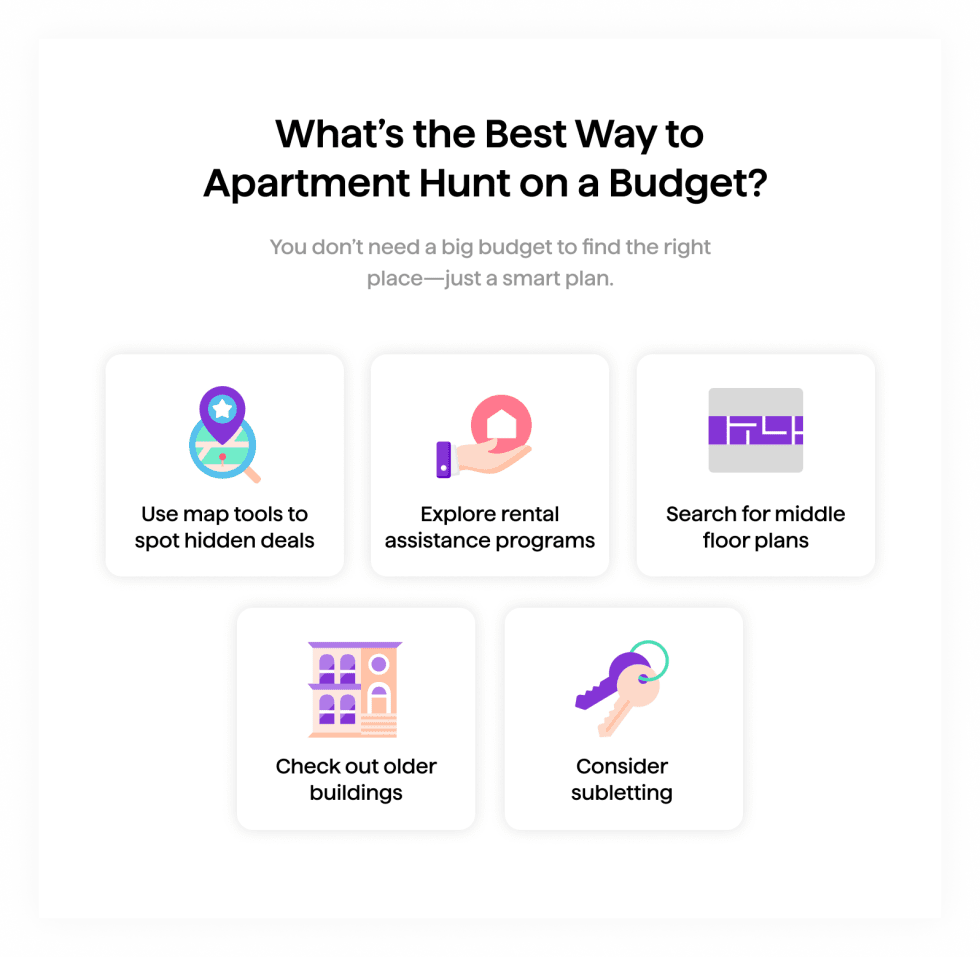
Map-based search tools can help you explore areas just outside the neighborhoods with the highest demand. Zoom out from your usual search area and look at neighborhoods along public transit routes or near major roads. Compare rents, commute times, and access to the places you visit regularly.
Once you find a promising neighborhood, look at individual listings and compare the total cost of living there, including transportation and utilities. Don't assume that moving a few blocks away will automatically make an apartment cheaper. Prices vary from neighborhood to neighborhood, so use current listings to see what fits your budget.
9. Search for Middle Floor Plans
In a multistory building, compare options on different floors. A middle-floor apartment may have a different price or set of features than a ground-floor or top-floor apartment, depending on the building and local demand. Don't assume the floor alone will determine the price. Compare apartments with similar layouts and square footage, and ask whether the rent differs by floor.
Also consider elevator access, natural light, noise, and comfort throughout the year. For more on the trade-offs, read our guide to choosing the best apartment floor.
10. Consider Subletting
If you want short-term flexibility, subletting may be worth exploring. A sublet is an arrangement in which a current tenant rents their apartment, or part of it, to someone else for a period of time. Depending on the arrangement, you may find flexible move-in dates, furniture included, or utilities and Wi-Fi covered in the rent.
Before agreeing, confirm that the original lease and landlord allow it. Ask who is responsible for rent and utilities, how the security deposit works, and what happens if the original tenant returns sooner than expected. Get the terms in writing and verify the listing before sending money. If a furnished place appeals to you, compare its cost with an unfurnished apartment. Our guides to what subletting is and the pros and cons of furnished apartments can help.
11. Explore Rental Assistance Programs
If rent is difficult to manage on your current income, rental assistance may help. Start by checking your local housing authority and city government websites. You can also visit HUD's Housing Choice Voucher Program page to learn about federal rental assistance. The program, commonly known as Section 8, helps eligible households afford housing in the private rental market. Our Section 8 housing FAQs cover the basics.
Eligibility requirements, application periods, and waiting lists vary. Vouchers often have waiting lists, local housing authorities administer them, and a program may not be accepting applications when you look. Check the official program website for current requirements rather than relying on an old listing or third-party post. If you're facing a temporary hardship, look into local nonprofits and emergency rental assistance, and be ready to document your income, household, and housing costs.
12. Check Out Older Buildings
Newer apartments may have modern finishes and amenities, but those features can come with additional costs. Compare the rent, square footage, and included features of older and newer apartments in the same area. An older building may offer a layout or location you like at a price that works better for you.
Look beyond appearances. Ask about maintenance, heating and cooling, included utilities, and recurring amenity fees, and find out which repairs the landlord is responsible for. An older apartment isn't automatically cheaper, just as a newer building isn't always more expensive, so compare the total cost before deciding.
Some rentals are advertised by individual landlords rather than through major listing platforms. Contacting landlords directly can help you learn about available apartments, ask about lease terms, and find out whether there's room to negotiate.
Look for owner-listed rentals through neighborhood signs, local housing groups, community boards, and legitimate listings that provide a way to contact the landlord. When you reach out, introduce yourself briefly, share your expected move-in date, and ask whether the apartment is still available. Ask about monthly rent, which utilities are included, additional fees, and the application process. You may have more room to negotiate if the apartment has been vacant for a while, but there's no guarantee.
Take precautions before sending an application fee, deposit, or other payment. Verify the landlord's identity, confirm that the apartment exists and is available, and arrange a viewing when possible. Be wary of anyone who pressures you to pay immediately, refuses to answer reasonable questions, or asks for an unusual payment method. Our guide to spotting and avoiding rental scams covers the warning signs.
Which Savings Strategies Fit Your Situation?
| Search outside the priciest areas | Nearby neighborhoods may have lower rents | Longer commute | You have transit, a bike, or a car |
| Time your search | Landlords may negotiate more in slower months | Fewer move-in dates in some markets | Your move date is flexible |
| Roommates | Splits rent and utilities | Shared space | You can share a lease |
| Rent specials | Free months or waived fees lower total cost | Advertised rent may reset later | You read the lease terms |
| Older buildings | May cost less than newer buildings nearby | Fewer amenities | Layout and location matter more than finishes |
| Middle floors | Price may differ from ground or top floors | Varies by building | You are flexible on views and access |
| Direct landlords | Room to ask about terms | More verification needed | You can check identity and the listing |
| Subletting | Short-term flexibility, sometimes furnished | Needs landlord approval | You need a short stay |
What Costs Should You Include When You Compare Apartments?
The advertised rent is only one part of your monthly housing expenses. Compare utilities, parking, internet, renter's insurance, amenity fees, and other recurring charges. Also account for one-time costs such as application fees, security deposits, and moving costs.
Ask each landlord which utilities are included. Our guides to estimating apartment utility costs and the hidden costs of renting explain what to plan for. Compare the total cost over the period you expect to live there, not just the first month's payment, because a rent special may make one apartment cheaper overall while another has a lower advertised rent but more fees.
Rent Smart, Spend Less
Finding an apartment that fits your budget takes strategy, flexibility, and careful comparison. Set a realistic rent ceiling, explore different neighborhoods, consider your timing, and weigh options like roommates or rent concessions. If you're building a budget for your first place, our first-apartment budgeting checklist can help. When you're ready to narrow your options, take Apartment List's personalized quiz to find rentals that match your budget, location, commute, and must-have amenities.
Frequently Asked Questions
How much should rent be for a single person?
A common starting point is to spend no more than 30% of your gross monthly income on rent. For example, if you earn $3,500 per month before taxes, that works out to $1,050. Your ideal budget also depends on debt payments, savings goals, and transportation costs. Be sure to subtract utilities and other housing charges to find your individual rent ceiling. Read our guide to how much you should spend on rent for more details.
Are utilities included in rent?
Not always. Some apartments include water or trash collection, while electricity, gas, and internet may be billed separately. Ask the landlord which utilities are included before signing. Our guide to estimating apartment utility costs can help you plan.
Is it normal to negotiate rent?
Yes, you can ask a landlord whether they're willing to negotiate rent or other lease terms. Your chances depend on local demand, how long the apartment has been available, and whether the landlord offers move-in specials. If a lower rent isn't possible, ask about another concession, such as a waived fee, and understand the final terms before signing. See how to find move-in specials.
What is the cheapest time of year to rent an apartment?
According to Apartment List Research, November and December are generally the cheapest months to rent, with the national median rent reaching its seasonal low in November. Local trends vary, so compare current listings and ask about move-in specials if your moving date is flexible.
How do I find an apartment on a low income?
Start by searching within a realistic budget and checking whether you qualify for rental assistance. HUD's Housing Choice Voucher Program helps eligible households pay for housing, while local housing authorities and community organizations may offer additional help. Programs have eligibility rules and may have waiting lists, so check official websites for current availability.
How do I find a cheap apartment fast?
Set your maximum rent, identify your must-haves, and search several neighborhoods at once. Use Apartment List's personalized quiz to narrow your options, and read our guide to finding an apartment fast for more ways to streamline your search. Before committing, compare total housing costs and verify the listing to avoid scams.