Detroit Renter Behavior Data Shows Renters Are Moving Faster Than Leasing Teams Think

When rents soften, the first instinct is price. Cut the ask, offer a month free, wait for the market to stabilize. In Detroit right now, that instinct is actually working against you.
The renter behavior underneath the headline numbers points somewhere else. The window between a renter's first search and their intended move-in is shorter than it was a year ago and getting shorter. The operators converting demand in Detroit are winning the follow-up window. Their leasing operation is built for the renter who is already closer to a decision than the rent headlines suggest.
Detroit’s vacancy challenge is increasingly a speed-of-conversion challenge. The intent and behavioral data show exactly where operators are losing leases.
What the Detroit Renter Behavior Data Shows
- Detroit renters' search-to-intended-move-in window has compressed 13 days YoY, from 49 days to 36.
- 44.6% of Detroit renters on Apartment List are signaling intent to move within 30 days, up 8 points YoY.
- Renters evaluate 21 properties and return 10.5 times before making first contact. Nearly half reach out after business hours.
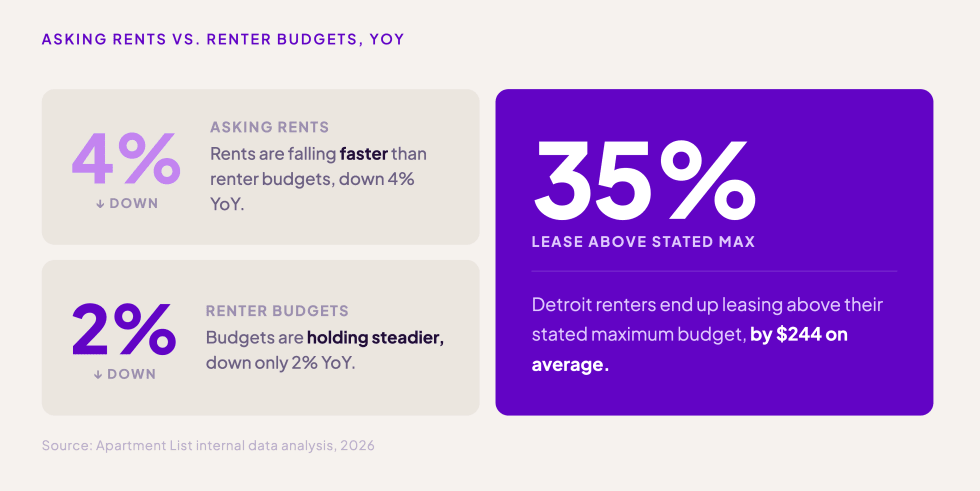
- 35% of renters end up leasing above their stated maximum budget, by $244 on average.
- Operators who match their response infrastructure to this funnel appear to be outperforming on conversion, not on concessions.
Detroit Renters Are Searching 13 Days Closer to Move-In
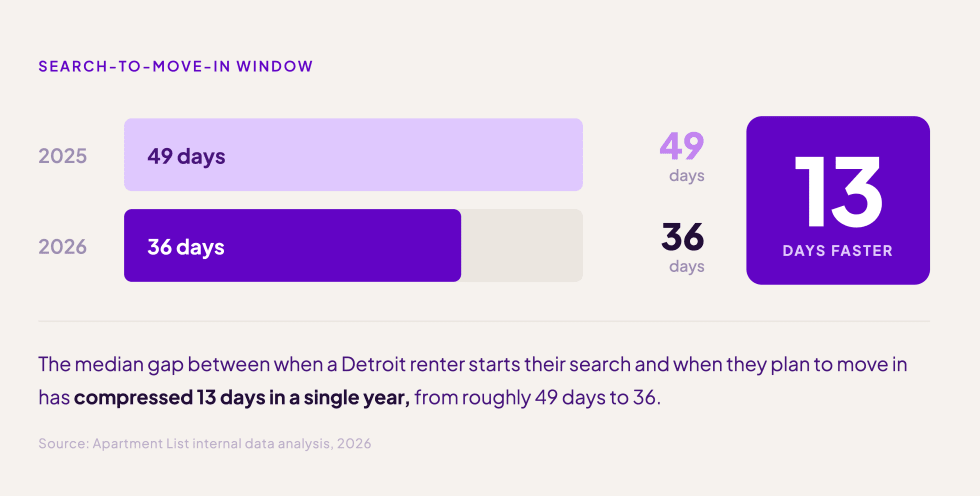
The median gap between when a Detroit renter starts their search and when they say they plan to move in has compressed 13 days in a single year, from roughly 49 days to 36, per Apartment List internal data analysis, 2026.
A year ago, a renter entering the funnel gave you seven weeks. They're now indicating they want to be settled in five.
For a leasing operation built around a longer conversion cycle, 13 days is not a minor adjustment. A lead that goes quiet in your CRM for a few days isn't browsing. They may have already signed.
Detroit Renters Build Their Shortlist Before First Contact
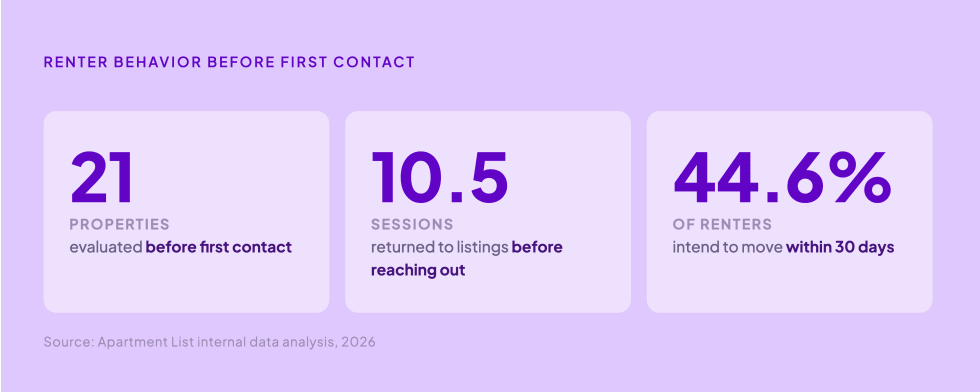
A shorter timeline does not mean renters are making rushed decisions. Detroit renters on Apartment List return an average of 10.5 times across sessions before making contact with a property. They evaluate 21 properties before reaching out to one, per Apartment List internal data analysis, 2026.
By the time a renter contacts your property, the decision is close. That contact represents a renter who's already done the work. From there, friction matters more than research. Nearly half of all first contacts from Detroit renters, 45.7%, arrive outside business hours. The renter who found your listing at 9pm on a Tuesday, evaluated it against 20 others, and sent an inquiry is not going to wait until morning if someone else responds that night.
The conversion window is narrow and concentrated at the bottom of the funnel. Operators who treat every inbound lead like the start of a multi-day conversation may already be late.
Detroit Renter Urgency Is Rising Despite Softer Rents
In theory, softer rents and more supply should give renters more time. In Detroit, that is not what the data shows. 44.6% of Detroit renters on Apartment List are indicating they need to move within 30 days, up 8 points YoY, per Apartment List internal data analysis, 2026. As inventory loosens, urgency is rising.
The budget data points to the same issue. 35% of Detroit renters end up leasing above their stated maximum budget, by $244 on average, per Apartment List internal data analysis, 2026. These aren't renters holding out for a better deal. When the right property is visible and someone responds quickly, renters often close above the number they said was their ceiling.
The renter with a $1,139 stated budget may not be asking for a discount. They may be waiting for the first property that makes it easy to move forward.
Slow Follow-Up Costs More in Detroit’s 36-Day Leasing Window
In a 36-day search-to-intended-move-in window, a 48-hour delay eats up real time.
Picture a renter who is already deep into her search. It’s 9pm. She has evaluated 21 properties, returned to your listing three times, and sent an inquiry. Three properties got that inquiry. One responds by morning. Two don’t. She tours the one that responded. The other two are still in her unread messages when she signs.
If nearly half of your leads arrive while the office is closed, after-hours coverage is no longer a nice-to-have. Every week without it creates leakage you may not see until the unit stays open longer.
Essential Property Management, a Detroit-based operator running 100-150 unit communities with one and two-person teams, built the coverage model to match. The result: a 36% tour conversion rate and 3.3 average days from lead to tour. Read the full case study.
Four Leasing Adjustments for Detroit’s Faster Renter Timeline
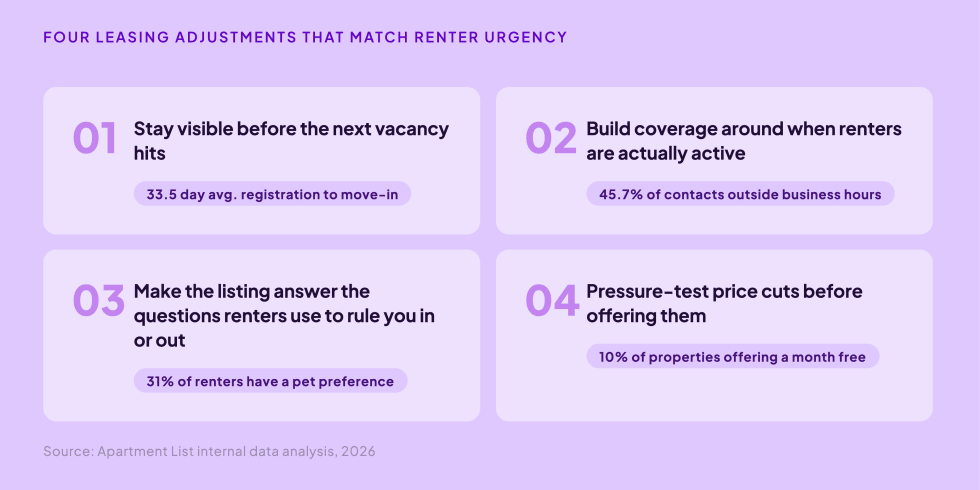
The operators converting faster are changing how quickly renters can move from search to tour.
1. Stay visible before the next vacancy hits.
On Apartment List, the average gap between when a Detroit renter registers and when they move in is 33.5 days, per Apartment List internal data analysis, 2026. Operators who pull listings when a unit fills and repost when it turns over miss renters who are in-market during that gap. If you are not listed when the renter is searching, you do not make the shortlist.
2. Build coverage around when renters are actually active.
45.7% of contacts happen outside 9-to-5. At that contact volume, automated response is not extra coverage. It is part of the leasing desk. A renter who gets a response at 10pm is more likely to book a tour. One who has to wait until morning has often moved on. How Thrive Communities handles after-hours volume without adding headcount is worth a look.
3. Make the listing answer the questions renters use to rule you in or out.
Renters evaluate 21 properties before making contact, which means most of the narrowing happens before you know they exist. Your listing is either in or out of consideration before a renter ever reaches out. A listing without photos, with approximate pricing, or with a buried pet policy doesn't make the contact list. 31% of Detroit renters have a pet preference, per Apartment List internal data analysis, 2026. A clear pet-friendly flag can keep you in the running with nearly a third of the market.
4. Pressure-test price cuts before offering them.
Asking rents in Detroit are down 4% YoY, but renter budgets are falling more slowly, approximately 2%. In plain terms, renter budgets are not falling as fast as asking rents. Only 10% of Detroit properties on Apartment List are currently offering a month free or more, and that figure has declined YoY. The market isn't demanding concessions. Giving one away in that environment can shrink margin without solving the real conversion problem. For a deeper look at how leasing cost structure holds up in a high-vacancy market, the math is worth reviewing.
Speed Is Now the Detroit Leasing Baseline
Detroit’s rent numbers still point to a softer market. The pressure is showing up in the conversion window: active renters are moving on shorter timelines, and many are still closing above budget when a property responds quickly enough to stay in consideration.
A 13-day compression is big enough to change how teams should staff, respond, and stay visible. The operators who match their leasing operation to it will outperform the ones still running a funnel built for a renter who no longer exists.
These numbers only show part of the Detroit demand picture. The full demand picture – who's actively searching in Detroit, what's driving their urgency, and where operators are winning conversions – is in Apartment List's Detroit Renter Behavior Report.
Frequently Asked Questions About Detroit Renter Demand
Rents are down in Detroit. Shouldn't I be cutting price to compete?
The budget data argues against it. 35% of Detroit renters end up leasing above their stated maximum budget, by $244 on average. Renter budgets are falling more slowly than asking rents, approximately 2% versus 4% YoY, meaning the gap between what renters can spend and what operators are charging is actually widening in operators' favor. The renter who told you her ceiling was $1,139 is not your pricing problem. They’re a first-contact problem.
How quickly do Detroit renters actually make a decision?
Faster than most leasing operations are built to handle. The median search-to-move-in window on Apartment List in Detroit is 36 days, down from 49 a year ago. By the time a renter contacts a property, they've already compressed their own consideration period, the research is done, the shortlist is set, and the decision is close. A delayed response doesn't necessarily extend that window. For a renter this far into the process, it may close it.
Nearly half of my leads come in after hours. What's the actual cost of not responding until morning?
In a 36-day decision window, a next-morning response to a 9pm inquiry is a meaningful delay. Renters who contact multiple properties simultaneously, which the funnel data suggests is common, are more likely to tour the property that responds first. The after-hours contact rate, 45.7% of all first contacts from Detroit renters, isn't an edge case. It's a significant share of your first-contact pipeline arriving at a moment when most leasing offices are dark.
Is the urgency signal in Detroit real, or just a data artifact?
The 36-day timeline and 44.6% 30-day intent figure come from renter quiz data, specifically self-reported preferred move-in dates, not observed lease behavior. What's harder to dismiss is the direction: urgency is up 8points YoY as inventory has loosened. Renters are signaling faster timelines even as they have more options. That's the number operators should be building their leasing operation around.
Should Detroit operators be offering concessions right now?
Only 10% of Detroit properties on Apartment List are currently offering a month free or more, and that figure has declined YoY. The operators converting faster in Detroit are not just changing price. They are changing how quickly renters can move from search to tour. Giving them away in a market that isn't demanding them risks compressing margin without improving conversion.
Share this Article