Income-restricted apartments have income limits and program-set rent rules. Learn how to qualify, check income limits, calculate potential rent, and find available housing.
Updated September 2026. Eligibility and rent guidance draws on HUD, IRS, and USDA program resources. Market-rent figures reflect Apartment List data as of September 2026.
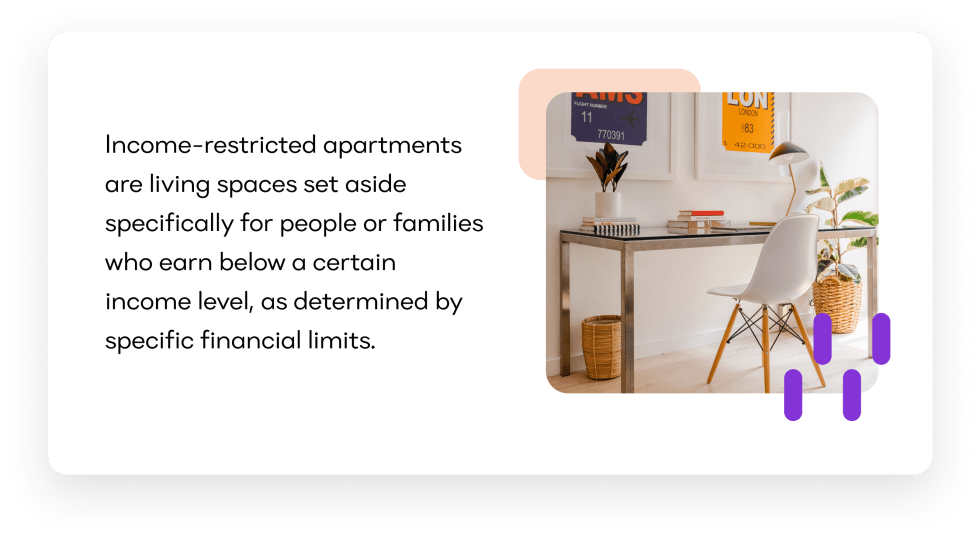
Income-restricted apartments are reserved for households that meet a housing program's income requirements. Your eligibility depends on the program, where you live, and your household size and income. The program also sets rules for rent.
Income-Restricted Apartments at a Glance
- What they are: Apartments reserved for households that meet a housing program's income requirements, with program rules governing rent.
- Who qualifies: Eligibility depends on the property's housing program, your location, household size, and income. Meeting the income limit does not guarantee approval.
- What you'll pay: Some programs cap the apartment's rent; others calculate your share from your income. Ask for the quoted rent and utilities.
- Where to start: Use HUD's Resource Locator or your local housing agency's listings to find participating properties.
- Before preparing paperwork: Confirm whether applications or the waiting list are open, then request the property's eligibility requirements and document checklist.
What Is an Income-Restricted Apartment?
An income-restricted apartment is one where a housing program sets a maximum income for the household renting it and limits what the owner can charge in rent.
Many of these apartments come from the federal Low-Income Housing Tax Credit (LIHTC) program. State and local governments run their own, and so does the U.S. Department of Agriculture in rural areas. The table further down shows who administers each program and where its applications go.
A rent cap isn't automatically lower than market rent. In LIHTC and similar programs, the cap comes from what people in the area earn, not from what nearby apartments actually rent for. That means it can land close to, or even above, what comparable apartments are asking. Check the capped rent against current listings in the same neighborhood before you assume it's the cheaper option.
How Do You Qualify for an Income-Restricted Apartment?
Start by comparing your household income and household size against the income limit for that specific property or program.
- Find out which program the apartment falls under.
- Look up the income limit that program uses for your area and household size.
- Check whose income counts and which income sources the program includes. Use its rules rather than take-home pay alone, and ask whether assets affect eligibility.
- Ask whether applications are open. Properties and agencies open and close their waiting lists, so make sure yours is taking applicants before you put time into paperwork.
- Gather your documentation. Income records, identification, and whatever household or asset paperwork the property asks for.
- Send your application to the property, or to the agency that runs the program.
Meeting the income limit is one eligibility requirement. The property or agency running the program confirms whether you qualify, and it can consider more than your income.
Spending a Lot on Rent Doesn't Make You Eligible
Spending a large share of your income on rent does not automatically qualify you. Eligibility depends on the program's income limits and other requirements.
How Much Do Income-Restricted Apartments Cost?
In an income-restricted apartment, the program sets either a rent limit or a formula for working out your share. That limit is the most the owner can charge, so your quoted rent may come in lower.
An apartment can meet the program's affordability rules and still stretch your budget. Ask for the actual quoted rent and which utilities you'd pay on top of it, then check that total against what you can spend. If you want a rough starting point, explore a starting rent budget. It uses the general 30% guideline, and it doesn't calculate program eligibility or subsidized rent.
Compare the quoted rent with your local market. The Apartment List Rent Index provides monthly citywide median rents by bedroom count. Use the median for your city and apartment size as a starting point, then compare similar nearby listings and check which utilities are included.
For example, the Apartment List Rent Index's September 2026 Austin report puts the citywide median one-bedroom rent at $1,176. A hypothetical income-restricted one-bedroom advertised at $1,100 would be $76 below that median. That comparison provides context, but differences in utilities, location, and amenities affect the apartment's value. Check the total monthly cost against your budget before deciding.
Income-Based Rent vs. Income-Restricted Rent
These two phrases describe how rent gets calculated, and properties and listings use them loosely. Ask which one applies to the apartment rather than going by the label.
Income-based rent starts from your household's income. Public housing and the Housing Choice Voucher program both work this way: you generally pay about 30% of your adjusted monthly income, which is your income after the deductions the program allows.
Income-restricted rent: in LIHTC housing, the apartment's rent limit generally isn't calculated from your individual earnings. It comes from the income level the apartment is set at and how many bedrooms it has, and the owner may charge that limit or less. Two households earning very different amounts can pay the same rent in identical apartments.
One building can use both. A LIHTC building may also accept Housing Choice Vouchers, and in that case the apartment keeps its rent limit while your own share is based on your income. The practical question is simple: is your payment tied to what you earn, or to a rent limit set for the apartment?
Does the Rent Change if My Income Changes?
If your rent is income-based, yes. Public housing and voucher households get their rent recalculated whenever the program rechecks income, so a raise or a job loss can change what you pay.
If your rent is a program-set limit, as it is in LIHTC housing, it generally doesn't change when your income does. The property checks your income when you move in. After that, whether you'll need to submit updated records depends on the program and the property, and some LIHTC properties don't ask every year. Programs also set their own rules for households whose income later rises above the limit, so ask about both before you sign.
Waiting lists for income-restricted apartments can run long. While your applications are pending, take the Apartment List quiz to see what's available right now in your area and price range.
How Do Income Limits Work?
The U.S. Department of Housing and Urban Development (HUD) publishes annual income limits used by many federal housing programs. Which limit applies depends on the area, your household size, and the program.
Area median income, or AMI, is the income figure HUD publishes each year for every metropolitan area and county, calculated from median family income for that area. Affordable-housing programs set their income limits at a percentage of it, commonly 30%, 50%, 60%, or 80%. Which percentage applies depends on which program the apartment falls under and, in LIHTC properties, on the income level that particular apartment is set at.
HUD publishes income limits including:
- Extremely low-income limits
- Very low-income limits, generally set at 50% of area median income
- Low-income limits, generally set at 80% of area median income
Other programs may use different limits. LIHTC properties, for example, can have apartments set at different income levels under federal tax-credit rules.
An Austin Example: Checking an Income Limit
Illustrative example: A person renting alone earns $60,000 under the program's income rules. HUD's FY2026 HOME table, effective June 1, 2026, lists Austin-area one-person limits of $47,050 at 50% AMI and $74,800 at 80% AMI.
That hypothetical income is below the 80% limit but above the 50% limit. Which limit applies to the apartment matters: ask the property to confirm its income requirements and other eligibility criteria.
How Do I Find the Income Limit for My Area?
For programs that use HUD's Section 8 income limits, start with HUD's Income Limits Documentation System.
- Open HUD's current income limits lookup tool.
- Select the current fiscal year and search for your location.
- Find the column for your household size.
- Identify the income limit used by the program or property you're considering.
If the apartment is in a LIHTC or tax-exempt bond-financed property, use a different table. HUD publishes MTSP income limits separately from the Section 8 income limits, and the two can differ for the same area and household size. Ask the property which limits apply to its apartments.
Don't substitute another county's income limit for yours. Even nearby locations can fall in different HUD-defined areas with different limits.
Is Income-Restricted Housing the Same as Public Housing or Section 8?
No. Income-restricted apartments, public housing, Housing Choice Vouchers, USDA rural housing, and local affordable-housing programs all involve income requirements, but they're separate systems with separate applications.
| LIHTC | Private owners and managers under IRS Section 42 rules, monitored by state housing agencies | A rent limit set by a formula tied to the income level the apartment is set at. Rent is generally not calculated from your individual household income | The property or management company |
| Public housing | Your local Public Housing Agency (PHA) | Generally about 30% of adjusted monthly income, recalculated whenever the program rechecks your income | Your local PHA |
| Housing Choice Vouchers (Section 8) | Local PHAs, funded by HUD | Your PHA calculates your assistance from your income, the apartment's rent and utilities, and the local payment standard. The payment standard is not a rent ceiling, so your share can be higher depending on the apartment you choose | Your local PHA, when its waiting list is open |
| USDA Rural Development | Private owners with USDA financing, in eligible rural areas | Restricted rents, and Section 521 rental assistance can reduce your share to roughly 30% of adjusted income | The individual property |
| Local inclusionary housing | City or county housing departments | Set by local program rules, often tied to a percentage of AMI | The property, a centralized application, or a lottery |
Tenant-based Housing Choice Vouchers generally move with the household and can be used at a LIHTC property. Demand for vouchers can exceed availability, so PHAs use waiting lists. Read our Section 8 Housing FAQs for more.
For a broader explanation of these terms, see our guide to low-income vs. affordable housing.
What Documents Do You Need for an Income-Restricted Apartment?
Applications typically ask for identification, recent income records, and documentation of who will live in the apartment. Expect to be asked for some combination of:
- Identity: Government-issued identification
- Income: Recent pay stubs, tax returns or other tax documents, employer verification or income statements, and benefit or assistance statements
- Assets: Bank or asset information
- Household: Documentation of who will live in the apartment
Which earnings and assets count, and how recent your records need to be, varies by program. Start with the property's checklist so you're only chasing the records it actually needs.
Do Income-Restricted Apartments Have Waitlists?
Often, yes. Waiting lists are standard in public housing and the Housing Choice Voucher program, and privately operated income-restricted properties may keep them too.
HUD notes that Housing Choice Voucher applicants may need to apply to multiple PHA waiting lists because of high demand, and a PHA may open or close its list depending on where things stand locally. For privately operated properties, ask how applicants are selected from the list and how you'll hear back about your place on it.
How Do You Find and Apply for Income-Restricted Housing?
There's no single national application, so where you go depends on the program. To build a list of places to apply:
- Start with HUD's Resource Locator, a map-based search covering LIHTC properties, privately owned subsidized housing, public housing developments, USDA rural housing, and local Public Housing Agencies.
- For public housing and Housing Choice Vouchers, contact your local housing agency. HUD maintains a directory of local Public Housing Agencies, and its guidance for voucher tenants explains how assistance is calculated.
- For rural areas, search USDA's MFH Rentals directory by state and county. Each listing includes income limits and the management agency to contact.
- Check your city, county, or state housing agency for local affordable-housing programs, centralized applications, and lotteries.
- Search rental listings for income-restricted or affordable apartments, and ask each property which program they fall under.
Take the Next Step: Check One Property
Start with HUD's Resource Locator or your local housing agency's listings. Choose a property in an area you're considering, then contact its leasing team.
You can use this message:
"Hi, I'm interested in your income-restricted apartments. Are any units available, or is your waiting list accepting applications? My household has [number] people. Could you send me the applicable income requirements, rent and utility costs, and application checklist?"
Use the response to decide whether to move forward. You don't need to understand every housing program before making that first inquiry.
FAQs About Income-Restricted Apartments
What does income restricted mean?
An income-restricted apartment is one set aside for households earning under a limit that an affordable-housing program sets. You'll need to be under that limit when you apply, and the program also caps what the owner can charge.
How much do income-restricted apartments cost?
It depends on the program. In public housing and with a Housing Choice Voucher, you generally pay about 30% of your adjusted monthly income. In LIHTC housing, the program sets a rent limit for the apartment, and that limit generally isn't calculated from your individual earnings.
What's the difference between income-restricted and income-based rent?
Income-based rent is calculated from your household's income, as in public housing and with a Housing Choice Voucher, where you generally pay about 30% of adjusted monthly income. Income-restricted rent is a limit set on the apartment, and in LIHTC housing that limit generally isn't calculated from your individual earnings. One building can use both.
Does my rent change if my income changes?
If your rent is income-based, yes. Public housing and voucher households have their rent recalculated whenever the program rechecks income. If your rent is a program-set limit, as in LIHTC housing, it generally doesn't change when your income does, though the property may still ask for updated records, and programs set their own rules for households whose income later rises above the limit.
Area median income, or AMI, is the annual income figure HUD publishes for each metropolitan area and county, based on median family income. Affordable-housing programs set their limits at a percentage of it, commonly 30%, 50%, 60%, or 80%.
How do I find the income limit for my county?
Search HUD's Income Limits Documentation System for your location and household size. If the apartment is in a LIHTC or bond-financed property, use HUD's separate Multifamily Tax Subsidy Project limits instead, then confirm with the property which limit applies.
Is income restricted the same as Section 8?
No. Housing Choice Vouchers, commonly called Section 8, are a HUD-funded rental-assistance program administered by local Public Housing Agencies. Income-restricted apartments can fall under other programs, including LIHTC, USDA Rural Development programs, and local affordable-housing programs.
How do income-restricted apartments verify income?
Properties verify income through the records you provide, such as pay stubs, tax documents, benefit statements, and bank or asset information. Which records count, and how recent they need to be, varies by program, so ask the property for its current checklist.
How long are income-restricted apartment waitlists?
There is no standard wait time. Ask the property or housing agency whether its list is open, and where a new applicant would land on it.
Sources & Methodology
- HUD income-limit methodology and lookup: HUD Income Limits Documentation System
- LIHTC and tax-exempt bond-financed properties: HUD Multifamily Tax Subsidy Project income limits
- FY2026 Austin example, HUD HOME Program income limits for the Austin-Round Rock-San Marcos area, one person at 50% and 80% AMI, effective June 1, 2026: HUD FY2026 HOME income limits, Texas
- Housing Choice Voucher and public-housing guidance: HUD guidance for voucher tenants
- Property search across LIHTC, subsidized multifamily, public housing, and USDA rural housing: HUD Resource Locator
- LIHTC program rules: IRS guidance on the Low-Income Housing Credit, IRC Section 42
- USDA Rural Development multifamily housing, including Section 515 properties and Section 521 rental assistance: USDA MFH Rentals directory
- Austin market rent: Apartment List Rent Report for Austin, Texas, September 2026
This article provides general information, not legal or financial advice. Eligibility for an income-restricted housing program is determined by the property, agency, or organization administering that program. Income limits, eligibility requirements, application procedures, and waitlist policies vary by program and location and can change over time. Confirm current requirements with the relevant property or housing agency before applying.