Addressing Multifamily’s Airbnb Misconceptions

Ask any onsite team why “Airbnb-friendly” feels risky and you’ll hear the same story: unclear rules, edge-case requests, and worries that responsible hosting might outrun control. Those aren’t deal-breakers; they’re gaps, and gaps are where myths multiply.
This is what Apartment List’s Airbnb partnership addresses. By making your policy visible at discovery and keeping approvals, caps, enforcement, and revocation firmly in your hands, we bring hosting back inside the multifamily playbook. One policy, one process, cleaner conversions. Renters see what’s allowed before they apply, and your team operates from the same facts in every conversation.
In that light, the question isn’t “Should we allow hosting?” so much as “How do we govern it?” When the rules are explicit, responsible hosting behaves like a modern operator-run program: defined, measurable, and under your control. That’s how we retire the myths, with clarity that scales.
How Airbnb-friendly Actually Works
Airbnb-friendly visibility brings structure to something that used to feel informal, placing your policy where it belongs: in plain sight, at the exact moment renters are deciding where to live.
Here’s what that looks like in practice:
- Where it shows up: Airbnb-friendly communities now appear inside Apartment List search. Renters can apply an Airbnb-friendly filter and instantly see properties that allow occasional, compliant hosting. It’s visibility with intent built in.
- What renters see: Each listing includes a single line of factual language:
- “This property allows residents to earn extra money from hosting on Airbnb. Hosting is subject to rules, restrictions and limitations. Ask property management for details.”
- It’s simple, standardized, and removes the gray area before the first tour.
- Who sets the rules: Operators do. You define eligibility, approval workflows, caps, blackout periods, and enforcement. We surface that information, but control stays fully with you.
- Why it matters: When renters and leasing teams share the same information from the start, expectations align, and friction drops. Prospects know what’s allowed; onsite teams stop fielding ad-hoc requests.
- Operator policy, stated plainly: define and publish your rules clearly so expectations are unambiguous. Typical elements include eligibility and approval criteria, hosting caps and quiet hours, insurance or fee requirements, and plain-language house rules (like “no events or parties”).
- Participation profile: most approved residents host occasionally, the typical Airbnb-friendly host logs ~32 nights/year, and not all hosts participate at the same time.
One policy, one process, and an approval-first workflow that lives inside your existing systems:
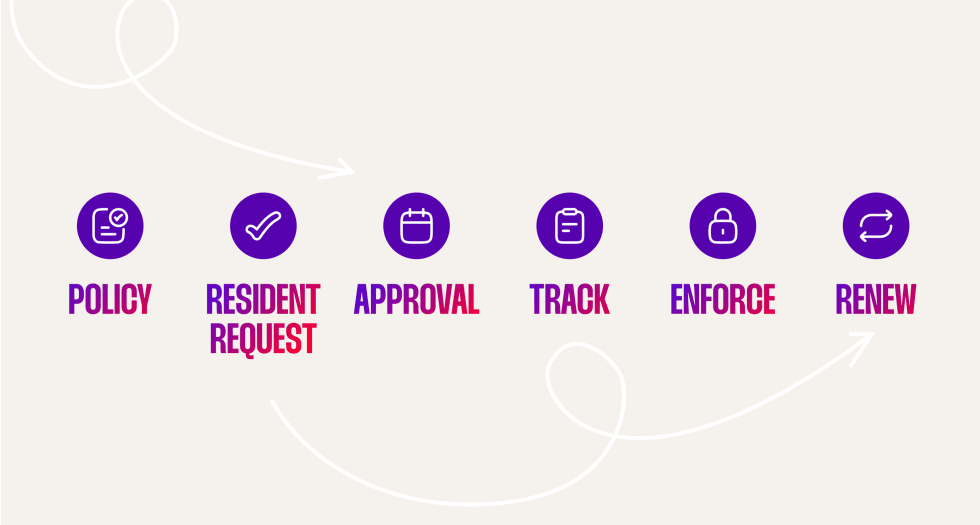
With the guardrails visible and consistent, responsible hosting becomes predictable, and predictability is what scales.
Operator Concerns: Six Airbnb Misconceptions, Answered
Below, we address the six most common myths by spelling out how the program actually runs in practice, so residents can earn responsibly and operators keep full control, and, where desired, properties may set a clearly disclosed administrative fee or revenue-share as part of their policy.
Myth #1: “We’ll lose control.”
The concern: “If we open the door to Airbnb, we lose control over who comes and goes. Guests we didn’t screen show up, and we’re left managing problems after the fact.”
The reality: Control becomes codified on your terms. You publish one policy, route participation through an approval-first flow, set caps/blackouts, and revoke eligibility when rules aren’t met. Residents who host are doing so responsibly under your rules, not outside them. The rules live in your team’s oversight.
Meanwhile, Airbnb’s infrastructure now reinforces that governance:
- Global party ban, first introduced in 2020 and made permanent in 2022.
- Reservation screening tools block high-risk bookings before they occur.
- ID verification required for booking guests and primary hosts.
- Data transparency:
- Party reports have fallen materially since the ban, and in 2024 ~0.03% of reservations resulted in $1,000+ damage reimbursement.
- Guests average 4.9/5 on respecting house rules (Airbnb 2024 data across US Airbnb-friendly Apartments on 16,500 reviews.)
Together, that means fewer external risks, fewer gray areas, and a system where the operator still holds the reins.
Myth #2: “This turns us into a hotel.”
The concern: “If we allow Airbnb, we’re effectively running transient operations – constant check-ins, hotel-style traffic, and pressure on onsite teams.”
The reality: Airbnb-friendly doesn’t convert a community into a hotel; it formalizes an operator-run program under your existing standards.
Participation is occasional and staggered across the calendar, and residents do not all host at the same time. You decide eligibility, caps (e.g., limited nights/year), quiet hours, guest limits, building constraints, and blackout dates.
Those rules are published once and applied every time, so onsite isn’t negotiating edge cases at the desk. The program language shown to renters is simple and factual, setting expectations before any tour or application, and it points residents back to your team for details, keeping the locus of control in-house.
Myth #3: “It will create noise and complaints.”
The concern: “Weekend bookings will spike noise issues and put our team in constant conflict with residents and neighbors.”
The reality: Noise problems are usually a symptom of ambiguity, not hosting itself. When the rules are explicit and approval-first, conflict drops because everyone is operating from the same script.
Here’s what that looks like in a governed model:
- Visible house rules (including “no events or parties”): Publish guest limits, quiet hours, and building constraints in a single source of truth, and reference it in all approvals.
- QR-accessible rules in-unit: Post a QR code to “House Rules” so residents and guests can’t claim confusion.
- Auto-messaging on approval: When a request is approved, trigger an automated message that reiterates quiet hours, guest caps, and any weekend/holiday restrictions.
- Complaint triage ladder: Standardize who handles what and when, so escalations are consistent and fast.
With caps, approval-first, visible rules, incidents trend down and conversations become shorter and more factual, with less debate, more enforcement. That’s how you replace guesswork with governance and keep weekends predictable.
Myth #4: “It’s too hard to administer.”
The concern: “Our team is already stretched. If we allow hosting, it becomes a never-ending queue of exceptions, emails, and manual follow-up.”
The reality: A hosting-friendly program is only hard when it’s ad hoc. Run as a single, lightweight process, it’s predictable. When the workflow maps to leasing, renewals, and ancillary-revenue metrics, onsite teams tend to embrace the program.
- One intake channel, one queue. Route all requests through a standard form so onsite isn’t fielding hallway asks or DM one-offs.
- Template the decision. Approvals/denials use the same language every time, with caps and end dates baked in, no bespoke negotiation.
- Track once a month. A simple cap/eligibility tracker and a monthly review keep oversight consistent without day-to-day overhead.
- Bundle touchpoints you already do. Fold eligibility checks into renewal-time conversations to reassess participation with zero extra meetings.
Treat it like any other operator-run program: one policy, one workflow, periodic reporting. When the steps are standardized, the program stops creating work, and starts reducing it by eliminating case-by-case negotiation.
Myth #5: “Messaging is tricky.”
The concern: “If we even mention Airbnb, prospects will assume anything goes. Onsite will field endless ‘can I…?’ questions, and we’ll spend time clarifying edge cases.”
The reality: Messaging gets easy when it’s standardized, factual, and placed at discovery – not improvised at the tour desk. The campaign uses a single line of copy on the listing to set expectations before any application or tour:
“This property allows residents to earn extra money from hosting on Airbnb. Hosting is subject to rules, restrictions and limitations. Ask property management for details.”
Because that language appears in search, renters and leasing teams start from the same facts, which reduces mismatched expectations and scales trust. The listing copy also points residents back to your team for specifics, keeping policy interpretation in-house and consistent.
When you mirror that same factual line across channels (ILS, website, tour scripts, renewal comms, and signage), the gray area disappears and ad-hoc clarifications drop, freeing your onsite to enforce, not re-explain.
Myth #6: “It won’t help performance.”
The concern: “Even if we control it, will this actually move the numbers? We can’t add complexity without a clear upside in demand, decisions, or renewals.”
The reality: When hosting eligibility is made visible in search and paired with factual policy language, match quality improves and decisions speed up because renters and leasing teams start from the same facts.
Performance signals are strong when operator control is tight:
- Demand capture: About 50% of Gen Z renters say they’re interested in hosting while they’re away; clear policies tend to increase match rate and shorten decisions. (RealPage National Multifamily Renter Survey)
- Ancillary revenue. In 2024, Airbnb-friendly partners earned about $3M; the median resident host earned $3,540 from 32 nights. (Airbnb 2024 data on ever-active hosts in US Airbnb-friendly Apartments – median; results vary).
- Retention. One large operator reported +12% renewal among hosts vs. non-hosts.
- Trust. 85% of partners report improved resident sentiment (on an Airbnb Partner & Resident Survey conducted in Q1 2023); Guests average 4.9/5 on “respecting house rules.” (Airbnb 2024 data across US Airbnb-friendly Apartments on 16,500 reviews).
- Ancillary operator revenue (when implemented): Some operators report incremental revenue via a policy-defined admin fee or revenue-share tied to approved hosting activity; structure and results vary by property and market.
In short: visibility drives cleaner demand; governance preserves control; together they create measurable, portfolio-wide impact without turning your teams into hotel operators.
Responsible Earnings. Operator Oversight. Real Results.
In multifamily, myths grow where rules are fuzzy, and they recede when residents earn responsibly under rules operators control. That’s the shift this partnership is designed to create – policy shown at discovery, the same factual language everywhere, and approvals that live with your team.
By surfacing eligibility in Apartment List search and anchoring participation to one policy and an approval-first workflow, you replace one-off exceptions with a governed system you can run portfolio-wide: one policy, one process, cleaner conversions. Renters act on the same information as leasing; operators keep full control over caps, enforcement, and revocation. Clarity does the heavy lifting; governance replaces guesswork.
Ready to activate Airbnb-friendly visibility in your communities? Reach out to our team to learn how.
Share this Article