Facing obstacles on how to get an apartment with no rental history? We simplify the process with essential tips for first-time renters.
You can rent an apartment with no rental history by showing a landlord other proof that you can pay rent on time, such as pay stubs or bank statements, references, and, if needed, a co-signer or guarantor. Gather those documents before you apply so the application is complete the first time.
In this guide, we cover how to qualify for an apartment with no rental history and how to apply for and secure a lease.
Key Takeaways
- No rental history means a landlord has no past rent record to review, so other documents carry more weight.
- Proof of income, references from employers or professors, and a co-signer or guarantor are the most common substitutes.
- Ask how the landlord evaluates applicants without a history before you pay an application fee.
The Quick Path
- Gather proof of income, identification, and two or three references.
- Ask each landlord how they evaluate applicants with no rental history and which alternative documents they accept.
- Add a co-signer, guarantor, or roommate if the landlord's requirements call for one.
- Submit a complete application with a short note explaining your situation.
Table of Contents
What If I Have No Rental History?
If you've never rented before, a landlord has no record of past rent payments to review. Not having a rental history doesn't mean you can't qualify for an apartment, though. You can show your ability to pay rent and meet your lease obligations with other documents, references, and, when necessary, additional financial support.
If you have no rental history, the goal is to replace the traditional rental history with alternative qualifications. Maybe you've lived with family, stayed with roommates, or moved frequently without signing a lease. Whatever your situation, you can prepare an application that explains your background and shows you're ready to rent.
How Can You Qualify for an Apartment Without a Rental History?
Below are the top ten strategies to help you qualify for an apartment without a rental history.
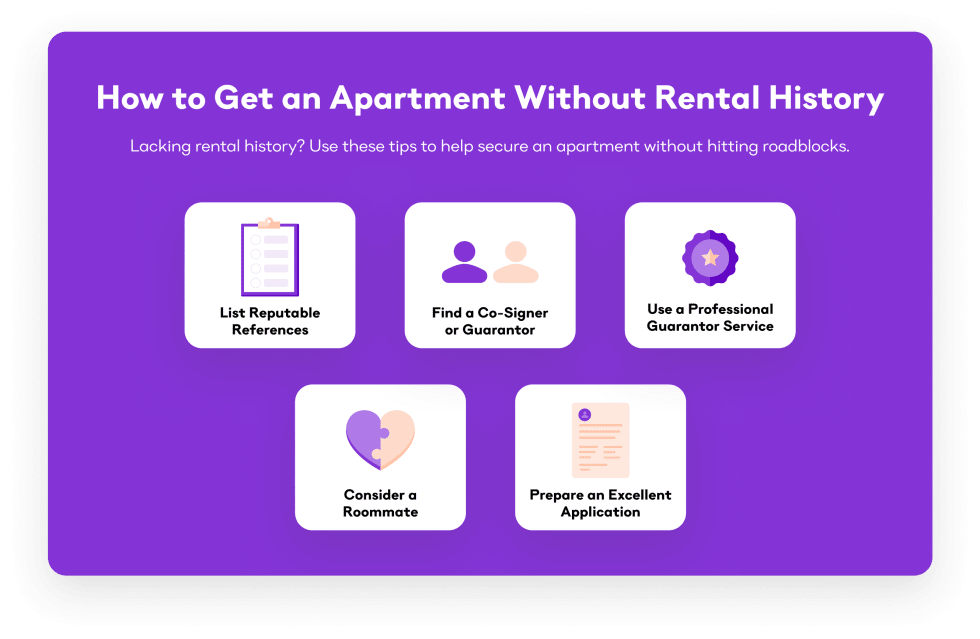
1. List Reputable References
List professors, previous employers, professional acquaintances, or volunteer coordinators as references if you've never had a landlord. They may not be able to speak to your reputation as a tenant, but they can speak to your character and sense of responsibility.
Choose people who can give specific examples of your reliability, such as a former manager who can confirm you consistently met deadlines. Ask for permission, confirm their preferred contact information, and let them know a landlord may reach out.
For more guidance, see our guide to rental references for an apartment application.
2. Find a Co-Signer or Guarantor
A co-signer or guarantor with good credit and a strong rental history can help convince landlords to rent to you.
Your co-signer or guarantor gives your landlord additional assurance that rent will be paid. Choose someone with a strong financial background who understands the responsibilities they'll be taking on. A co-signer or guarantor agrees to pay the rent if you don't, under the terms of what they sign.
Not every landlord accepts co-signers or guarantors, so ask about the requirements before applying. Your co-signer or guarantor may need to provide financial documents or go through screening, and the financial obligations depend on the documents involved. Learn more in our guide to lease guarantors.
3. Use a Professional Guarantor Service
A professional guarantor service is a third party that agrees to pay the landlord if you don't, under the terms of its agreement. These services charge a fee, but they can be an option if you can't find a guarantor in your personal network and your landlord accepts this arrangement.
Ask the landlord which services they accept, and review the service's fees, eligibility requirements, coverage, exclusions, and whether it can collect from you for anything it pays the landlord. A guarantor service doesn't guarantee approval, and you'll still need to meet the landlord's other application and screening requirements. For more information, review our guide to lease guarantors.
4. Consider a Roommate
Roommates can potentially balance out your lack of rental history. Some landlords consider the combined income and rental history of everyone applying, and sharing an apartment can make rent and utilities more manageable.
If you apply with a roommate, ask whether both of you will be on the lease and how the landlord evaluates co-applicants. Don't assume a roommate's rental history will make up for yours, because the landlord may evaluate each applicant individually. Discuss how you'll split rent and bills, and what happens if one person can't pay or moves out early.
5. Prepare an Excellent Application
Make your apartment application stand out by gathering all necessary documents. Include details about your employment and mention relevant accomplishments, like being promoted twice within a year's time.
Check the landlord's application requirements first, since some request proof of income, references, identification, or other documentation. Make sure every field matches your supporting documents, because missing information can delay the process. For a full breakdown, see our guide to the forms you need to rent an apartment.
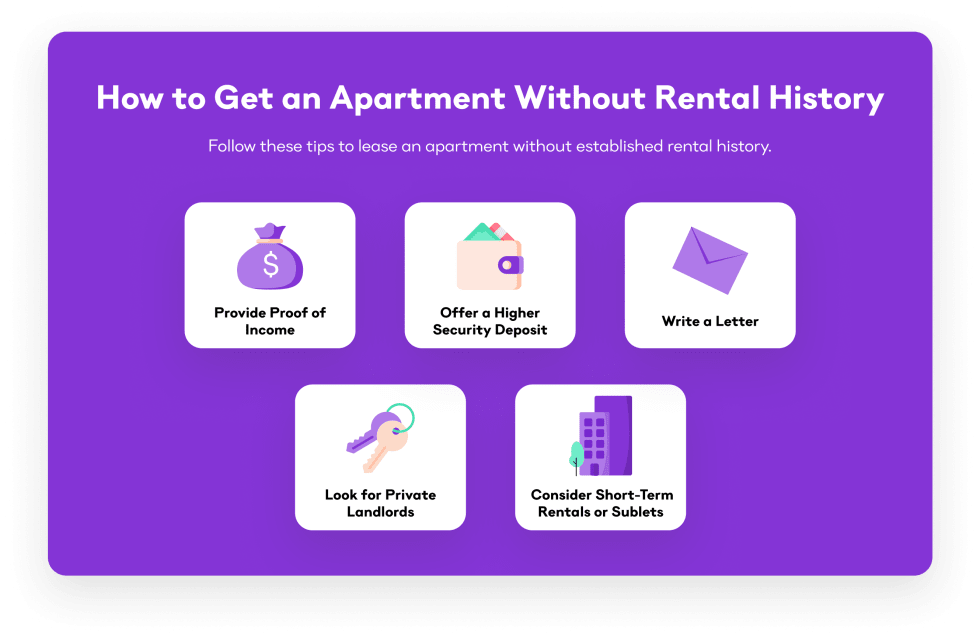
6. Ask About the Security Deposit
A larger security deposit can sometimes help make up for a lack of rental history. Ask whether a larger deposit is allowed where you live and whether the landlord will accept one. Many states and local jurisdictions limit security deposits, and landlords must follow the rules that apply where the apartment is located, so don't offer additional money until you've confirmed the legal limit.
Before paying, review the lease to see how the deposit will be held, what deductions may be permitted, and when it should be returned. Keep a copy of your receipt and the signed lease. Learn more in our guide to security deposits.
7. Provide Proof of Income
Pay stubs, bank statements, or an official job offer can show a landlord that you're prepared to cover rent. If you're self-employed, work as a contractor, or earn money from multiple sources, ask which documents the landlord accepts. Tax returns, client contracts, or other records may help show your earnings over time.
Don't assume that a job offer or savings balance will satisfy every landlord's requirements. Ask what qualifies as acceptable proof before you submit your application. For more details, check out our guide to proof of income.
8. Write a Letter to the Landlord
A short, sincere letter can give a landlord context for your application. Explain why you've never rented before, such as living with family or in shared housing, and point to the documents you've included and how you'll meet your rent obligations.
Keep the letter focused on information relevant to your application. A clear, professional note can help the landlord understand your circumstances, but it doesn't replace the required application materials. See the sample note below.
9. Look for Private Landlords
Private landlords may have different application criteria from larger management companies. Some rent out condos, single-family homes, or townhouses and may consider applicants who are renting for the first time.
Private landlords still need to evaluate whether you meet their requirements, and they may request proof of income, references, a credit check, or other documentation. Before paying an application fee, ask whether the landlord considers applicants without rental history and which alternative documents they'll accept.
10. Try Short-Term Rentals or Sublets
Short-term rentals or sublets may offer an alternative to a traditional long-term lease, depending on the arrangement and the requirements of the person renting out the space.
Before signing anything, confirm that the arrangement is permitted by the original lease and that the landlord has given any required approval. Ask for a written agreement that explains the rental period, payment terms, and responsibilities of everyone involved.
Keep copies of your agreements and payment records. These documents may help you show your housing and payment history later, although a future landlord may not treat a short-term rental or sublet as equivalent to a traditional rental history. A short-term arrangement isn't a guaranteed path to approval.
What Documents Should You Bring If You Have No Rental History?
The documents you need depend on the landlord's screening criteria and your financial circumstances. Before applying, ask which materials are required and whether alternative documents are accepted.
You may not need every document on this list. Check the landlord's requirements before submitting sensitive financial information, and use a secure method to share documents when possible.
How Do You Explain No Rental History to a Landlord?
Be honest and concise. You don't need to make your situation sound unusual or apologize for it. Explain your circumstances, show how you'll meet your financial obligations, and offer supporting documentation.
For example, you could write:
Hello,
I'm interested in applying for this apartment and wanted to provide some context about my rental history. I've lived [with family / in shared housing / somewhere I wasn't on the lease] and haven't signed a lease in my own name, so I don't have a traditional rental history to share. I've included documentation of my income and references to help demonstrate my ability to meet the lease requirements.
Please let me know if there are any additional documents I can provide to support my application.
Thank you for your consideration.
Adapt the note to your own circumstances. If you've lived in shared housing or another arrangement, you can briefly explain that instead. The goal is to answer the landlord's question before it becomes a concern.
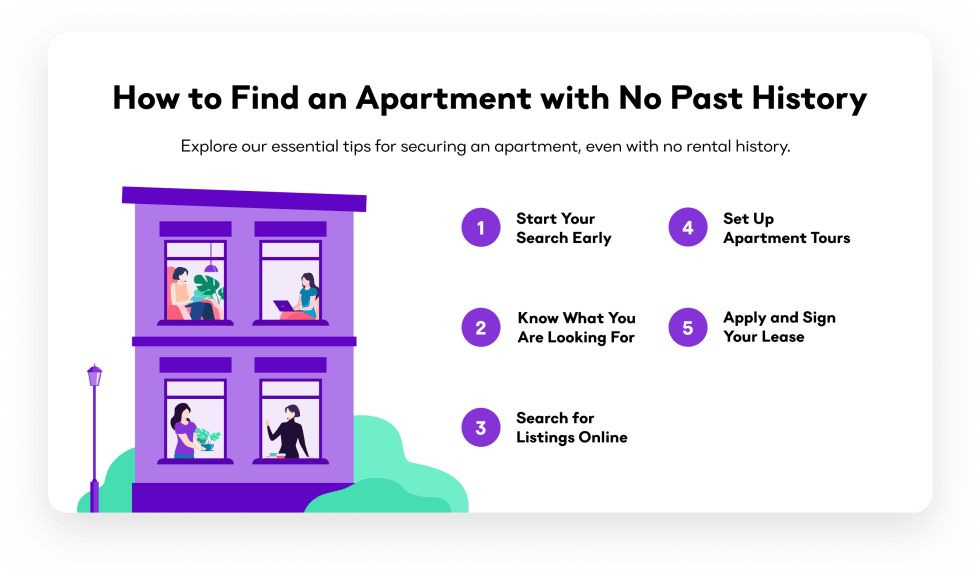
How Do You Search and Apply With No Rental History?
A little preparation keeps your search and application materials organized when you don't have a previous lease to reference.
Start Your Search Early
Begin looking well before your ideal move-in date. You may need extra time to gather documentation, contact references, or arrange a guarantor. Keep a list of prospective apartments, application deadlines, fees, and required documents so you can track your progress.
Know What You're Looking For
Identify your must-haves, nice-to-haves, and can-live-withouts, including budget, commute, neighborhood, bedrooms, and essential amenities. Calculate the full cost of moving, including the security deposit, application fees, utilities, and other upfront expenses, and choose an apartment you can afford based on your current finances, not just the advertised monthly rent.
Search Online and Compare
Online rental platforms let you filter by price and area. Confirm important details with the landlord before you pay an application fee.
Schedule Apartment Tours
Visit in person or take a virtual tour, and prepare questions about lease terms, rent increases, utilities, parking, and maintenance. Ask about the application process and whether the landlord considers applicants without rental history, and confirm which documents you'll need before applying.
Apply and Sign Your Lease
Gather your documents before submitting an application, and make sure your information is accurate and your references are prepared. Ask about the application fee and screening process before paying.
If your application is approved, read the lease carefully before signing. Review the monthly rent, deposit, lease term, payment deadlines, and any additional fees, and keep a copy for your records. For a step-by-step overview, read our guide to applying for an apartment.
Start Your Search With Apartment List
Search apartments on Apartment List and use its filters to find apartments that fit your budget, preferences, and move-in timeline.
Prepare your documents, ask landlords about their requirements, and keep your application materials organized as you compare options. A lack of rental history doesn't have to stop you from finding a place to live. With the right preparation, you can give landlords a clearer picture of your ability to meet your rental obligations.
Frequently Asked Questions
What documents do I need to provide when applying for an apartment with no rental history?
Documents you may need to provide when applying for an apartment with no rental history include the following:
- Proof of income: This could include pay stubs, tax returns, or a letter from your employer confirming your salary.
- Bank statements: This will show the landlord that you have a stable financial history and can afford to pay the rent.
- Employment verification: This could be a letter from your employer confirming your employment dates and salary.
- Personal references: This could include former employers, professors, or volunteer coordinators who can vouch for your character and responsibility.
In addition to these documents, you may also be asked to provide a copy of your driver's license or other form of identification. The specific documents required will vary depending on the landlord or property management company.
Can I rent an apartment without employment history?
Yes, it's possible to rent an apartment with no employment/job history. If you don't have a job history, ask whether the landlord accepts a co-signer or a guarantor.
You may also be able to provide proof of funds, such as bank statements, or other documents that demonstrate your ability to cover rent. Requirements vary by landlord, so confirm which alternatives are acceptable before applying.
How do you explain a lack of rental history?
Be upfront about your background. Write a brief letter explaining why you have no rental history and why you're interested in the apartment, include relevant information about your finances and supporting documents, and offer to answer any questions the landlord may have.
Does having no rental history hurt your application?
Without a rental history, a landlord has no record of your past rent payments to review. You may need to provide other evidence of your ability to meet your rental obligations, such as proof of income, references, or a guarantor if required. Ask the landlord how applicants without rental history are evaluated before paying an application fee.
Can a landlord deny you for having no rental history?
Landlords set their own screening criteria within applicable laws, so an application that doesn't meet those criteria may be declined. Ask what the landlord requires from applicants without rental history, and if they will accept alternative documents or a co-signer or guarantor before you apply.
Can I rent an apartment without a credit check or rental history?
Possibly, but it depends on the landlord's screening requirements. Some landlords may consider applicants with limited credit or rental history, while others require credit and background checks. If you're looking for apartments that don't require a credit check, read our guide to no-credit-check apartments and confirm the screening requirements with the landlord before applying.
Do I need a guarantor if I have no rental history?
Not necessarily. Some landlords may accept alternative documentation, such as proof of income, savings, or references. Others may require a co-signer or guarantor if you don't meet their screening criteria independently. Ask the landlord what options are available before applying, and read our guide to lease guarantors for more information.