Why “We’re Doing Fine” Is the Most Dangerous Leasing Signal
The most dangerous word when reviewing your leasing performance is “fine.” It can show up when occupancy reads high, the lead count looks full, and the risk that should worry you is a quarter away.
“We’re still like 97, 98% occupied,” an operator told us on a recent call, before adding that the property usually runs at 99.5%. He was more than a point under his own baseline, and the headline number told him nothing about what it may have cost to preserve it. Occupancy can look stable while loss to lease is already doing the damage underneath.
The damage works on a delay. By the time occupancy slips, the demand that set it is months gone. The same blind spot can hide under a healthy lead count and a market lifting with the season.
When the pipeline softens, occupancy might hold a bit longer, and then you’ll pay the difference later in rent cuts to fill the unit.
4 Ways “Fine” Can Hide a Softening Leasing Pipeline
The four reasons “fine” can sound credible while the leasing pipeline thins beneath it:
- Occupancy slips last. A soft pipeline can run 8 to 12 weeks before the number budges. By the time it drops, the cause is already old.
- Seasonal lift disguises softness. Peak season hands nearly every property a bump. That bump is not proof you're doing something right.
- Your own baseline is the first read. A one-point drop below your historical norm matters even when the absolute number still looks high.
- Missed softness compounds. A quiet stretch you let pass resurfaces as concessions, weak renewal conversations, and lost pricing power you can't buy back.
Why Direction Matters More Than the Occupancy Snapshot Alone
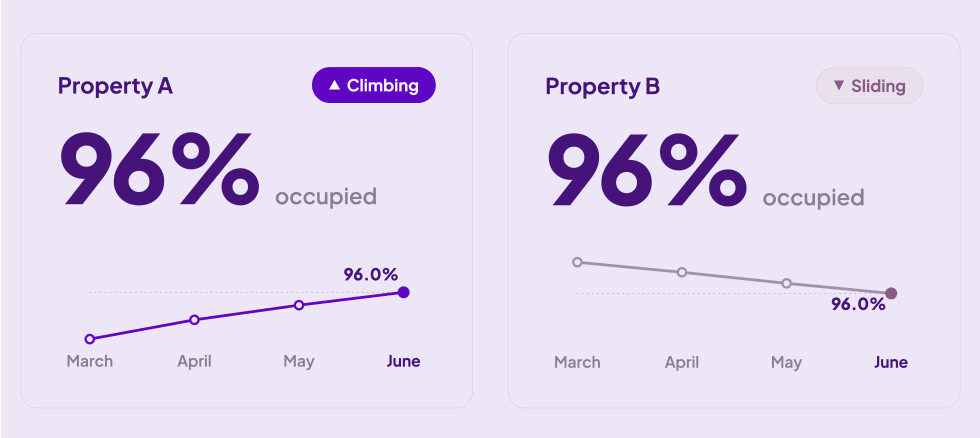
Picture two properties at 96% occupied. One climbed there and is still climbing. The other is on its way down. On a monthly report, they look identical, because a single occupancy reading never shows the trend. The number worth watching is your own direction over time. History is what gives the percentage its meaning.
Before you call 96, 97, or 98% occupancy “fine,” check whether the number is improving, holding, or quietly sliding against the demand you should be capturing now.
Occupancy Slips After the Leasing Pipeline Has Already Softened
Occupancy reports the truth late. By the time a signed lease changes the number, the demand behind it has already spent weeks moving from inquiry to tour to lease.
A unit you list today takes about 30 days to lease right now, the slowest any May has been since 2019. That is a national average, and your market could run faster or slower, though the funnel works the same everywhere. Before that lease, someone toured. Before that tour, they inquired.
You, or someone on your team, runs that sequence every day. The damage is in the lag stacked between each step, weeks at a time. When inquiries thin out, you won't see it in tours for weeks, and those softer numbers take weeks more to show up as fewer signed leases. Only then does occupancy move.
How a Soft Spring Turns into a Weak Fall
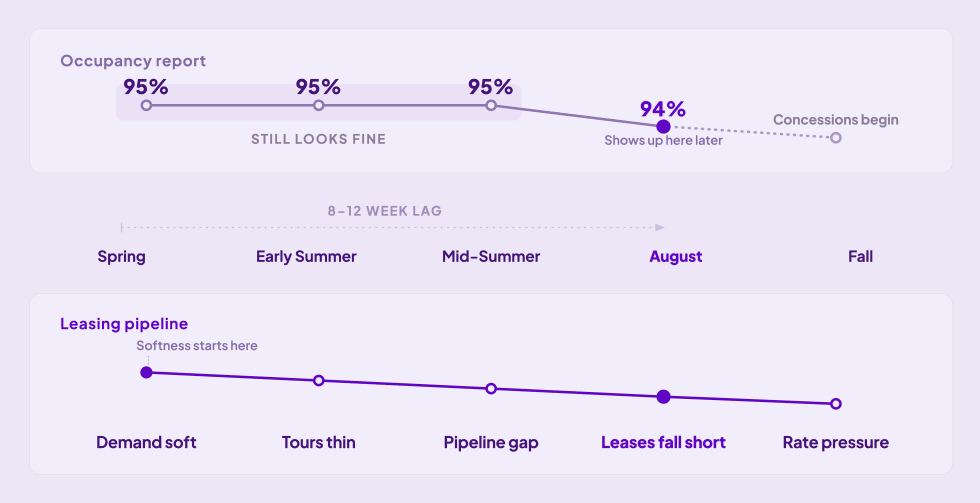
These figures are idealized, built to show how the lag moves rather than to set an occupancy target. Your own numbers will likely be messier, and your strong and soft seasons may land on a different calendar than this one.
The operating risk remains. Soft demand impacts occupancy after the easiest weeks to correct it have already passed.
Picture a 300-unit property holding at 95% occupied:
- To stay level, the team needs to replace roughly a dozen move-outs each month.
- In spring, demand comes in below the property’s usual seasonal baseline, but the team misses it because inquiry volume still looks better than winter.
- By late summer, that softer demand reaches the bottom of the funnel. The team signs nine leases instead of twelve, and occupancy slips for the first time.
The late-summer report feels sudden, even though the problem started months earlier. By the time occupancy shows the slide, the back half of the year is already harder to protect. The fastest lever left is usually rate, exactly when the property has the least leverage.
Speed Is the Lever You Can Still Move
When Thrive Communities put always-on, instant follow-up behind every inquiry, average time in the leasing funnel fell from 87 days to 23 in about two months. Those 64 days are the difference between filling a unit and watching it sit.
“We Have Enough Leads” Is Not the Same as Leasing Momentum
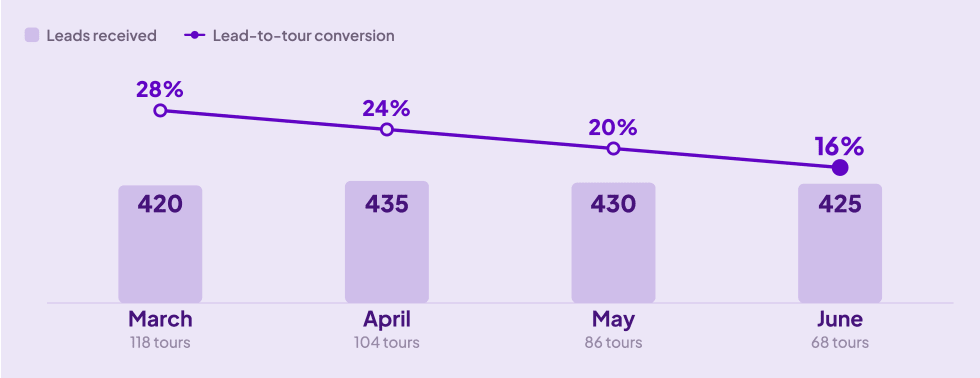
A team that points to either occupancy or lead volume as proof of health is leaning on metrics that can read as fine long after the trouble starts.
Lead count behaves like occupancy at the top of the funnel in the sense that it can hold flat month over month while the share that books a tour quietly erodes.
A healthy-looking lead volume number can sit on top of two problems at once:
- Weak conversion. A shrinking share of inquiries ever turns into a tour, even while the raw count holds.
- A leaking middle. A reply that lands hours late loses the renter to whoever answered first, and leads you already paid for die before they book a tour.
The number that matters sits one level below volume: how many leads move from inquiry to tour to signed lease before the team has to replace momentum with concessions.
Lead flow can look fine. Conversion is where the softness shows first.
Peak Season Can Make Drift Look Like Progress
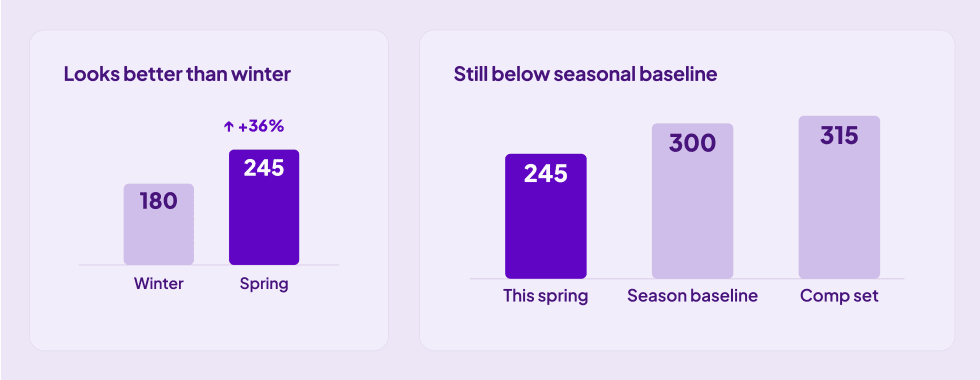
There's one more trap, and it comes from outside your own numbers. You have read these market numbers already, and the broader thaw can make a wait-and-see posture feel safer than it is:
- Vacancy slipped to 7.2%, its first drop in more than four years.
- Units are leasing faster than they did last month.
- Rent just posted its fourth straight monthly increase.
That lift is the floor every property gets when seasonal demand returns. Beating last month only proves the season arrived on schedule, not that you are winning more of the renters your comp set is chasing.
Every one of those upticks is a small move off an extreme. Vacancy is only easing from its highest level on record, and units still take longer to lease than a year ago. Rent sits below where it was twelve months ago and well under its 2022 peak. Treating that early improvement like a recovery is how a quiet quarter sneaks up on you.
The Real Benchmark Is the Field, Not Your Slowest Month
Asset Living is a useful example. Across Atlanta, Dallas, Denver, Houston, and Phoenix, five Sun Belt metros carrying heavy new supply, the team generated stronger leasing performance against the surrounding market. In Houston and Phoenix, Asset Living communities produced more leases per property than nearby operators. In Denver and Phoenix, stronger renter interest carried through to more tour activity.
That is the benchmark worth holding yourself to in peak season: the operators facing the same supply pressure, in the same metros, with the same renters still deciding where to tour. Your baseline tells you which way you are bending. The field tells you whether you are keeping up while everyone chases a thinner pool.
“Let’s See How Things Go” Is How the Season Gets Away From You
By the time ownership sees the problem, the cheapest fixes are usually gone. The report that read fine in June shows up as a concession budget in August and a weak renewal conversation in February. Leasing complacency doesn't stay in the leasing office. It travels up the stack.
“Fine” does not stay neutral for long. It becomes a pricing conversation, a staffing conversation, or a spend conversation.
Every Comfortable Number Hides a Question
The pattern repeats at every level of the funnel. The snapshot instills false confidence because it rarely makes the team ask how long units have been sitting or which way the trend is bending.
More leads cannot fix a funnel that leaks between inquiry and tour. Faster follow-up does nothing for demand that was never a fit for the unit. The read that matters pairs the demand reaching you with how much of it converts, and acting on it is harder than spotting it.
Before You Call Leasing “Fine,” Check These 3 Metrics
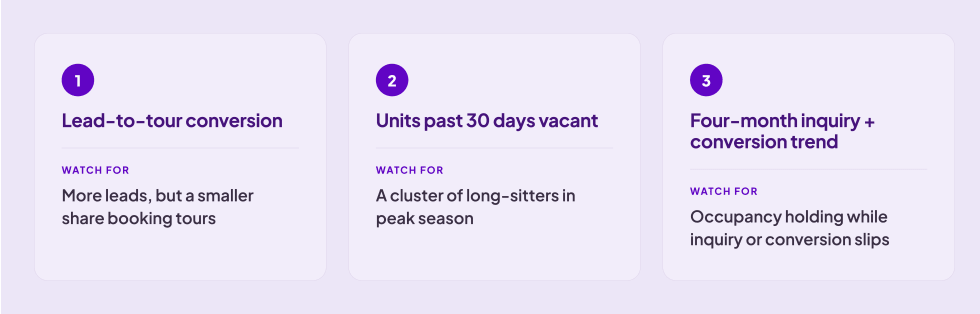
This is a fast operating read, built around the places softness usually shows before occupancy moves. All three read your own funnel first. The field is the outside gut check on top, your directional sense of how peers under the same supply pressure are holding up.
1. Lead-to-Tour Conversion Against the Season
Lead-to-tour is the first place softness shows, so it is the first number to pull. Take this month's rate and set it beside the same month last year, not your January low. If it only holds because summer hands you more traffic, the pipeline isn't stronger; it just looks that way against an easy month. What the rate won't tell you is which step bled it: whether the first response ran too slow or the tour never got booked.
2. Units Sitting Longer Than 30 Days
Pull days-vacant for every available unit and count how many have crossed 30. A couple of long-sitters might be a hard floor plan or a top-floor walkup. A cluster that runs high for a property your size, in peak season, usually points at the funnel, not the units. The limit is timing: it catches units that already stalled, not the demand thinning behind them now.
3. Four-Month Inquiry and Conversion Trend
Line up the last four months of inquiry volume beside lead-to-tour conversion. Look for early drift inside the funnel: occupancy holding steady as inquiry volume or conversion starts to soften. This view has one important limit. Every number on the page came from demand that already reached you. Renters who searched your market and chose another property before inquiring are already outside the report.
These three numbers give you a cleaner read before occupancy moves. If inquiry or conversion is drifting while long-sitters are building, the quarter is already asking for a decision on follow-up, exposure, pricing, or all three.
“Push Harder” Is Not a Pipeline Strategy
If the trend comes back soft, the reflex is usually to push harder, spend more, or cut rate.
That reflex has a ceiling. A team can only work so much of the funnel by hand, and when the hours run out, the next moves get expensive:
- Pushing harder adds strain to a team already working at capacity.
- Buying more leads raises spend on volume that may already be leaking before it reaches a tour.
- Cutting rate fills units faster, but trades away revenue you do not earn back. More than a third of properties are already running a concession worth a month or more.
A discounted lease is loss to lease you chose, and the gap rides the full term before it anchors the renewal. The lever that protects rate is exposure: putting your community in front of more move-ready renters already searching your market, so you fill at your number instead of widening the gap with a concession.
Protect the Demand Before It Turns Into a Concession
Apartment List is built for the part of the funnel where “fine” becomes risky:
- We bill against signed leases rather than raw volume, so chasing exposure cannot quietly inflate your spend, and what you pay stays easy to defend to ownership.
- Our leasing AI works the early pipeline around the clock, including the late-night and weekend inquiries your team cannot reach, so softer demand stays engaged instead of going cold.
Essential Property Management ran pay-per-lease across its one and two-person teams and saw more than 30x total ROI, with no new hire. Its leads reached a tour in 3.3 days on average.
Apartment List Covers the Part of the Funnel “Fine” Leaves Exposed
None of this required teaching you the basics. You already know occupancy lags, a full lead count can hide softness, and seasonal lift reaches every property. The costly part is how easy it is to know all of that and still let the quarter keep moving.
That is what “fine” does. It turns a demand problem into a timing problem. The team waits for more proof, the report stays clean for a few more weeks, and the first real decision shows up later than it should. By then, the cheapest moves are usually gone. Follow-up is already late, exposure is already thin, and pricing starts carrying the weight.
Apartment List gives operators more room to move before that happens. We put communities in front of move-ready renters already searching the market, keep more of that demand engaged with always-on leasing AI, and tie spend to signed leases instead of raw lead volume. That gives teams a better chance to remain competitive before “fine” becomes a concession conversation.
Ready to talk? See how Apartment List can help your team turn renter demand into more signed leases.
Frequently Asked Questions
Is high occupancy a reliable sign that leasing is healthy?
Not on its own. Occupancy is a lagging indicator. A soft pipeline can run eight to twelve weeks before the number moves, so a property can read 97 or 98 percent while demand has already started to thin.
Why is occupancy a lagging indicator?
It sits at the end of the funnel. Inquiries soften first, then tours thin, then signed leases slow, and occupancy only drops after all of that. By the time it moves, the cause is already weeks or months old.
Does strong lead volume mean my pipeline is healthy?
Lead volume can hold flat while the share that converts to tours and leases slips underneath it. Your peak season hands every property more inquiries, so volume that beats your slow months says little about whether it is strong for the season. Conversion is where softness shows first.
What should I check before assuming my leasing numbers are fine?
Three things. Your lead-to-tour conversion against the same window last year, the count of units sitting longer than 30 days, and the trend in inquiry volume and conversion over the last four months. Flat or declining trends under steady occupancy mean you are reading the lag.
Should I change anything if my property is already highly occupied?
Yes, if the pipeline behind that occupancy is softening. High occupancy can still hide declining inquiry quality, weaker lead-to-tour conversion, longer days vacant, or rate pressure that has not shown up in the monthly report yet. The question is not whether the number looks good today. The question is whether the next quarter is already getting harder to protect.
Share this Article