What Determines Whether Your Property Shows Up in AI Search Results

Two separate layers decide whether a property appears in an AI answer, and only one of them belongs to the multifamily operators. Broad discovery visibility is won by domains with years of topical history and scale. That's a marketplace's job. Property-level readability is a different contest, won by complete, current, structured data about the property itself, and that part is your team's. Most operators are underinvesting in the layer they fully control.
The Two Layers of AI Visibility: Discovery and Readability
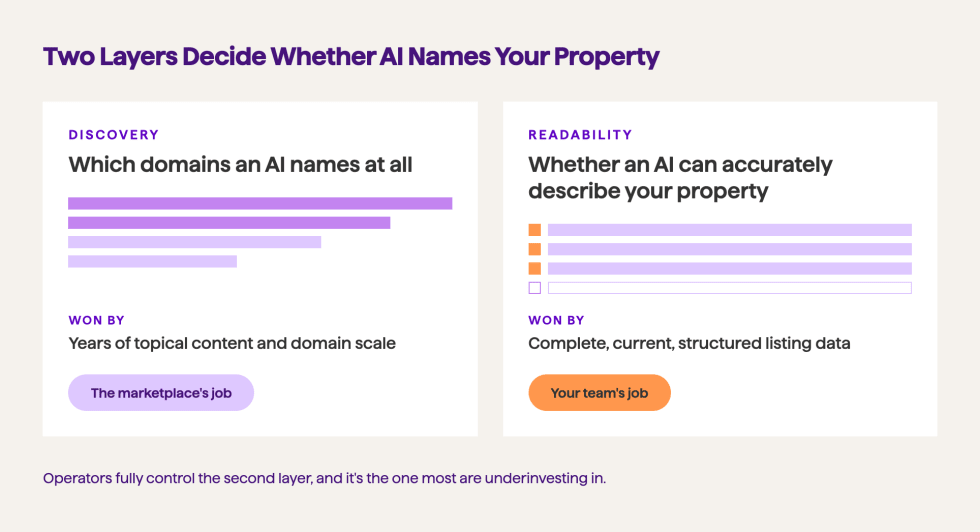
- Discovery and readability are the two layers. One rewards domain scale and history. The other rewards complete, current listing data.
- The marketplace competes for the first layer. No single property page has the content depth to win it, and no AEO vendor retainer changes that.
- Operators fully control the second layer: filled structured fields, current pricing and photos, and explicit answers to the questions renters actually ask.
- On an operator's own site, schema markup and open retrieval crawlers decide whether an AI system can read a property at all.
How Renters Use AI Tools to Find Apartments
Renters are starting to turn to AI tools before they open a listing site. When ChatGPT answers a rental question, the response usually links to:
- Internet listing services (73% of the time)
- Community websites (71%)
- Map results (35%)
(Agency Fifty3, reported by NAA, May 2026)
This is the property-level half of answer engine optimization, or AEO. Plenty of operators are asking whether this channel matters. The sharper question is which parts of it you can actually move.
Why Can't a Single Property Page Win AI Discovery?
Discovery questions, like "what should I budget for rent in Austin" or "pet-friendly apartments under $2K in Denver," don't get answered by any one property page. No single listing has the content depth to be the source an AI names. These systems weigh topical depth and history, favoring content that already exists on a domain that has covered the subject for years. Scale earns that visibility, and scale is slow to replicate. The recent citation shift bears this out, rewarding established domains over forums and thin pages.
Winning discovery is the marketplace's job, the same top-of-funnel work listing platforms have always done, now on a new surface. Qualified renter demand still lands on your listings either way. Our COO's take on AI-driven discovery shows how we approach it. Hiring an AEO vendor to chase discovery questions won't change the math.
Operator Takeaway: Domain history decides broad AI discovery, and you can't buy it quickly. Property-level readability comes down to data completeness, which sits entirely in your hands. Put your effort there.
Optimizing Your Listings for AI Search
Three things, all unglamorous, all within your team's hands.
Fill every structured field, not just the description. AI systems parse structured attributes, like unit specs, pet policy, parking, utilities, and square footage, more reliably than prose. A blank field reads as unknown, and unknown functions like no.
Answer the questions renters ask, explicitly. Are dogs over 50 lbs allowed? Is there in-unit laundry? What's included in rent? Q&A phrasing extracts cleanly into an AI answer. A bare amenities list makes the model infer, and models decline to infer when confidence is low.
Keep listings current. Stale pricing and outdated photos cut the confidence a system places in a listing. Showing a unit as available when it isn't erodes that confidence just as fast. Confidence is what decides whether your property makes the answer.
Making Your Own Site Readable to AI Search
Add schema markup if you run your own site. ApartmentComplex and FAQPage schema let a model read facts off the page instead of inferring them. Across Google AI Overviews, schema-marked pages are cited about 2.3x more often (AI Citation Source Index, 2026).
Don't block the crawlers that matter. Training crawlers (GPTBot, Google-Extended, ClaudeBot) and retrieval crawlers (OAI-SearchBot, PerplexityBot, Claude-SearchBot) are different things. Blocking retrieval bots in robots.txt removes you from live AI answers. You can decline training and stay citable. Many sites block both anyway, without realizing they've opted out of the channel entirely.
Build third-party reputation. Recent, substantive reviews on Google and apartment review sites feed the confidence signals these systems use. AI platforms are re-weighting away from forums toward structured, moderated sources. You don't own your review profiles outright, though they shape how an AI system reads your property.
Operator Takeaway: An AI system can only be as confident about your property as your data allows. Complete, current listings with explicit answers build that confidence at the property level.
Which Layer Is Yours, and Where to Start
Two layers decide whether a property surfaces in an AI answer, and the split is clean. Discovery, the question of which domains an AI names at all, is won on content scale and topical history. That is a marketplace's job, and no vendor retainer shortcuts it. Readability, the question of whether an AI can accurately describe your specific property, is won on complete, current, structured data. That half is yours, and the work is free of any new tool or contract.
The payoff for the second half is direct. The more completely your listings and your own site describe a property, the more often an AI system can name it with confidence. Start this week: fill blank structured fields, then check your robots.txt for blocked retrieval crawlers. Talk to our team about how AI platforms represent your communities and where your listings stand today.
For the metrics behind this, our guide to measuring AI leasing performance covers what to track once the work starts converting.
Data Appendix: Every Number, Sourced
| Metric | Value | Source |
|---|---|---|
| ChatGPT rental answers linking to internet listing services / community websites / map results | 73% / 71% / 35% | Agency Fifty3, reported by NAA, May 2026 |
| Citation lift for schema-marked pages on Google AI Overviews | ~2.3x | AI Citation Source Index, 2026 |
| Apartment List AI citation growth since standing up the program | 2x | Apartment List internal data |
FAQ
Is AEO replacing SEO?
Traditional search still carries most rental search volume, and renters often verify an AI recommendation with a search before they act. AEO covers a growing slice of early, exploratory questions, and both run at the same time.
Do we need to hire an answer engine optimization (AEO) vendor for our properties?
Multifamily operators don't need an AEO vendor for broad discovery visibility. That layer is decided by content scale and topical history, which is what a marketplace partner already brings. Property-level readability is different: the work is listing-data completeness, and your team already owns those fields.
What's the fastest way to improve my property's AI visibility?
Audit listings for blank structured fields, and check your site's robots.txt for blocked retrieval crawlers. Both are same-day fixes, and both directly change what AI systems can say about your properties.
How does Apartment List help with AI search visibility?
Apartment List competes for the discovery layer on operators' behalf. We track citation share and the prompts renters actually use, then run weekly content optimization against that data. Our AI citations have doubled since we started. That coverage comes with your existing listing agreement, and the property-level work above is what your team adds on top.
Share this Article